
NFT Marketplace as a Service
Can SaaS Models Help Stabilize NFT Marketplaces?

Back in the beginning, the NFT space felt wild—honestly, anything could happen. Collectors chased the latest trends, marketplaces scrambled for cash, and artists suddenly found their work in front of people all over the world. But when the excitement faded, a lot of NFT platforms ran into the same problem that’s tripped up tech companies for years: you can’t build a stable business on shaky revenue.
Now, there’s a new idea getting some traction—NFT Marketplace as a Service. It borrows from the SaaS playbook. Instead of hoping for another trading frenzy or short-lived boom, this model focuses on building solid infrastructure. Think: reliable, flexible and steady.
So, let’s take a look at how NFT marketplace business models have changed, why the old ways just don’t hold up, how SaaS principles give NFTs a real shot at stability, and why this shift actually matters for the future.
The Early NFT Marketplace Model: Growth at All Costs
When NFT marketplaces first emerged, their business logic was simple: maximize volume.
Platforms generated revenue primarily through:
- Percentage-based transaction fees
- Listing fees and marketplace service fees
- Premium placement for high-profile drops
As long as trading activity increased, the model worked. During bull markets, transaction-based revenue soared. Marketplaces could afford generous incentives, subsidized gas fees, and aggressive marketing. However, this structure had an embedded weakness: revenue was entirely dependent on speculative demand.
When activity slowed, income dropped instantly. Fixed operational costs—engineering, compliance, security, infrastructure—did not. Many marketplaces discovered that even large user bases do not guarantee resilience if revenue depends solely on trading velocity.
In hindsight, early NFT platforms behaved less like software companies and more like financial intermediaries tied to market sentiment.
The Structural Problem: Volatility as a Business Risk
NFT marketplaces are uniquely exposed to boom-and-bust cycles because they sit directly on top of crypto market psychology. When prices rise, users flood in, when prices fall, engagement evaporates.
This volatility creates several structural challenges:
- Unpredictable Cash Flow: Transaction fees fluctuate wildly month to month, making planning difficult.
- Overbuilt Infrastructure: Systems designed for peak traffic remain underutilized during downturns.
- Misaligned Incentives: Platforms benefit from high-frequency trading, even when it harms creator trust.
Short-Term Focus: Product decisions prioritize hype-driven features instead of durable tools.
In traditional software industries, these risks are mitigated through recurring revenue. In NFTs, that concept arrived late—but it is now gaining serious traction.
The Current Hybrid Phase: Experimentation and Adjustment
Today’s NFT marketplace landscape sits in an in-between stage. Many platforms still rely on transaction fees, but they are experimenting with additional revenue streams:
- Creator tools with optional paid features
- White-label marketplace solutions
- Enterprise partnerships
- API access for developers
- Subscription-based analytics dashboards
These additions signal an important shift in mindset. Marketplaces are no longer positioning themselves purely as trading venues. They are becoming service providers, offering tooling, infrastructure, and compliance layers.
However, in most cases, these efforts remain secondary to the core transaction model. The result is a hybrid structure that improves resilience but does not fully solve instability.
To do that, marketplaces need to go further.
What Is NFT Marketplace as a Service?
NFT Marketplace as a Service applies SaaS logic directly to NFT infrastructure. Instead of building a single destination marketplace and hoping users trade frequently, the platform provides modular tools that others can use to launch, operate, and scale NFT ecosystems.
At its core, this model treats NFT marketplaces like software products rather than speculative hubs.
Key characteristics include:
- Subscription-based pricing tiers
- Predictable recurring revenue
- Feature access based on plans
Scalable infrastructure independent of trading volume
Long-term customer relationships
In this model, customers are not only collectors and traders. They include:
- Artists and creative studios
- Brands and IP owners
- Galleries and cultural institutions
- Web3 startups
- Enterprises entering tokenized assets
The marketplace becomes a platform, not a destination.
Why SaaS Changes the Stability Equation
The most important contribution of SaaS to NFT marketplaces is revenue predictability.
Instead of earning only when users trade, platforms also earn when customers subscribe. This allows for:
- Better forecasting
- Sustainable hiring
- Long-term product roadmaps
- Reduced dependence on hype cycles
When revenue depends on subscriptions, success is tied to customer retention, not transaction churn. This encourages marketplaces to prioritize reliability, usability, compliance, and support.
In other words, SaaS aligns the marketplace’s interests with its users’ long-term success.
The Future Business Model: Modular, Subscription-Driven, Infrastructure-First
Looking forward, the most resilient NFT marketplaces are likely to look very different from the early giants of the space.
The future model emphasizes:
- Multi-chain compatibility as a standard feature
- Built-in compliance and identity tools
- Customizable royalty logic
- Integrated fiat on-ramps, analytics, and regulatory reporting
- Recurring service contracts and subscription-based revenue models rather than one-time fees
- Native staking mechanisms to support long-term participation and ecosystem alignment
Rather than competing for attention on a single marketplace homepage, platforms compete on who provides the best underlying system.
This approach mirrors how cloud providers replaced physical servers, and how CMS platforms replaced custom-built websites. NFTs follow the same pattern: from bespoke experiments to standardized infrastructure.
Visualizing the SaaS-Based NFT Marketplace Model
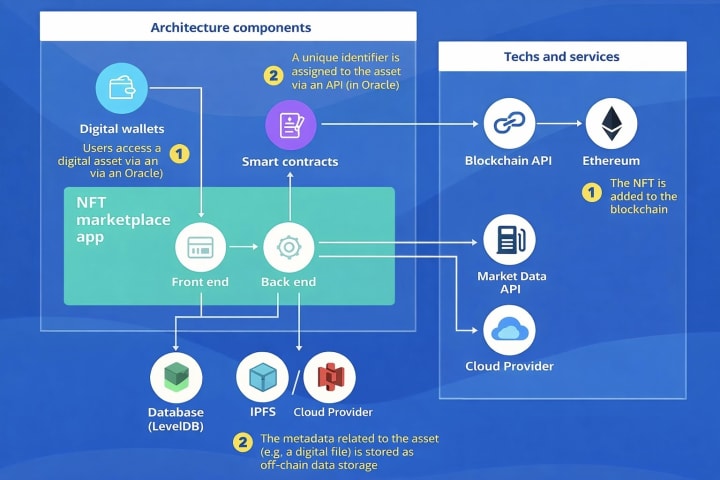
The picture depicts an NFT marketplace that is not so much a trading arena as it is a software product. The system is constructed in layers, with wallets, smart contracts, databases, cloud services, and integrations; all operating in the background, rather than everything centering around buying and selling.
The way this structure distinguishes between market activity and platform stability is noteworthy. Because they are a part of a continuous service rather than a one-time transaction, the essential tools and infrastructure continue to function even if trading slows down. Compared to previous marketplace models that relied almost solely on volume, that is a significant change.
For creators, this means the tools they rely on don’t disappear during downturns. For brands and enterprises, it signals reliability and scalability—two things that matter far more than hype. Overall, the image reinforces the idea that when NFT marketplaces are built like SaaS platforms, they can stay functional and relevant regardless of market cycles.
Why This Model Supports Creators Better
Creators were among the earliest adopters of NFTs—and also among the first to feel the structural weaknesses of transaction-driven marketplaces. When trading activity slows, the effects ripple outward quickly. Visibility algorithms prioritize volume, discovery mechanisms weaken, and royalty income becomes unpredictable. For many artists, this meant that their livelihoods were indirectly tied to market speculation they couldn’t control.
SaaS-based NFT marketplaces fundamentally change that relationship.
Instead of depending on trading spikes, creators gain access to stable, always-available tools that function regardless of broader market sentiment. Whether prices are rising or falling, creators can still mint, manage, showcase, and distribute their work without the platform pulling back resources during downturns.
Another significant change is predictable pricing. Uncertainty is introduced by variable transaction costs, particularly for creators with narrow profit margins. Subscription-based access substitutes unexpected expenses with clarity. Long-term planning is made possible because creators are fully aware of what they are paying for and receiving in return.
More significantly, SaaS models are based on continuous partnerships rather than one-time exchanges. Customizable storefronts, integrated community tools, mailing lists, analytics, and CRM-style insights are among the elements that platforms are encouraged to invest in, in order to sustain audience development over time. "Building sustainably" takes precedence above "selling fast."
Another crucial factor is ownership. In SaaS-based marketplaces, creators are far more likely to have control over their distribution routes, storefronts, branding, and consumer data. Creators become independent enterprises with top-notch infrastructure, rather than just another listing in a massive marketplace feed.
When creators become customers rather than traffic sources, the power dynamic shifts. Success is no longer measured by how much value can be extracted from creator activity, but by how effectively the platform helps creators grow, retain audiences, and monetize over time. That alignment is what makes the model more durable—and more ethical.
Enterprise Adoption and the SaaS Advantage
Stability is of essence for creators and enterrice alike. Brands and institutions shy away from platforms that feel risky or unpredictable. For them, uncertainty isn’t some thrilling adventure—it’s a headache they don’t want. That’s a big part of why enterprise interest in NFTs fizzled out after the initial buzz.
SaaS-based NFT marketplaces change the game. They offer what these companies actually look for: clear service agreements, steady pricing, rules they can trust, and support that sticks around. None of this feels new or experimental to enterprises—it’s just the standard they expect.
By abstracting away the volatility of the open market, NFT Marketplace as a Service platforms make it possible for organizations to deploy NFTs as functional digital infrastructure rather than speculative assets. This opens the door to use cases that are fundamentally less sensitive to market cycles.
Digital collectibles can complement physical products instead of replacing them. Access tokens and memberships can function as authentication layers rather than tradable assets. Cultural institutions can archive, license, and distribute digital works without worrying about sudden platform instability.
In all of these cases, NFTs become tools—not bets.
The SaaS model also simplifies internal decision-making. When costs are fixed and outcomes are measurable, it becomes easier for enterprises to justify long-term investment. NFTs stop being a marketing experiment and start looking like a legitimate digital strategy.
The Broader Impact on the NFT Ecosystem
If SaaS-based models become the dominant approach, the NFT ecosystem will look very different from what we saw during the first wave.
Long term effects would include the disappearance of many short-lived marketplaces that exist solely to capitalize on hype cycles, as well as the rise of specialized platforms that could serve a specific industry, creative niche, or business use case.
Fee competition would also change. Instead of fighting over who can offer the lowest transaction fees, platforms would start focusing on what really matters—reliability, useful features, smooth integrations, and actually helpful customer support. That kind of competition pushes everyone to build better user experiences, making products work together more easily.
But the real win comes from the fact that the whole ecosystem gets friendlier. Creators, brands, and institutions stop feeling like they’re just trying to outmaneuver each other. Suddenly, they’re working with the platforms, not against them. It feels more like a partnership and less like a battle where only one side can win, particularly when long-term trust begins to replace short-term extraction.
Speculation wouldn’t disappear entirely—and it doesn’t need to, but it would stop defining the entire system, allowing NFTs to mature into a broader digital infrastructure layer rather than remaining trapped inside boom-and-bust narratives.
Final note
NFTs are here to stay, however, the idea that transaction-heavy marketplaces alone can support a healthy ecosystem on the long run is an illusion that may have been crucial in the beginning—but it was never meant to be the point.
As the industry matures, stability will come from treating NFT marketplaces the same way other successful digital platforms are treated: as software infrastructure, not hype engines.
The NFT Marketplace as a Service model represents that evolution. By prioritizing subscriptions over speculation and service over volume, it replaces volatility with predictability and short-term excitement with long-term value creation.
Some platforms are already moving in this direction, applyin this future-oriented approach by focusing on subscription-driven NFT infrastructure rather than transactional dependency. While still early, models like this hint at what a more resilient, professional NFT economy could look like—one capable of surviving both bull markets and bear markets.
In the end, the stabilization of NFT market won’t come from another surge of hype. It will come from better business models—and SaaS may be the most important one yet.
About the Creator
Mark Arthur
Keynote speaker, author, serial entrepreneur and digital lifestyle evangelist working at the intersection of blockchain and artificial intelligence.
Keep reading
More stories from Mark Arthur and writers in 01 and other communities.
The Intersection of Quantum Computing and Blockchain
Blockchain and quantum computing seem to belong to entirely different worlds, and yet both have become inextricably linked. Blockchain relies on math, distributed systems, and a comprehensive encryption scheme that is hard to crack. Quantum computing, on the other hand, leverages quantum mechanics to smash through the limits of regular computers — and maybe, just maybe, to break a lot of the cryptography we use today.
By Mark Arthur22 days ago in 01
Legacy Application Modernization: Benefits, Strategy, and Cost
In today’s rapidly evolving digital landscape, businesses must continuously upgrade their technology to remain competitive. Many organizations still rely on outdated systems that limit scalability, performance, and innovation. This is where Legacy Application Modernization service becomes essential.
By keith laurancea day ago in 01
The Role of Custom Watch Straps in Personalizing Timepieces
Watches have long been appreciated not only as tools for telling time but also as objects that reflect personal style and craftsmanship. While many discussions focus on the movement or the case design, the watch strap plays a crucial role in shaping how a watch feels and appears on the wrist. Over time, collectors and everyday wearers alike have shown increasing interest in customization, particularly in solutions that allow a watch to adapt to different styles and situations.
By charliesamuel6 days ago in 01
Turquoise Clouds in a Green Sky
“I always remember the first time I saw the green sky and the turquoise clouds skating across it.” These words had stayed with Alice Barrett for two years. She’d been six- years-old and snuggled next to her great-grandmother, known to nearly all the family as Granny Rose, on a large, rather uncomfortable armchair. Granny Rose had been telling her a story, at least that’s what Alice believed, but it was a strange memory, blurry apart from those few words.
By Matthew Batham2 days ago in Fiction




Comments
There are no comments for this story
Be the first to respond and start the conversation.