
Carlos Carulo: Curiosity and the Architecture of the Cosmos
- Santa Fe, NM
By Brian D’Ambrosio
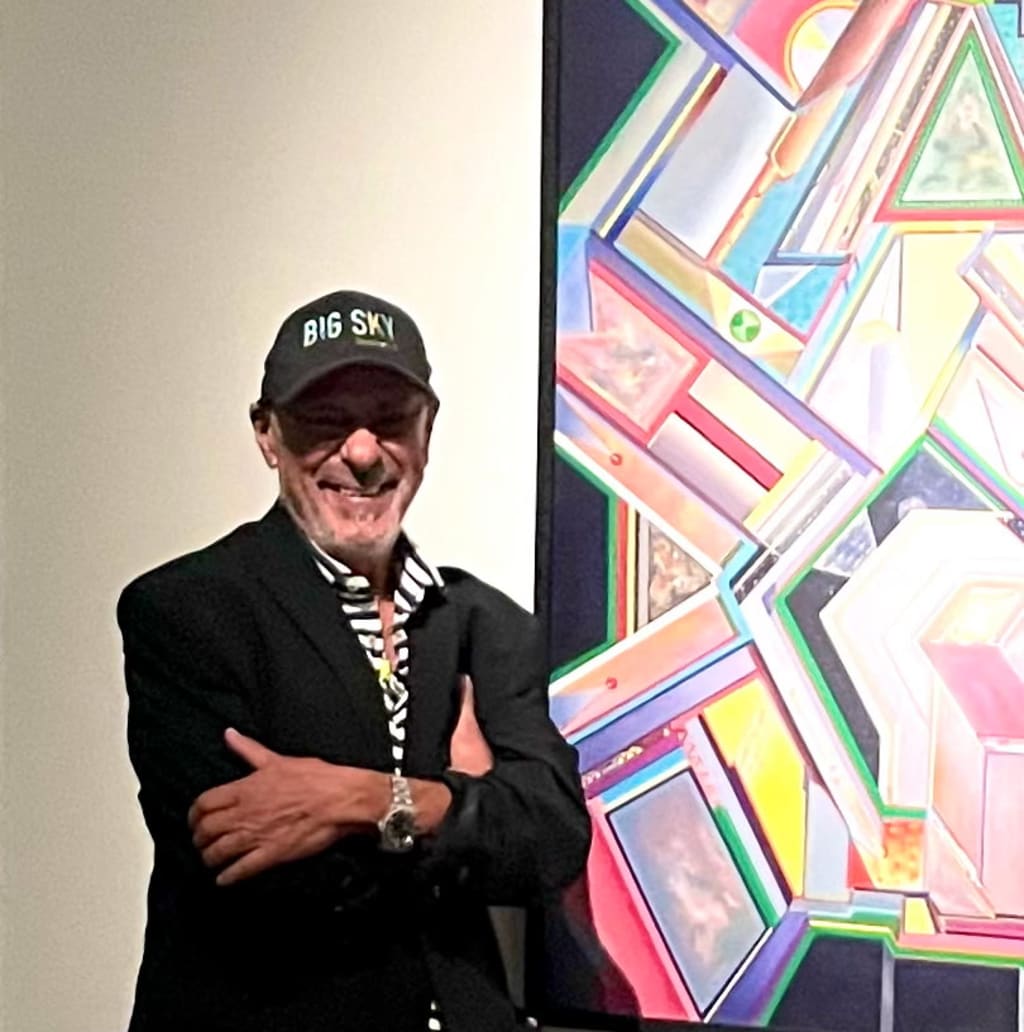
The Chilean-born painter known as Carlos Carulo has spent much of his life trying to understand the invisible forces that bind existence together. In his Santa Fe studio, canvases shimmer with nebulae, fractured geometries, drifting structures, and luminous particles that seem to float between worlds. At first glance, the imagery suggests deep space. But Carulo insists his work is not science fiction.
“It’s not Star Wars,” he says with a laugh. “I’m not interested in violence in space. I’m interested in beauty.”
For Carulo, the cosmos is less a battlefield than a vast field of connection—a place where time, energy, and consciousness converge. His paintings attempt to translate those ideas into visual form: architecture suspended in space, fragments of light, swirling energies suggesting unseen structures shaping the universe.
“Everything is related,” he says. “The past and the future. Where we are from and where we are going.”
What binds his work is a single principle he returns to again and again: “Stay curious. … Curiosity is the glue. That’s how you discover the universe.”
Carulo was born Carlos Ruiz Lolas in 1950, in San Felipe, Chile, in the fertile Aconcagua Valley. It’s a place where mountains, vineyards, and the Pacific Ocean exist in proximity. In time, he would condense his name into the eight letters that form his artistic signature—Ca, Ru, and Lo—becoming simply Carulo in galleries.
The foundations of his artistic life were laid early. His father was a philosophy professor, writer, poet, and painter. His circle of intellectual friends often gathered in the Chilean countryside to paint landscapes outdoors. When Carulo was 7, he began following them with a small watercolor set and easel.
“I just tagged along,” he said. “They were painting outside and I thought, ‘This is cool.’”
Those early sessions shaped his view of art. Painting outdoors meant “you’re not just interpreting what you see,” he said. “There are smells, sounds, energy around you.”
He often cites the Dutch master Vincent van Gogh as someone who understood this idea instinctively.
“When you see a real Van Gogh, you can feel the particles in the painting,” Carulo said. “It’s electrifying.”
Carulo grew up immersed in culture and conversation. His father’s intellectual world introduced him to artists, writers, and thinkers at a young age. One of them was the Chilean Nobel Prize–winning poet Pablo Neruda, whom Carulo encountered as a boy when Neruda visited San Felipe to give a lecture arranged by his father. The moment, however, did not unfold quite as one might imagine.
“I was maybe 12,” Carulo said. “He started reciting his poetry in this very steady voice. After a while, I fell asleep.”
Yet those early experiences left their mark. Carulo grew up surrounded by literature, philosophy, and art, influences that would shape both his painting and his own existential poetry.
“There weren’t enough words to express what I was feeling,” he says. “So I started painting.”
After graduating from high school in San Felipe, Carulo enrolled in architecture studies at the University of Chile in Santiago. He studied there for two years, until his path soon widened beyond formal schooling.
He traveled extensively—working and moving through Peru, Bolivia, and across Europe. In La Paz, he exhibited Chilean seascapes under the sponsorship of the Chilean consulate. In Lima he painted landscapes while exploring the region’s art scene. Later he spent time in England, Denmark, and Norway. In Barcelona he attempted to meet the surrealist master Salvador Dalí.
“He had too many Dobermans on the property,” Carulo says, smiling. “I never made it inside.”
For six months he lived in Amsterdam, in a house nearly 800 years old. By then, painting had become not just a practice but a way of navigating the world.
In the mid-70s, Carulo flew from Santiago to Miami and then to Deming, New Mexico, where his wife at the time had friends. A visit to nearby Mesilla changed everything.
“I fell in love with the place,” he said.
Soon after, he moved north to Santa Fe, where he found something he had been searching for: time.
“I needed a place where nothing was too fast-paced,” he says. “I needed a place to paint.”
Over the decades, Carulo’s style has shifted dramatically. Earlier works blended ancient symbolism—particularly forms reminiscent of Inca imagery—with futuristic figures. Today his paintings move deeper into cosmic territory, his fascination with astrophysics and quantum mechanics driving much of this imagery.
“I’m interested in the disorder, the chaos,” he says. “Black holes, nebulae, energy.”
Carulo’s philosophy is also shaped by personal experiences that pushed him toward questions about existence and consciousness. He was born without breathing, he said, and was revived only after desperate efforts by a relative who worked as a nurse. Years later he survived a serious car accident as a teenager in Chile.
Moments like those, he believes, open doors of perception.
“When you come close to death, you start seeing things differently,” he says. “You realize there’s a bigger picture.”
Carulo’s interest in science, consciousness, history, and the universe has sustained his decades-long career in Santa Fe. His recent paintings explore what he calls “architecture in space,” structures that seem both ancient and futuristic. Rather than predicting the future, the works attempt to show that the past, present and future are all linked, interconnected.
Ultimately, Carulo believes both art and science point toward the same truth — that existence itself is extraordinary.
“We’re here,” he says. “That alone is a miracle.”
Brian D'Ambrosio is the author of several books, including New Mexico Eccentrics, a collection of stories profiling over 40 unconventional artists, builders, visionaries, and creators who define the state's creative, independent spirit.
About the Creator
Brian D'Ambrosio
Brian D'Ambrosio is a seasoned journalist and poet, writing for numerous publications, including for a trove of music publications. He is intently at work on a number of future books. He may be reached at [email protected]
Keep reading
More stories from Brian D'Ambrosio and writers in Art and other communities.
Ken Wolverton
By Brian D’Ambrosio Along a dusty roadside of Cerrillos, connected weathered shacks lean into the landscape like a creature molded from the earth itself. Its walls are alive with color: horses rearing across mesas, dreamlike murals, and abstract forms that seem to vibrate with movement. Inside, brushes slant in jars, canvases are stacked against walls, and unfinished murals climb wooden planks. This is the world of Ken Wolverton, an 80-year-old artist whose life has been as itinerant and unconventional as the art he creates.
By Brian D'Ambrosio about a month ago in Art
Elderly Woman Behind the Table in a Large Town
The glass of Absinthe sat before me. It’s quite amazing how despite such terror rendered upon their stones in the preceding decades, these streets still held the beauty I first read about as a girl. I never dreamed I’d set foot on these cobbles, at least not safely.
By Matthew J. Fromm7 days ago in Art
Retrospective: To The Missionary At The Austin, TX Ghost Show
"...It is a wonderful feeling. I've always felt that if I just got to the end of the rainbow, whatever is there, I will find belonging. I'm assuming that this is it, this is the belonging that we're sharing." -- Papa Emeritus IV, Ghost, Re-Imperatour
By Ashley McGee6 days ago in Art

Comments (1)
Hi! There’s something very cinematic about the way you write, not just visually, but emotionally. The subtle expressions and pauses between scenes felt intentional and well-crafted. It honestly made me think how beautifully this could translate into a comic format. I’m a commission artist who works in visual storytelling, and your work genuinely sparked ideas for me. If you’d ever be curious to see how one of your scenes might look as artwork, I’d love to share sometime. Discord: ava_crafts | Insta: eve_verse_ Either way, you’ve written something memorable. Ava