
LANGUAGE GENESIS (review)
THE MISCOMMUNICATION TRILOGY “The Conspiracy of Speech, Vol. I.” Part 7


Genesis of Noise: The Rise and Exhaustion of Language
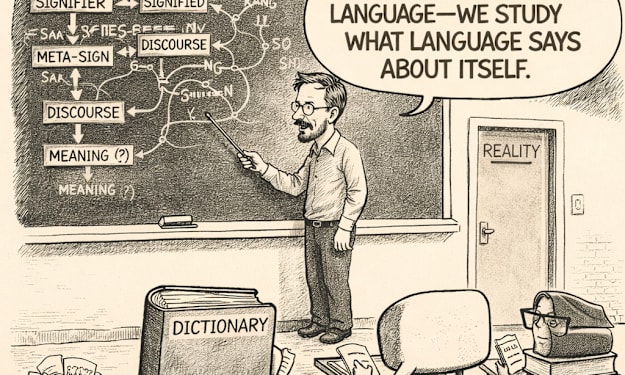
This volume, Language Genesis, Part 7 of The Miscommunication Trilogy, presents itself as both an origin story and a diagnosis. It reconstructs the emergence of language from evolutionary, cognitive, and social perspectives, but it does so with a distinctive theoretical ambition: to show that the very processes that made language possible have also driven it toward excess, instability, and eventual obsolescence. The book is not simply about where language comes from; it is about what language becomes when its success exceeds its constraints. At its core, the text offers a synthetic account of language evolution, weaving together a wide range of theoretical frameworks. It draws on the improvisational model of language proposed by Morten H. Christiansen and Nick Chater, where language is not a fixed system but an emergent, adaptive process shaped by real-time interaction. It incorporates insights from Robin Dunbar’s social bonding hypothesis, which positions language as a replacement for grooming in increasingly large human groups. It engages with Darwinian perspectives, particularly through Charles Darwin’s idea of a musical protolanguage, later revisited and refined by W. Tecumseh Fitch. And it critiques the Chomskyan paradigm by challenging the notion of an innate, static universal grammar.
What emerges from this synthesis is a model of language as a dynamic, culturally evolving system that adapts to human cognitive and social constraints. The book systematically rejects the idea that language is a pre-designed computational system encoded in the brain. Instead, it argues that language evolves to fit the brain, not the other way around. This inversion is crucial: it reframes language as a product of improvisation, negotiation, and selection rather than as an expression of an internal blueprint. One of the strongest aspects of the book is its insistence on gradualism. Rather than positing a sudden evolutionary leap, it reconstructs language development as a step-by-step process. Drawing on work such as Ray Jackendoff and Robbins Burling, the text outlines plausible stages: from isolated signals to word combinations, from protolanguage to structured syntax, and eventually to recursive grammar. This evolutionary narrative is reinforced by the concept of grammaticalization, where linguistic structures emerge through repeated use and gradual compression over time.
Equally important is the book’s attention to the cognitive constraints that shape language. The “Now-or-Never bottleneck,” derived from the work of George A. Miller and expanded in contemporary psycholinguistics, is used to explain why language must be processed in real time. This constraint forces language to become highly structured, chunked, and predictable. The apparent complexity of grammar, therefore, is not evidence of innate design but of adaptive solutions to cognitive limitations. However, the book does not stop at explaining how language works. Its central contribution lies in its reinterpretation of why language evolved in the first place. Rejecting purely instrumental accounts, it emphasizes the social and political dimensions of communication. Language is presented as a tool for alliance formation, status negotiation, and social display. The idea of language as “showing off” aligns with theories of sexual selection, particularly those associated with Geoffrey Miller, where linguistic skill functions as a signal of intelligence and fitness.
This perspective leads to one of the book’s most compelling insights: that communication is inherently costly, but not in the way traditional signaling theory suggests. While animal signals rely on physical cost to ensure honesty (as in Amotz Zahavi’s handicap principle), human language shifts the cost to information acquisition. The speaker must invest effort not in producing signals, but in gathering relevant, credible information. This reconfiguration of cost explains how language can remain functional despite its low production cost. Yet it is precisely this low cost that becomes problematic. The book’s second major movement transitions from genesis to critique, arguing that the success of language leads to its overproduction. Once words become cheap, they proliferate beyond necessity. The constraints that once ensured relevance and reliability weaken, and language begins to drift toward redundancy and noise.
This is where the concept of the “planned obsolescence of language” becomes central. Borrowing implicitly from economic metaphors, the text suggests that language, like industrial products, is subject to cycles of innovation, saturation, and decay. In early stages, communication is tightly coupled with survival and social coordination. In later stages, it becomes detached, serving functions of display, persuasion, and manipulation. Eventually, the system becomes saturated, and meaning itself begins to erode. The book supports this argument by examining the properties of language that enable both meaning and distortion. Drawing on Ludwig Wittgenstein’s notion of language games and family resemblances, it emphasizes the fluidity and ambiguity of meaning. Words do not have fixed definitions; they acquire meaning through use, context, and shared practices. This flexibility is a strength, allowing language to adapt to new situations. But it is also a weakness, making language vulnerable to misinterpretation and manipulation.
The discussion of metaphor is particularly effective. By showing how abstract concepts are grounded in metaphorical extensions of physical experience, the book highlights the creative power of language. At the same time, it demonstrates how these extensions can lead to conceptual confusion. When metaphors become reified—treated as literal truths—they generate illusions of clarity that mask underlying complexity. Another important contribution is the integration of cultural and symbolic perspectives. Drawing on Chris Knight and others, the book explores the role of ritual, play, and symbolic systems in the emergence of language. Language is not just a biological adaptation; it is embedded in social practices that establish trust, cooperation, and shared meaning. The transition from analog signaling to digital symbolic communication is presented as a cultural achievement, dependent on collective agreement and institutional frameworks.
The inclusion of music as a communicative system adds an additional layer to the analysis. By comparing language with musical communication, the book highlights the role of ambiguity and emotional resonance in managing social relationships. Music, unlike language, thrives in contexts of uncertainty, where precise meanings might provoke conflict. This contrast reinforces the idea that different communicative systems evolve to handle different social functions. Despite its strengths, the book is not without its challenges. Its ambition to synthesize multiple disciplines sometimes results in a dense and conceptually demanding text. The rapid movement between evolutionary biology, linguistics, anthropology, and philosophy requires a high level of familiarity with these fields. For some readers, the lack of a single dominant framework may feel disorienting.
Moreover, the concept of the planned obsolescence of language, while provocative, remains partly metaphorical. The book suggests that language is becoming obsolete due to overproduction, but it does not fully specify the mechanisms through which this process operates in contemporary societies. Is the problem primarily technological, driven by digital media and information overload? Or is it a deeper structural feature of language itself? The text gestures toward both possibilities but leaves the question open. Nevertheless, this openness can also be seen as a strength. By refusing to reduce the problem to a single cause, the book invites further exploration. It positions language not as a closed system but as an ongoing process shaped by multiple interacting forces. The final sections of the book bring the argument full circle by returning to the question of what language has done to us. Here, the analysis becomes more reflective, examining the cognitive and social consequences of linguistic development. Language is shown to have expanded human thought, enabling abstraction, planning, and theory-building. At the same time, it has introduced new forms of distortion, allowing humans to construct and inhabit symbolic realities that may diverge from the physical world. This duality—language as both enabling and destabilizing—is the central tension of the book. It is what gives the text its philosophical depth and its critical edge. Language is not simply a tool; it is a force that shapes human existence, for better and for worse.
In conclusion, Language Genesis is a rigorous and ambitious contribution to the study of language evolution. It successfully integrates diverse theoretical perspectives into a coherent narrative that traces the emergence, expansion, and transformation of language. Its central thesis—that the success of language leads to its overproduction and potential obsolescence—is both original and thought-provoking. The book challenges readers to rethink fundamental assumptions about language. It moves beyond the idea of language as a neutral medium of communication and presents it as a dynamic, evolving system with inherent tensions and contradictions. By linking the origins of language to its contemporary condition, it offers a powerful framework for understanding the role of communication in human life. Ultimately, the book leaves us with a paradox. Language is the defining feature of humanity, the foundation of culture and society. Yet it is also a system that risks undermining itself through its own excess. In tracing this paradox, the text does not resolve it. Instead, it exposes it, forcing the reader to confront the possibility that the greatest human invention may also be its most unstable one.
About the Creator
Peter Ayolov
Peter Ayolov’s key contribution to media theory is the development of the "Propaganda 2.0" or the "manufacture of dissent" model, which he details in his 2024 book, The Economic Policy of Online Media: Manufacture of Dissent.
Keep reading
More stories from Peter Ayolov and writers in BookClub and other communities.
THE LANGUAGE OF LINGUISTICS
Review The Grammar That Consumes Itself: Linguistics at the Edge of Meaning The chapter ‘The Language of Linguistics’ from Part 6 ‘New Paradigm of Communication’ of THE MISCOMMUNICATION TRILOGY, ‘The Conspiracy of Speech, Vol. I.’ presents a dense and philosophically ambitious critique of linguistics as both a scientific discipline and a historical force that reshapes communication itself. It situates linguistics not merely as a neutral field of inquiry, but as a transformative meta-language that simultaneously clarifies and distorts the very phenomenon it seeks to explain. The chapter operates at the intersection of philosophy, communication theory, and linguistic history, advancing a central thesis: that the scientific study of language, while promising clarity and structure, ultimately contributes to the instability and obsolescence of meaning in contemporary communication systems. At the core of the chapter lies a fundamental paradox. Linguistics emerges as a discipline driven by the desire to stabilise language, to render it analyzable, predictable, and governed by rules. Yet this very act of systematisation produces an unintended consequence: the abstraction of language away from lived experience. Language, once embedded in social interaction, ritual, and context, is reconfigured into a system of categories—phonemes, morphemes, syntax—each designed to capture its internal logic. This transformation is not merely descriptive but constitutive. The act of analysing language changes its nature, creating a gap between theoretical models and practical communication that becomes increasingly difficult to bridge. The review must emphasise how the chapter frames this gap not as a temporary limitation but as an intrinsic feature of linguistic inquiry. The more linguistics refines its models, the further it distances itself from the fluidity of real communication. This tension between system and practice becomes the central axis around which the chapter unfolds. It is not a failure of linguistics but its defining condition: the discipline succeeds precisely by abstracting language, yet in doing so, it produces a form of knowledge that cannot fully return to the lived reality from which it emerged.
By Peter Ayolov4 days ago in BookClub
The Art of Reading Minds
Introduction In a world where communication goes far beyond words, The Art of Reading Minds by Henrik Fexeus offers a powerful guide to understanding people on a deeper level. This book is not about magic or psychic abilities—it is about mastering observation, emotional intelligence, and human behavior.
By Zain writes7 days ago in BookClub
Personal Space
For some reason, it seems to be unpopular to have the opinion of wanting personal space. I do very much miss the days when it was illegal to come within 6 feet of anyone else and I would like the earth to go back to that because what the hell is everyone on nowadays?
By Annie Kapur2 days ago in Psyche



Comments
There are no comments for this story
Be the first to respond and start the conversation.