
Why Is the Sky Blue?
The hidden physics behind everyday colors
Have you ever looked up on a clear day and wondered why the sky is blue instead of green, purple, or even black? It’s one of those everyday phenomena so familiar that we rarely question it—but the explanation reveals a fascinating mix of light, physics, and the structure of our atmosphere.
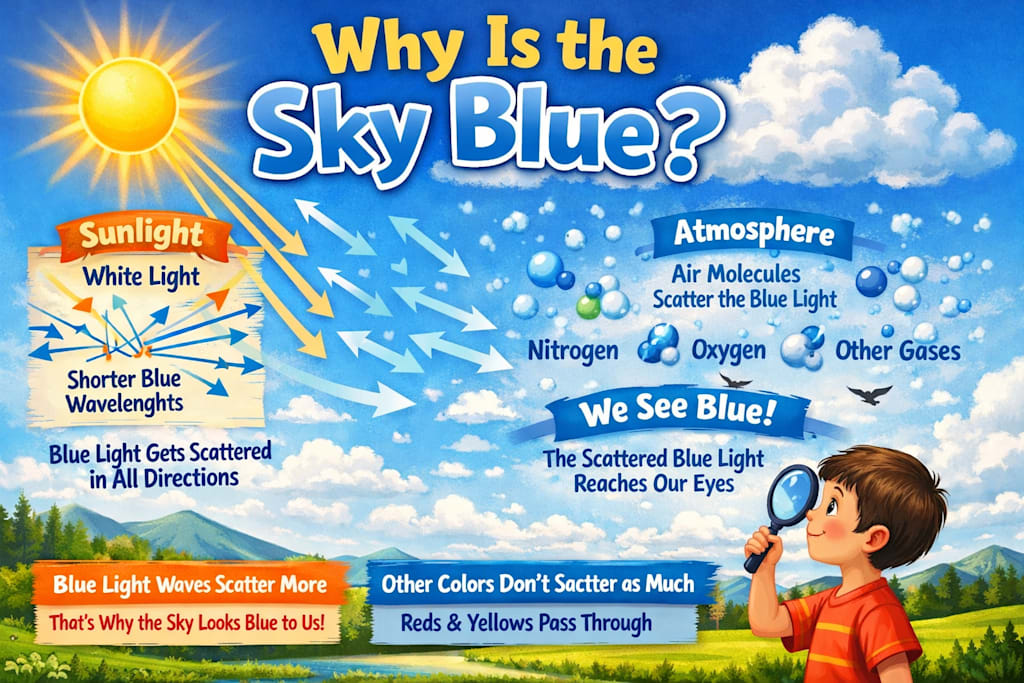
To understand why the sky appears blue, we need to start with light itself. Sunlight may look white to our eyes, but it is actually made up of many different colors. These colors correspond to different wavelengths of light, ranging from longer wavelengths like red and orange to shorter wavelengths like blue and violet. When combined, all these colors form what we perceive as white light.
As sunlight travels through space and reaches Earth, it encounters the planet’s atmosphere—a layer of gases composed mainly of nitrogen and oxygen. This is where the magic begins. The atmosphere is not empty; it contains tiny molecules and particles that interact with incoming sunlight. When light passes through this mixture, it doesn’t simply travel straight to the ground. Instead, it is scattered in different directions.
This scattering of light is the key to understanding why the sky is blue. Not all colors of light scatter equally. Shorter wavelengths—like blue and violet—are scattered much more efficiently than longer wavelengths such as red or yellow. This phenomenon is known as Rayleigh scattering, named after the scientist who first described it.
Because blue light has a shorter wavelength than most other visible colors, it gets scattered in all directions across the sky. So when you look up, you’re not seeing direct sunlight; you’re seeing sunlight that has been scattered by the atmosphere. And since blue light is scattered more than other colors, it dominates what you see.
But this raises an interesting question: if violet light has an even shorter wavelength than blue, shouldn’t the sky appear violet instead?
The answer lies in both the Sun and human vision. First, the Sun emits less violet light compared to blue light. Second, our eyes are not equally sensitive to all colors. Human eyes are much more sensitive to blue light than violet. Additionally, some of the violet light is absorbed by the upper atmosphere. When you combine these factors, blue becomes the most visible scattered color, giving the sky its characteristic hue.
The color of the sky isn’t always the same, though. If you’ve ever watched a sunrise or sunset, you’ve probably noticed that the sky can turn shades of orange, red, pink, or even purple. This change happens because the position of the Sun in the sky affects how much atmosphere its light must travel through.
When the Sun is low on the horizon, its light has to pass through a thicker layer of the atmosphere before reaching your eyes. During this longer journey, much of the shorter-wavelength blue and violet light gets scattered away before it can reach you. What remains are the longer wavelengths—reds, oranges, and yellows—which create those warm, glowing colors we associate with sunsets and sunrises.
Air pollution and particles like dust or smoke can also influence the color of the sky. These larger particles scatter light differently from gas molecules. Instead of favoring shorter wavelengths, they tend to scatter all colors more evenly. This can make the sky appear whiter or hazier, especially in urban areas. In extreme cases, such as after volcanic eruptions or during heavy pollution, the sky can take on unusual colors.
Clouds provide another interesting variation. While the sky itself appears blue due to scattered light, clouds are usually white. This is because the water droplets and ice crystals in clouds are much larger than air molecules. They scatter all wavelengths of light roughly equally, resulting in a white or gray appearance rather than a blue one.
The concept of scattering doesn’t just explain the color of the sky—it also helps us understand why the sky appears darker at higher altitudes. If you climb a mountain or travel in an airplane, you might notice that the sky becomes a deeper, richer blue. This happens because there is less atmosphere above you to scatter light. With fewer molecules to scatter sunlight, less blue light is redirected toward your eyes, making the sky appear darker.
In space, the situation is even more dramatic. Without an atmosphere, there is nothing to scatter sunlight at all. That’s why astronauts see a completely black sky, even when the Sun is shining brightly. The absence of scattering means that light travels in straight lines without being diffused across the sky.
Another factor that subtly affects the sky’s color is humidity. Water vapor in the air can change how light is scattered, sometimes making the sky look paler or slightly different in tone. On very dry days, the sky often appears a deeper blue, while on humid days it may look lighter or washed out.
The angle at which you observe the sky can also make a difference. When you look directly overhead, you’re seeing light that has traveled a shorter path through the atmosphere compared to when you look toward the horizon. As a result, the color overhead is often a deeper blue, while the sky near the horizon can appear lighter or even slightly white.
All of these variations show that the sky’s color is not fixed but constantly changing based on conditions like time of day, atmospheric composition, and your viewing position. Yet, despite these changes, the underlying reason remains the same: the scattering of sunlight by the atmosphere.
Understanding why the sky is blue also connects to broader scientific principles. It illustrates how light interacts with matter, how human perception shapes what we see, and how even simple observations can reveal complex physical processes. It’s a perfect example of how science can turn an ordinary question into an exploration of the natural world.
What makes this phenomenon especially remarkable is how it blends physics with everyday experience. You don’t need special equipment to observe it—just your eyes and a clear day. And once you understand the science behind it, the sky becomes more than just a backdrop; it becomes a dynamic display of light and energy in action.
In a way, the blue sky is a reminder of the invisible processes happening all around us. Every ray of sunlight entering the atmosphere is being scattered, redirected, and transformed before it reaches your eyes. What seems simple is actually the result of countless interactions between light and tiny particles in the air.
So the next time you look up and see a bright blue sky, you’ll know that you’re witnessing a beautiful consequence of physics. The color you see is not painted onto the sky but created by the way light behaves as it travels through Earth’s atmosphere.
And that simple question—“Why is the sky blue?”—turns out to have an answer that connects the Sun, the air, and your own eyes in a delicate and fascinating balance.
About the Creator
Keep reading
More stories from Aiman Shahid and writers in Confessions and other communities.
Find Your Voice
In a world filled with constant noise—social media updates, endless conversations, and competing opinions—finding your voice has never been more important. Your voice is more than just the sound you produce; it is your identity, your perspective, and your power. It represents how you communicate your thoughts, emotions, and ideas to the world. Whether spoken, written, or expressed creatively, your voice shapes how others perceive you and how you influence your surroundings.
By Aiman Shahida day ago in Confessions
Oh My Yes!
Life is full of moments that shape our future, but sometimes, one small word can change everything. That word is “yes.” The title Oh My Yes! represents a powerful feeling—a moment of excitement, courage, and hope. It is the moment when fear is left behind, and a new journey begins.
By aadam khan7 days ago in Confessions
Ghostly Happenings in Colorado
Disturbed Spirits In Denver, an expanse of greenery, Cheesman Park comes with a macabre history since it was once a burial ground known as Mount Prospect Cemetery established by General William Larimer in 1858. The job of exhuming bodies began, and some were left behind resting beneath the park. However, the ghostly spirits don’t wish to rest in peace beneath the park, and visitors here have felt cold touches, seen ghostly children playing at night, and heard a singing lady who disappears when approached.
By Rasma Raistersa day ago in Horror




Comments
There are no comments for this story
Be the first to respond and start the conversation.