
DeFi vs Web3: What's the Difference?
Understanding the Key Differences Between Decentralized Finance and the Future of the Internet

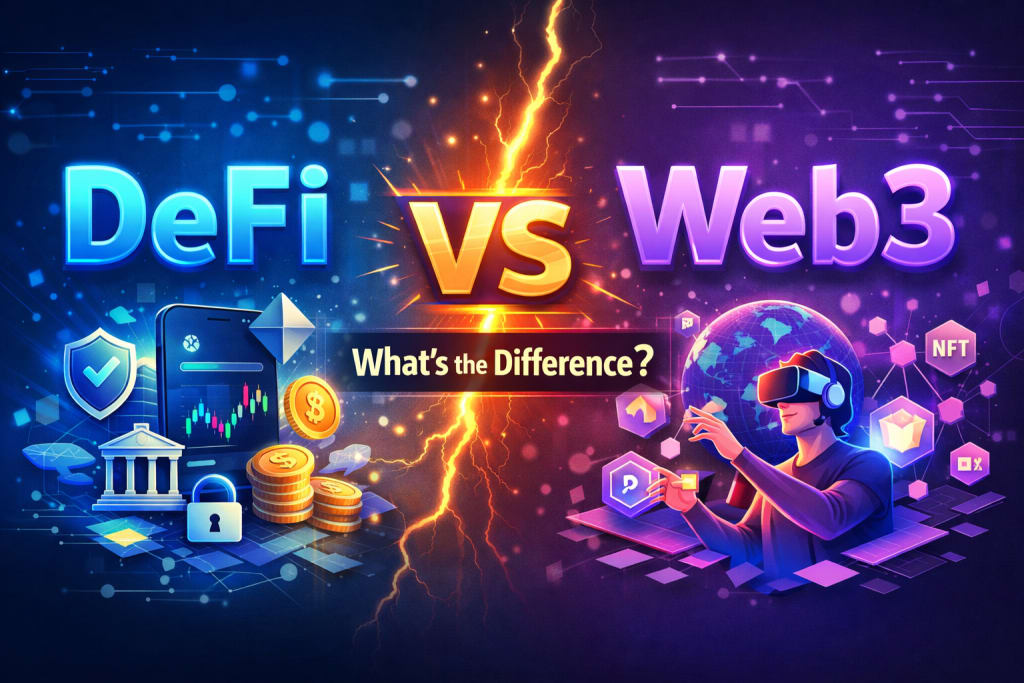
If you've spent any time reading about crypto, blockchain, or the future of the internet, you've almost certainly come across both of these terms. They get used interchangeably a lot. They shouldn't be.
DeFi and Web3 are related — but they're not the same thing. Understanding the difference matters, especially if you're building in this space, investing in it, or just trying to make sense of what's actually happening.
Let me break it down simply.
Start With Web3
Web3 is the big picture.
It's the idea that the next version of the internet should be owned and controlled by its users — not by a handful of corporations. Web1 was read-only (you consumed content). Web2 was read-write (you created content, but platforms owned it). Web3 is supposed to be read-write-own.
The core technology behind Web3 is the blockchain. Instead of your data, identity, and digital assets living on servers owned by Google or Meta, they live on decentralized networks that no single entity controls. You hold your own private keys. You own your digital assets. You participate in networks directly, without intermediaries.
Web3 is a broad vision. It includes:
- Decentralized finance (DeFi)
- NFTs and digital ownership
- Decentralized autonomous organizations (DAOs)
- Decentralized identity and reputation
- Decentralized social networks
- Gaming with real asset ownership (GameFi)
- Decentralized storage and computing
Think of Web3 as the operating system. Everything else is an application running on top of it.
Now, What Is DeFi?
DeFi — decentralized finance — is one specific application of Web3.
It's the attempt to rebuild the financial system on blockchain infrastructure. Everything traditional finance does — lending, borrowing, trading, earning interest, insurance, derivatives — DeFi tries to do without banks, brokers, or any centralized intermediary.
The mechanics work like this: instead of going to a bank to get a loan, you interact with a smart contract. Instead of using a stock exchange, you trade on a decentralized exchange. Instead of earning 0.5% interest in a savings account, you provide liquidity to a protocol and earn fees directly.
💡 Want a deeper breakdown of how DeFi actually works? Check out this Complete Beginner's Guide to DeFi — it covers everything from liquidity pools to yield farming.
DeFi is entirely on-chain. Every transaction is recorded on a public blockchain. Every rule is encoded in smart contracts that execute automatically. There's no CEO to call, no customer service line, no office. Just code.
The most well-known DeFi applications include:
- Decentralized exchanges (DEXs) like Uniswap and Curve, where you can swap tokens without a centralized order book
- Lending protocols like Aave and Compound, where you can borrow against crypto collateral or earn interest by lending
- Yield aggregators like Yearn Finance, which automatically move funds between protocols to maximize returns
- Stablecoins like DAI, which maintain price stability through algorithmic mechanisms rather than centralized reserves
The Relationship Between the Two
Here's the clearest way to think about it:
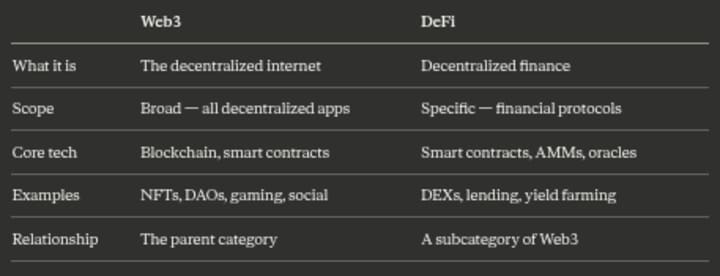
Web3 is the category. DeFi is a subcategory.
Every DeFi protocol is a Web3 application. But not every Web3 application is DeFi.
An NFT marketplace is Web3 but not DeFi. A decentralized social network is Web3 but not DeFi. A blockchain-based video game where you truly own your in-game items is Web3 but not DeFi.
DeFi specifically refers to financial applications — anything involving money, lending, trading, earning, or financial instruments — built on decentralized infrastructure.
Where People Get Confused
The confusion usually comes from two places.
First, the same technology underlies both. Ethereum smart contracts power both DeFi protocols and NFT marketplaces. The same wallets — MetaMask, Coinbase Wallet — are used for both. The same blockchain explorers like Etherscan show transactions for both. When you use DeFi, you're using Web3. So the lines blur naturally.
Second, a lot of projects blend both worlds. A protocol might combine DeFi mechanics (token rewards, liquidity mining) with Web3 identity features (soul-bound tokens, on-chain reputation) or gaming elements (GameFi). These hybrid models make clean categorization harder.
But the conceptual distinction still matters. When someone says "I'm building a Web3 product," they're telling you very little about what they're actually building. When someone says "I'm building a DeFi protocol," you immediately know they're in the business of on-chain finance.
A Simple Analogy
Think of it this way.
Web3 is like the internet. It's the underlying infrastructure — the protocols, the networks, the shared standards — that makes everything possible.
DeFi is like online banking. It's one specific, hugely important application of that infrastructure. Online banking couldn't exist without the internet. But the internet is much bigger than online banking.
DeFi couldn't exist without Web3. But Web3 is much bigger than DeFi.
Why Does This Distinction Matter?
If you're a builder, it matters because DeFi has specific requirements that general Web3 development doesn't. Smart contract security in DeFi is life-or-death — a vulnerability can mean millions of dollars drained in seconds. Tokenomics design, liquidity mechanics, oracle integration, flash loan resistance — these are DeFi-specific concerns that require DeFi-specific expertise.
A general Web3 developer isn't necessarily equipped to build a DeFi protocol. You need a team that understands the financial mechanics deeply, not just the blockchain plumbing. Working with a specialized defi development company rather than a generic blockchain agency can make an enormous difference in the quality, security, and long-term viability of what you build.
If you're an investor or user, the distinction matters because the risk profiles are completely different. DeFi protocols carry smart contract risk, liquidity risk, oracle manipulation risk, and economic attack vectors that most Web3 applications don't deal with. Understanding that you're interacting with a financial protocol — not just a Web3 app — should change how carefully you evaluate what you're putting your money into.
The Overlap Is Getting Bigger
One thing worth noting: the boundary between DeFi and the rest of Web3 is getting blurrier over time, not clearer.
Protocols are combining DeFi mechanics with identity, social, and gaming layers. DAOs are using DeFi infrastructure for their treasuries. NFTs are being used as collateral in DeFi lending protocols. Decentralized social networks are building token economies that look a lot like DeFi.
The trend is toward composability — different Web3 primitives combining in increasingly complex ways. DeFi protocols interact with each other constantly. Money Legos, as the ecosystem often calls it.
So while the conceptual distinction between DeFi and Web3 remains useful, the real-world applications are increasingly hard to neatly categorize.
Quick Summary
Final Thought
DeFi is one of the most transformative applications Web3 has produced. The idea that anyone, anywhere, can access financial services — lending, borrowing, trading, earning — without a bank account or a government ID is genuinely radical.
But it's one piece of a much larger shift in how the internet is organized and who controls it.
Web3 is the vision. DeFi is one of the clearest proofs that the vision works.
Understanding both — and the difference between them — puts you ahead of 95% of people who throw these terms around without really knowing what they mean.
Found this useful? Share it with someone who's been confused by the terminology. And if you have questions, drop them in the comments — happy to help.
About the Creator
HIMANSHU
Technoloader is a top meme coin development company offering end-to-end crypto solutions on major blockchains like Ethereum and BSC.
How machines can learn from human behaviour
In order to understand where we are and where we are going, we need to understand where we were first. - Susan Fourtane Could a human behaviour simulator be embedded into a robot or online avatar to the point that it’s hard to distinguish between a real person or artificial intelligence? Scientists have been upping the stakes in this “Turing test” for years, to the point that human-mimicking programmes are ready to answer tricky questions, assist people with online shopping or be companions.
By Susan Fourtané 5 days ago in Futurism
From Digital Noise to Masterpieces: How AI Actually "Sees" and Creates Images 🎨✨
You type three simple words: "cat in space," hit enter, and a few seconds later, you’re looking at a graphic that a professional illustrator would be proud of. Magic? 🌌 To most of us, it certainly feels that way. However, behind those few seconds lies a fascinating mathematical battle and processes I came to understand better thanks to a course from IBM 🎓. I decided to explain it "in plain English" because while we’re all generating images like crazy, few people know what’s actually happening "under the hood" 🤖.
By Piotr Nowak7 days ago in Futurism



Comments
There are no comments for this story
Be the first to respond and start the conversation.