
Luxury Goods Market Trends: Brand Collaborations, Limited Editions & Industry Forecast to 2034
How rising affluence, digital retail adoption, and personalized experiences are redefining purchasing behavior and brand engagement in the global luxury goods market

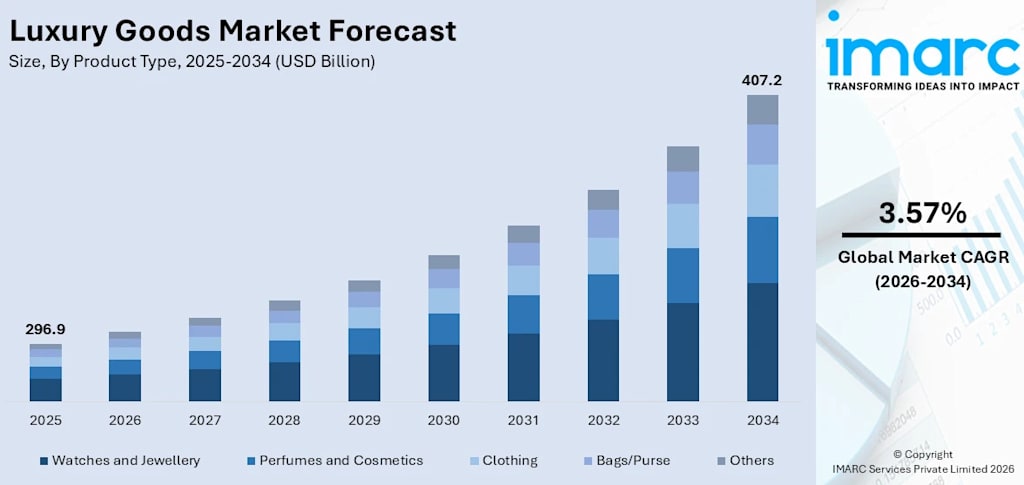
Rising demand for personal expression, increasing disposable incomes, and a strategic shift toward digital-first retail models are fueling the luxury goods sector. Consumers are moving beyond traditional status symbols, prioritizing brand heritage, superior craftsmanship, and exclusive experiences. According to IMARC Group’s latest data, the global luxury goods market size was valued at USD 296.9 Billion in 2025. Looking forward, IMARC Group estimates the market to reach USD 407.2 Billion by 2034, exhibiting a CAGR of 3.57% from 2026-2034.
The luxury landscape has evolved into a powerhouse industry where heritage houses and modern innovators coexist. Growth is underpinned by a surging affluent middle class in emerging economies and a "generational handoff" to Gen Z and Millennials, who now influence over half of all high-end purchases. Key segments such as watches and jewelry, which hold a 27.0% market share, continue to see robust interest as "investment pieces." Meanwhile, the digital revolution has turned e-commerce into a primary growth engine, with online channels accounting for more than 32.5% of global sales as brands master personalized, omnichannel storytelling.
Download Free Sample of "Luxury Goods Market" Research Report
Luxury Goods Market Growth Drivers:
- Rising Affluence and Wealth Concentration
The steady expansion of the High-Net-Worth Individual (HNWI) population remains a cornerstone of market stability. By early 2026, global records show a significant increase in ultra-wealthy individuals who remain largely insulated from inflationary pressures. This demographic fuels demand for ultra-exclusive items, such as limited-edition timepieces and high-jewelry collections. In the United States alone, the affluent consumer base sustains a market share of nearly 76.8% within its regional borders. As disposable income grew by over 3.4% globally in recent periods, luxury products have become more accessible to a broader, aspiring upper-middle class.
- Generational Shift and Youthful Influence
Millennials and Gen Z are no longer the "consumers of the future"—they are the primary engine of the present. These cohorts are projected to account for nearly 70% of luxury purchases by 2030. Unlike previous generations, younger buyers prioritize brands that align with personal values, such as ethical sourcing and social responsibility. They are also driving the "experiential luxury" trend, where the prestige of a brand is measured by unique digital engagement and immersive physical pop-ups. This shift has forced heritage labels to innovate, blending traditional craftsmanship with streetwear influences and high-tech collaborations to maintain cultural relevance.
- Digital Transformation and E-commerce Dominance
The transition from physical boutiques to sophisticated "phygital" ecosystems has revolutionized how luxury is consumed. Online sales now lead the distribution segment, driven by the convenience of global access and AI-driven personalization. Industry data suggests that the global retail e-commerce sector is moving toward a USD 7.4 Trillion valuation, with luxury brands capturing a significant portion through virtual showrooms and augmented reality (AR) try-ons. By integrating blockchain for provenance and data-enabled clienteling, brands are creating seamless, high-touch shopping journeys that mirror the exclusivity of an in-store experience while reaching a worldwide audience 24/7.
Luxury Goods Market Trends:
- Sustainability and the Rise of Circular Economy
Modern luxury is increasingly defined by "quiet sustainability" rather than overt opulence. Brands are adopting circular models, with over 68% of leading companies now offering repair, refurbishment, or certified pre-owned programs. This trend is a direct response to consumer demand for transparency and longevity. Materials like organic silk, traceable leather, and recycled precious metals are becoming industry standards. The luxury resale market is also booming, as buyers view high-end goods as appreciating assets. This shift toward "investment-grade" fashion reduces environmental footprints while maintaining the high-value perception essential to the luxury sector’s DNA.
- Hyper-Personalization and Bespoke Offerings
In 2026, the "one-size-fits-all" approach has been replaced by hyper-personalized services tailored to individual data profiles. Luxury houses are leveraging Generative AI to offer bespoke product designs and curated shopping experiences. Whether it is a custom-engraved timepiece or a personalized skincare formulation—like Prada’s recent venture into color cosmetics—the focus is on creating a unique sense of ownership. Statistics show that personalized interactions can drive a 20% increase in customer loyalty. Brands are now investing heavily in "theatrical" flagship stores that function more like private clubs or galleries than traditional retail outlets.
- Market Expansion in Emerging Hubs
While North America and Europe remain strong, the "center of gravity" for luxury is shifting toward vibrant emerging markets. India, Southeast Asia, and the Middle East are witnessing rapid retail infrastructure development. For instance, high-end beauty brands opened their first standalone Indian stores in late 2024 to tap into a surging domestic market. In the Middle East, the addition of massive retail spaces and a resilient tourist flow from high-spending regions have made it a "bright spot" for global brands. These regions benefit from a young, tech-savvy population and a growing appetite for products that symbolize personal achievement and social status.
Recent News and Developments in Luxury Goods Market
- November 2025: A major European fashion house announced the implementation of blockchain-based "Digital Product Passports" across its entire leather goods line to ensure 100% traceability and combat the rising global counterfeit market.
- September 2025: LVMH expanded its footprint in the hospitality sector, unveiling a new ultra-luxury "lifestyle destination" in the Middle East that integrates high-end retail with Michelin-starred dining and private residential suites.
- August 2025: Kering Group entered into a strategic partnership with a leading biotech firm to develop lab-grown alternative materials, aiming to replace traditional exotic skins in their flagship accessory collections by the end of 2027.
Note: If you require specific details, data, or insights that are not currently included in the scope of this report, we are happy to accommodate your request. As part of our customization service, we will gather and provide the additional information you need, tailored to your specific requirements. Please let us know your exact needs, and we will ensure the report is updated accordingly to meet your expectations.
About the Creator
Andrew Sullivan
Hello, I’m Andrew Sullivan. I have over 9+ years of experience as a market research specialist.
Keep reading
More stories from Andrew Sullivan and writers in Futurism and other communities.
Metaverse Market Trends: Blockchain Ecosystems, Secure Transactions & Industry Forecast to 2034
The rapid expansion of immersive digital ecosystems and the integration of 3D-driven environments are redefining how individuals and businesses interact, creating a landscape where the physical and virtual worlds blend seamlessly. Supported by advancements in high-speed connectivity and spatial computing, the global metaverse market is evolving into a comprehensive infrastructure for commerce, education, and social engagement. According to IMARC Group’s latest data, the global metaverse market size was valued at USD 180.8 Billion in 2025. Looking forward, IMARC Group estimates the market to reach USD 2,609.5 Billion by 2034, exhibiting a CAGR of 34.53% from 2026-2034.
By Andrew Sullivan3 days ago in Futurism
The Fears of AI And How Much Fun It Can Be
ChatGPT has come a long way, as has AI in general. There are those people who are scared of it, and for understandable reasons. People fear that as technologies advance, they’ll be replaced in the workforce. Then, there are the fears that AI could evolve into something that brings us to the brink of extinction.
By Jason Morton5 days ago in Futurism
Passive Fire Protection Market Report: Revenue Insights, Regional Outlook & Opportunities
Market Overview: The global passive fire protection market size reached USD 4.7 Billion in 2025. Looking forward, IMARC Group expects the market to reach USD 6.3 Billion by 2034, exhibiting a growth rate (CAGR) of 3.21% during 2026-2034.
By sujeet. imarcgroup4 days ago in Futurism


Comments
There are no comments for this story
Be the first to respond and start the conversation.