
THE FRAILTY OF FLESH IN THE ABYSS: THE UNCOMFORTABLE TRUTH ABOUT ARTEMIS II
We love to romanticize the stars. We imagine our grand return to the Moon as a flawless, cinematic triumph of human engineering and unbreakable willpower. But as the Artemis II crew drifts nearly 200,000 miles away from Earth this week, the terrifying reality of deep space has revealed itself not through a dramatic meteor strike, but through a blinking red fault light. Behind the heroic speeches and the roaring rockets, four biological creatures are fighting to survive in an unforgiving void. And this week, the void fought back by freezing the plumbing.
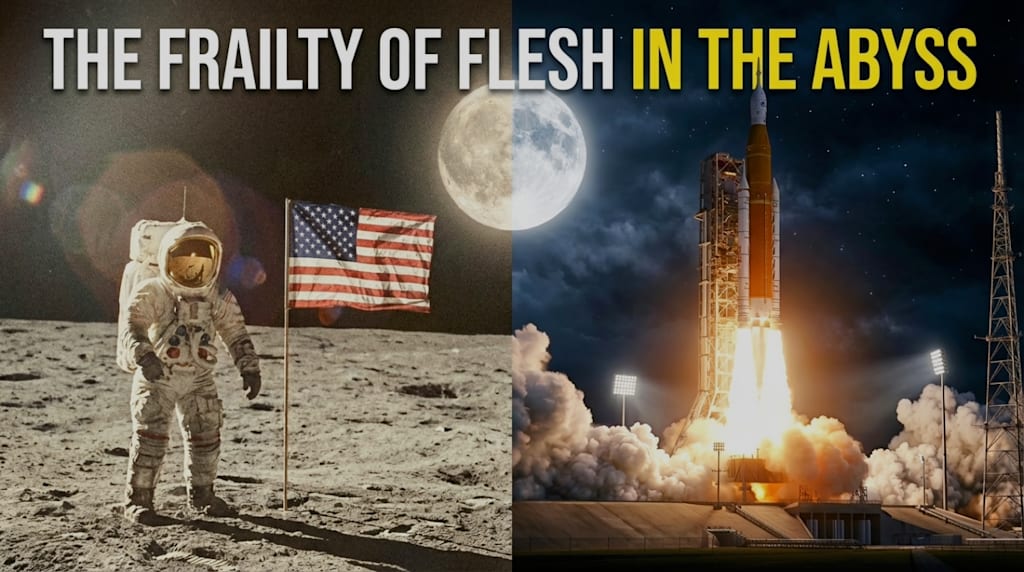
APRIL 6, 2026 (MISSION UPDATE) — When the Space Launch System tore through the Florida sky on April 1, humanity held its breath. The fire was glorious. The radio transmissions were historic. Commander Reid Wiseman told the world, "We go for all of humanity," and we all felt a collective shiver of pride. We watched the glowing screens, believing we had finally conquered the darkness that kept us grounded for fifty years.
But space does not care about our pride. Space does not care about our poetry. The absolute, crushing vacuum of the cosmos is a sterile, freezing, radiation-soaked wasteland that is violently hostile to human life. And over the last five days, the Artemis II crew has been given a brutal, humiliating, and terrifyingly real reminder of exactly how fragile we are.
The rumor circulating on social media over the weekend sounded like a bad joke: The astronauts are stuck in space with a broken toilet. But the reality is not a rumor. It is a documented, alarming fact, and it strips away all the Hollywood glamour of space exploration.
Within mere hours of liftoff, as the Orion spacecraft—named Integrity—was pushing into the blackness, mission specialist Christina Koch noticed something that would make any astronaut’s blood run cold. A fault light began aggressively blinking on the control panel. The problem was not the engines. It was the $30 million Universal Waste Management System (UWMS). The fan that creates suction in the zero-gravity toilet had jammed.
Mission control in Houston had to deliver a sobering message to the crew: You can use it for solid waste, but you cannot urinate. Imagine the psychological weight of that moment. You are sitting in a metal canister hurtling at thousands of miles per hour away from your home planet. You are surrounded by absolute nothingness, relying entirely on machines to keep your lungs breathing and your blood warm. And the very system designed to handle basic biological functions suddenly fails. The crew was forced to use "collapsible contingency urinals"—essentially plastic backup bags—while engineers on the ground scrambled for a fix.
They managed to restore it temporarily. But the darkness was not done playing with them.
By Day 3 of the mission, as the crew reached nearly 200,000 miles from Earth, the situation devolved from a mechanical glitch to a fight against the fundamental laws of thermodynamics. The vacuum of space is unimaginably cold. The vent line that is supposed to expel liquid waste into the void had completely frozen shut. The urine had turned into solid ice, blocking the plumbing of humanity's most advanced spacecraft.
NASA was forced to initiate a desperate maneuver. They could not send a plumber. They could not send spare parts. So, engineers in Houston directed the crew to physically rotate the entire Orion spacecraft. They had to angle the ship so that the raw, unfiltered heat of the Sun would hit the frozen pipe, slowly melting the ice blockage so the crew could relieve themselves without relying entirely on plastic bags.
When you strip away the sanitized press releases, this is a profoundly unsettling image.
We look up at the Moon and think of ourselves as gods of technology. But Canadian astronaut Jeremy Hansen said it best before the launch when he praised the fact that this new toilet actually had a privacy door—a first for a deep-space capsule. "The one place during the mission where we can go and actually feel like we're alone for a moment," he said.
Think about that isolation. Four human beings are currently trapped in a space the size of two SUVs. Outside their thin walls is instant, freezing death. Inside, they are dealing with the messy, undignified reality of having a human body. They are just bags of warm water, pumping blood, sweating, and creating waste in an environment that wants them dead.
This broken toilet is not just a funny news headline to laugh at over morning coffee. It is the perfect, chilling metaphor for the entire Artemis mission. It reminds us that no matter how much titanium we forge, no matter how many billions of dollars we spend, we are still biological intruders in the cosmic deep.
As of today, April 6, the crew is still out there. They are managing the situation. They are surviving. But the blinking fault light serves as a haunting warning for the years to come. We are finally knocking on the door of the universe again. But if we are struggling with the plumbing on a ten-day flyby, what happens when we try to stay?
The void is waiting. And it has no mercy for the flesh.
About the Creator
Wellova
I am [Wellova], a horror writer who finds fear in silence and shadows. My stories reveal unseen presences, whispers in the dark, and secrets buried deep—reminding readers that fear is never far, sometimes just behind a door left unopened.
How machines can learn from human behaviour
In order to understand where we are and where we are going, we need to understand where we were first. - Susan Fourtane Could a human behaviour simulator be embedded into a robot or online avatar to the point that it’s hard to distinguish between a real person or artificial intelligence? Scientists have been upping the stakes in this “Turing test” for years, to the point that human-mimicking programmes are ready to answer tricky questions, assist people with online shopping or be companions.
By Susan Fourtané 19 days ago in Futurism
How I Quit Social Media and Discovered I Was Still Real
It started with a number. Not a big number. Not something that would make sense to anyone else. Just a notification that said I'd spent 7 hours and 43 minutes on Instagram yesterday. Seven hours. In one day. Almost a third of my waking hours, scrolling through pictures of other people's lives while my own life happened in the background, unwatched and undocumented.
By Muhammad Abbas khan3 days ago in Futurism
Ghostly Happenings in Colorado
Disturbed Spirits In Denver, an expanse of greenery, Cheesman Park comes with a macabre history since it was once a burial ground known as Mount Prospect Cemetery established by General William Larimer in 1858. The job of exhuming bodies began, and some were left behind resting beneath the park. However, the ghostly spirits don’t wish to rest in peace beneath the park, and visitors here have felt cold touches, seen ghostly children playing at night, and heard a singing lady who disappears when approached.
By Rasma Raisters5 days ago in Horror



Comments
There are no comments for this story
Be the first to respond and start the conversation.