
Vinyl Record Market Outlook: Retro Trends, Independent Artists & Forecast to 2034
How rising consumer interest in analog audio, indie music production, and limited-edition releases is reshaping demand in the vinyl record market

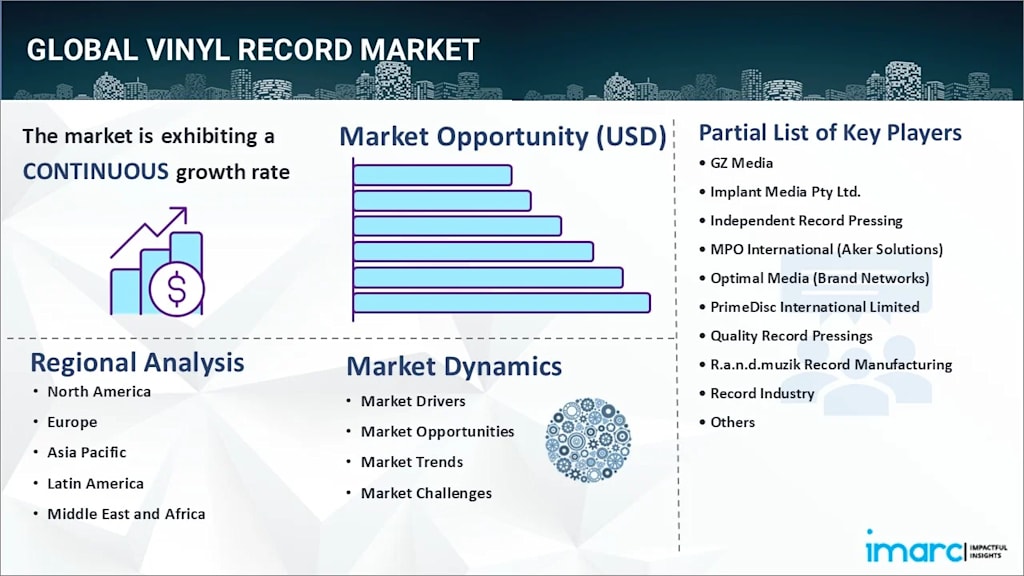
In a world saturated with instant, algorithm-driven music consumption, the vinyl record has staged one of the most unexpected commercial revivals in modern consumer history. Turntables are selling out. Pressing plants have backlogs stretching months. Independent record stores are not just surviving but expanding. The numbers tell a story that would have seemed improbable just two decades ago.
According to IMARC Group's latest research, the global vinyl record market is currently valued at USD 2.1 Billion, with projections pointing to USD 3.6 Billion as the sector continues to attract significant investment from labels, manufacturers, retailers, and artists alike. Industry stakeholders seeking granular regional and segment-level intelligence can access IMARC Group's comprehensive vinyl record market report for the full strategic picture.
Drivers Powering the Vinyl Record Market
Nostalgia With a New Audience
The emotional pull of vinyl is well understood for older listeners seeking to reconnect with music they grew up with. What has genuinely surprised industry observers is how effectively vinyl has captured younger consumers who have no prior memory of the format's first era.
The Recording Industry Association of America (RIAA) confirmed that 43.2 million LPs and EPs were sold in the United States in a single recent tracking year, continuing an unbroken streak of consecutive annual growth in vinyl album sales. That figure represents a dramatic contrast to the period when the vinyl revival first began, when annual unit sales in the same market sat at fewer than one million. The format has grown from near extinction to a commercially significant product category in under two decades, powered in large part by younger demographics discovering vinyl through social media, artist recommendations, and the broader cultural appeal of physical ownership.
Technology Enhancing a Vintage Format
Vinyl's comeback is not purely sentimental. Significant advances in pressing technology have improved the sound quality, durability, and visual variety of modern records in ways that genuinely differentiate them from both older pressings and competing audio formats.
Modern cutting lathes, improved lacquer formulations, and higher-grade PVC blends have produced a generation of records with lower surface noise and more faithful audio reproduction. On the playback side, the turntable market has seen a parallel renaissance, with brands across every price point offering equipment that makes vinyl accessible to casual listeners while also satisfying demanding audiophiles. This technological convergence between better records and better playback systems has broadened the vinyl audience considerably beyond the collector niche.
Independent Artists Driving Structural Demand
The growth of the independent music scene has become one of the most structurally important drivers in the vinyl record market. Independent artists and labels routinely use vinyl releases as both a revenue tool and a direct artist-to-fan connection mechanism. Limited pressings, exclusive colorways, and variant covers tied to crowdfunding campaigns or touring cycles have made vinyl central to the independent music economy.
Vinyl sales generated USD 467 million in revenue during one particularly strong growth period, with independent releases accounting for a meaningful share of that total. The culture that has grown around these releases, including record fairs, release-day in-store events, and online community trading, has created durable, self-reinforcing demand that does not depend on major label participation.
Segmentation Snapshot: Understanding Who Buys and What
By Product: Singles Lead in Volume
Single vinyl records represent the largest product segment globally. The 7-inch single occupies a commercially sweet spot: accessible in price, highly collectable due to distinctive artwork and limited availability, and deeply embedded in popular music history as the format that launched generations of iconic tracks.
LP and EP formats serve a different buyer profile. Full-length vinyl albums attract more committed listeners and collectors willing to invest USD 25 to USD 50 or more per record. These buyers are often motivated by the complete listening experience that an album format provides, including the ritual of side-flipping, the large-format artwork, and the narrative arc of a full tracklist as intended by the artist.
By Feature: Colored Vinyl Commands the Market
Among all feature variants, colored vinyl represents the dominant segment. The visual dimension of vinyl is a serious commercial consideration. Transparent pressings, marbled patterns, splatter effects, and solid premium colors transform records into display objects as much as listening experiences.
Artists and labels have recognized this dynamic fully. Exclusive color variants tied to specific retailers or release windows are now standard practice in vinyl marketing, driving collectors to purchase multiple editions of the same album. This behavior directly supports secondary market activity, with sought-after colored pressings regularly trading at multiples of their original retail price on platforms like Discogs and eBay.
By Age Group: Cross-Generational Appeal
The vinyl record market serves a notably broad age spectrum. Buyers aged 26 to 50 represent the core commercial base, combining nostalgia-driven purchasing with the disposable income to invest in premium formats and equipment. However, the 18 to 25 segment has grown substantially, with younger buyers engaging with vinyl through discovery formats, gift purchases, and the influence of artists who actively promote physical ownership as part of their brand identity.
Regional Landscape: Asia Pacific Leads Globally
The most strategically significant regional finding in the vinyl record market is that Asia Pacific holds the position of the largest market globally. This outcome reflects the combination of rising disposable incomes across the region, deep cultural appreciation for hi-fi audio formats particularly in Japan and South Korea, and the rapid expansion of independent music scenes in markets including China, Australia, and Southeast Asia.
Japan has maintained a sophisticated vinyl culture for decades, with specialist pressing facilities, audiophile-grade equipment retailers, and collector communities that rival anything found in North America or Europe. South Korea's music industry, supercharged by the global reach of K-pop, has embraced vinyl as a premium merchandise category, with major artists routinely releasing elaborate vinyl editions for international fan markets.
North America and Europe remain critically important in terms of revenue intensity and collector market depth, with the United States and Germany serving as the two most commercially significant individual country markets. These regions generate high per-unit value through premium pressings, audiophile labels, and the strong institutional support of networks like Record Store Day.
Competitive Landscape
The global vinyl record market is served by a mix of large-volume specialist manufacturers and boutique pressing operations. Key players include GZ Media, United Record Pressing, Quality Record Pressings, Pallas Group, MPO International, Optimal Media, Independent Record Pressing, Record Industry, PrimeDisc International Limited, Implant Media, and Stereodisk LLC, among others.
Competition in this sector centers on pressing quality, format versatility, production turnaround, and the ability to manage specialty requests including colored vinyl, picture discs, and heavyweight audiophile-grade pressings. Capacity has been a persistent industry constraint, with pressing plant backlogs extending to six months or longer during peak demand periods, creating a supply challenge that has also reinforced the perceived exclusivity of limited vinyl releases.
Recent News and Developments
March 2026: Craft Recordings, a division of Concord Music Group, announced an expanded vinyl reissue program focused on catalog titles from its jazz and soul archives, adding over 50 new pressings to its release schedule in response to sustained consumer demand for premium reissues in those genres.
October 2025: Universal Music Group confirmed a significant expansion of its dedicated vinyl production partnerships across pressing facilities in Europe and North America, citing consistent double-digit growth in physical music revenue driven predominantly by vinyl sales across both catalog and new release titles.
May 2025: Record Store Day organizers reported record-breaking participation figures across the United States and United Kingdom, with hundreds of exclusive limited pressings selling out within the first hour of store opening, reflecting the continued strength of in-person vinyl retail culture globally.
September 2024: Sony Music Entertainment announced a long-term capacity agreement with a major European pressing plant to secure dedicated pressing slots for its global vinyl release pipeline, signaling the label's strategic commitment to treating vinyl as a permanent commercial priority rather than a temporary trend.
March 2024: Discogs, the world's largest vinyl marketplace, reported surpassing 10 million listed sellers across its platform globally, marking a new milestone for the secondary vinyl market and underlining the depth of collector engagement driving liquidity and price discovery in the physical music economy.
Challenges and Opportunities in Balance
The vinyl record market carries real structural challenges. Production costs are substantially higher than digital distribution, and the specialized equipment required for pressing represents a meaningful capital barrier for new entrants. PVC supply chain pressures have periodically created input cost volatility, while skilled pressing plant operators remain a constrained resource globally.
Yet these same constraints have functioned as demand amplifiers. When scarcity is built into the production model, collectability follows naturally. Limited pressings that sell out drive secondary market activity, press coverage, and social media conversation, all of which feed back into primary demand for the next release cycle.
The opportunity set for the market remains substantial. Emerging markets in Latin America, the Middle East, and Africa represent the next frontier for vinyl penetration as infrastructure develops and music culture continues to diversify globally.
What Comes Next for the Vinyl Record Market
The vinyl record market has moved well beyond nostalgia as its primary commercial justification. It now functions as a multi-dimensional consumer goods category, serving audiophiles, collectors, casual music fans, artists, and independent labels in ways that are commercially self-sustaining and culturally reinforcing.
The industry is experiencing strong growth momentum with no structural signals suggesting a reversal. If anything, the convergence of omnichannel retail investment, artist-driven promotional activity, and continued manufacturing quality improvements suggests that vinyl's commercial trajectory will remain firmly upward across all major markets in the years ahead.
About the Creator
Suhaira Yusuf
I specialize in Consumer Insights, focusing on transforming detailed market data into strategic business solutions that accelerate growth and improve customer engagement.
Keep reading
More stories from Suhaira Yusuf and writers in Futurism and other communities.
Protein Ingredients Market Analysis: Food Innovation, High-Protein Diets & Forecast to 2034
Rising health awareness, growing adoption of plant-based diets, and surging demand for functional nutrition across food, beverages, and supplements are fueling strong momentum in the protein ingredients industry, supported by technological advancements in protein processing, expanding sports nutrition culture, and growing application across clinical nutrition and animal feed sectors. The global protein ingredients market size reached USD 46.0 Billion in 2025. Looking forward, IMARC Group expects the market to reach USD 66.9 Billion by 2034, exhibiting a growth rate (CAGR) of 4.12% during 2026-2034. Europe currently dominates the market as the largest segment, driven by high consumer awareness and robust food processing industries, while North America and Asia-Pacific show strong growth potential.
By Suhaira Yusufa day ago in Futurism
How machines can learn from human behaviour
In order to understand where we are and where we are going, we need to understand where we were first. - Susan Fourtane Could a human behaviour simulator be embedded into a robot or online avatar to the point that it’s hard to distinguish between a real person or artificial intelligence? Scientists have been upping the stakes in this “Turing test” for years, to the point that human-mimicking programmes are ready to answer tricky questions, assist people with online shopping or be companions.
By Susan Fourtané 19 days ago in Futurism
UAE IVD Devices Market Analysis: Demand Trends, Technology Adoption & Competitive Landscape
According to IMARC Group's latest research publication, the UAE in-vitro diagnostics (IVD) devices market generated a revenue of USD 299.7 Million in 2025 and is expected to reach USD 437.6 Million by 2034, exhibiting a CAGR of 4.17% during 2026-2034.
By Abhay Rajput6 days ago in Futurism




Comments
There are no comments for this story
Be the first to respond and start the conversation.