
Wi-Fi Market Trends: 6E Expansion, IoT Integration & Forecast to 2034
How increasing IoT penetration, enterprise network upgrades, and next-gen Wi-Fi 6E technology are driving scalability and efficiency across global wireless ecosystems

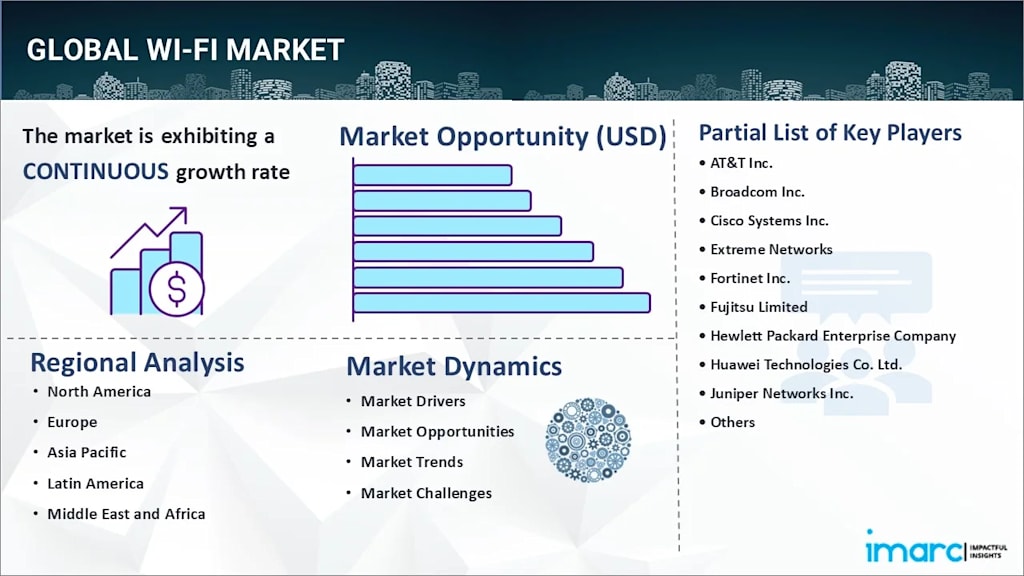
Rising adoption of BYOD policies, the growing need to share experiences and content on social media platforms, and the expanding popularity of online gaming and esports are some of the key forces fueling growth in the global Wi-Fi market. According to IMARC Group's latest data, the global Wi-Fi market size reached USD 39.7 Billion in 2025. Looking forward, IMARC Group expects the market to reach USD 101.0 Billion by 2034, exhibiting a growth rate (CAGR) of 10.90% during 2026–2034. North America currently dominates the market, holding a market share of over 40.55% in 2025.
Wi-Fi has become the backbone of digital connectivity — from smart homes and enterprise offices to public hotspots and industrial floors. Today, the market spans a wide spectrum of use cases: consumer mesh systems, enterprise WLAN deployments, cloud-managed networks, and the next-generation Wi-Fi 7 standard that promises multi-gigabit speeds with dramatically reduced latency. With over 950 million public Wi-Fi hotspots deployed globally as of 2025 and Wi-Fi 6 devices surpassing 5.2 billion cumulative shipments, the sector is no longer just an internet access tool — it’s a critical infrastructure layer supporting everything from telemedicine and distance learning to smart city management and industrial automation. Key segments include enterprise WLAN, public Wi-Fi infrastructure, consumer access points and routers, chipsets, and Wi-Fi as a Service (WaaS), with demand concentrated across North America, Asia Pacific, and Europe.
Request a Business Sample Report for Procurement & Investment Evaluation
Wi-Fi Market Growth Drivers:
Surging BYOD Adoption and Enterprise Mobility
The shift to bring-your-own-device (BYOD) policies across enterprises has dramatically expanded the demand for robust Wi-Fi infrastructure. By 2025, an estimated 36.2 million workers — representing 22% of the American workforce — were working remotely, an 87% jump from pre-pandemic levels. This shift requires offices, co-working spaces, and homes to maintain enterprise-grade wireless performance. IT departments are deploying dense Wi-Fi 6 and 6E networks to handle hundreds of simultaneous device connections without performance degradation. The financial and professional services sector remained the largest enterprise Wi-Fi spending vertical in 2025, with double-digit spending growth, underscoring how critical reliable wireless has become in modern workplace environments.
Online Gaming, Esports, and Social Media Content Sharing
Bandwidth-hungry applications like 4K/8K video streaming, cloud gaming, and live social media broadcasting are placing unprecedented demand on home and public Wi-Fi networks. Esports has gone mainstream, and gaming consumers now expect sub-millisecond latency and near-zero packet loss — performance that older wireless standards simply can’t deliver. This has accelerated upgrade cycles to Wi-Fi 6 and Wi-Fi 7, which support 320 MHz channel bandwidths (double that of Wi-Fi 6). Content creators sharing large video files and streaming in real time have similarly driven demand for multi-gigabit home networks, making high-capacity Wi-Fi a standard household expectation rather than a premium feature.
IoT Proliferation Across Industries
The explosion of IoT devices is one of the most powerful structural tailwinds driving Wi-Fi growth. From smart home appliances and wearable health monitors to factory sensors and connected logistics equipment, every added device demands a reliable, low-latency wireless connection. Industrial and logistics environments alone are forecast to record a 17.18% growth rate in Wi-Fi adoption through 2031, driven by autonomous guided vehicles, digital twins, and real-time asset tracking. Production facilities are now deploying Wi-Fi 6E networks that support more than 100 connected endpoints per access point, delivering the 99.9% uptime that modern automation requires. As smart city projects accelerate globally, the number of public Wi-Fi hotspots is projected to hit 3.15 billion units by 2030.
Wi-Fi Market Trends:
Wi-Fi 7 Becomes the New Enterprise Standard
Wi-Fi 7 is emerging as the defining enterprise connectivity upgrade of this decade, and adoption is accelerating faster than any previous wireless generation. Cisco, the current market leader, reported its Wi-Fi 7 technology ramp has outpaced all prior WLAN generational transitions, while Dell’O Group is forecasting double-digit WLAN revenue growth through 2026. The technology’s ability to operate simultaneously across 2.4 GHz, 5 GHz, and 6 GHz bands via Multi-Link Operation makes it the first “carrier-grade” Wi-Fi, giving enterprises the throughput and reliability needed for hybrid work, AI workloads, and real-time analytics. More than 40% of Cisco’s existing customers were still running Wi-Fi 5 as of early 2026, creating a massive upgrade opportunity ahead.
Cloud-Managed Wi-Fi and Wi-Fi as a Service (WaaS)
Network management is moving to the cloud, and Wi-Fi as a Service (WaaS) is capturing a growing share of enterprise IT budgets. The WaaS market is projected to grow from USD 1.71 billion in 2025 to USD 4.75 billion by 2034, as organizations of all sizes opt for subscription-based wireless management that bundles hardware, software, and support into one manageable package. Key players including Cisco (Meraki), Aruba (HPE), and Extreme Networks are expanding their WaaS portfolios aggressively. Public cloud-managed WLAN revenue outpaced the broader market in 2025, particularly in the large enterprise and service provider segment, reflecting a structural shift away from on-premises network management toward centralized, AI-assisted operations.
AI-Powered Network Optimization and Security Integration
Artificial intelligence is rapidly becoming embedded into Wi-Fi infrastructure, reshaping how networks self-manage and respond to security threats. Cisco’s latest intelligent access points now adjust channel plans autonomously and bundle zero-trust security directly at the network edge. Qualcomm’s FastConnect 7900 chipset integrates AI processing for real-time adaptive beamforming, targeting mobile devices and XR applications. Meanwhile, WPA3 protocol adoption is gaining ground as organizations respond to escalating cybersecurity risks on public and enterprise networks. With AI-driven traffic optimization now a standard selling point in enterprise WLAN tenders, the convergence of connectivity and intelligent network management is set to define the next wave of Wi-Fi infrastructure investment.
Recent News and Developments in Wi-Fi Market
• March 2026: Dell’O Group confirmed Cisco secured the top spot in Wi-Fi 7 enterprise market share for 2025, with its technology ramp outpacing all prior WLAN generational transitions. The research firm also forecasted double-digit WLAN revenue growth for 2026, though noting emerging supply constraints on DDR4 memory used in modern access points could pressure equipment lead times.
• February 2026: Cisco CTO Matt MacPherson publicly identified 2026 as Wi-Fi 7's breakout year, noting that Wi-Fi 7 compatibility has expanded beyond flagship smartphones to laptops and mid-range consumer devices. The company highlighted a strong pending refresh cycle, with over 40% of its customer base still running Wi-Fi 5 infrastructure.
• February 2025: Qualcomm posted Q1 revenues of USD 11.67 billion, up 18% year-on-year, with strong demand for Wi-Fi 7 radios in premium handsets cited as a key contributor. The company’s FastConnect 7900 chipset, which integrates AI-driven adaptive beamforming, began shipping at volume to device manufacturers targeting mobile, XR, and enterprise applications.
Note: If you require specific details, data, or insights that are not currently included in the scope of this report, we are happy to accommodate your request. As part of our customization service, we will gather and provide the additional information you need, tailored to your specific requirements. Please let us know your exact needs, and we will ensure the report is updated accordingly to meet your expectations.
About the Creator
Suhaira Yusuf
I specialize in Consumer Insights, focusing on transforming detailed market data into strategic business solutions that accelerate growth and improve customer engagement.
Keep reading
More stories from Suhaira Yusuf and writers in Futurism and other communities.
Insect Protein Market Analysis: Edible Insects, Food Innovation & Forecast to 2033
The way the world produces and consumes protein is changing — and insects are playing a bigger role in that shift than most people realize. Already consumed by over 2 billion people worldwide, insect protein is rapidly crossing from traditional diets into mainstream food, feed, and even personal care industries. According to IMARC Group's latest research, the global insect protein market size reached USD 1,171.4 Million in 2024. Looking forward, IMARC Group expects the market to reach USD 5,528.0 Million by 2033, exhibiting a CAGR of 18.82% during 2025-2033. The market is growing rapidly, driven by rising awareness of insect protein’s high nutritional value, growing demand for alternate protein sources, escalating prevalence of chronic conditions, increasing product adoption in animal feed, favorable regulatory environments, and rapid technological advancements in production.
By Suhaira Yusuf3 days ago in Futurism
The Fears of AI And How Much Fun It Can Be
ChatGPT has come a long way, as has AI in general. There are those people who are scared of it, and for understandable reasons. People fear that as technologies advance, they’ll be replaced in the workforce. Then, there are the fears that AI could evolve into something that brings us to the brink of extinction.
By Jason Morton5 days ago in Futurism
5 Delicious Ways to Use Remedy Beef Bone Broth in Everyday Recipes
The Ancient Tonic That Saved My Modern Routine: A Personal Journey In the fast-paced digital world of 2026, we are constantly bombarded with the "next big thing" in health. From synthetic supplements to high-tech wearable gadgets that track every heartbeat, the search for peak performance never ends. However, after years of managing a demanding digital agency and feeling the constant toll of burnout, I decided to look backward instead of forward. I decided to embrace one of the oldest nutritional secrets in human history: beef bone broth.
By Muhammad Owais SEO 3 days ago in Futurism



Comments
There are no comments for this story
Be the first to respond and start the conversation.