
The Songbird Sings
Architecture of the Scythe

The Orpheum Theater did not die all at once; it was strangled by degrees, one ninety-degree angle at a time. To the public, the grand reopening was a triumph of preservation, a gift from the Vane Foundation to a city that had forgotten how to breathe. But to Elena Vane, descending into the sub-basements felt less like a return to a cultural landmark and more like an entry into a high-security sanitarium.
The descent was a transition through eras of architectural thought. The lobby still boasted its original sprawling staircases—mahogany curves that felt like a slow, rhythmic exhale. But as Elena moved deeper, the "Gospel of the Grid" took hold. The transition was violent. The lush, curvilinear patterns of the Art Nouveau carpet were abruptly replaced by polished concrete, etched with the precise, interlocking squares favored by the Vane Foundation’s lead architect, Silas Thorne. Here, the air changed. It lost its scent of old perfume and stage dust, replaced by the sterile, ionized tang of industrial air scrubbers.
She reached Rehearsal Room 4-B. The door didn't creak; it hissed on pneumatic hinges, a sound of surgical precision that seemed to mock the very idea of a "rehearsal."
Inside, the room was a masterclass in architectural cognitive dissonance. Above, the original crown molding remained—a riot of plaster cherubs, bloated with age, and swirling acanthus leaves that clung to the ceiling like survivors of a shipwreck. They represented the old world, the world of the curve and the organic mess of human emotion. But they were no longer in control. Silas Thorne’s "structural reinforcements" bisected the history of the room with clinical indifference. Massive grey steel I-beams, cold and unyielding, had been driven through the plaster, pinning the heavy velvet curtains against the walls like moth specimens in a collector’s tray. The steel didn't just support the ceiling; it seemed to be colonizing it, a grey cancer of "unyielding structural truth" eating away at the theater’s soul.
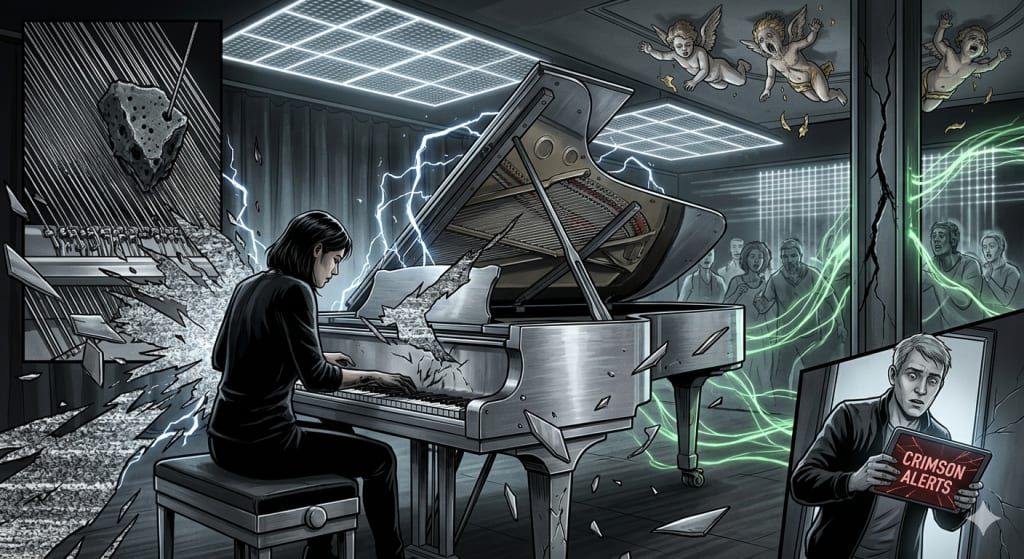
In the center of this clash stood the piano. It was a vintage Steinway, an instrument that once breathed with the humidity of the city, its wood expanding and contracting like a living lung. The elegant curves of its mahogany case were stripped away and replaced with brushed aluminum panels. The Vane Foundation called it "acoustic stabilization"—a necessary upgrade to ensure the instrument survived the "Seismic Vault" technology Thorne had installed in the foundation. To Elena, it looked like a coffin designed by an aerospace engineer.
She sat on the bench, which was a hard, geometric slab of reinforced carbon fiber. She pressed a middle C.
The note was perfect. It was, in fact, terrifyingly perfect. It lacked the "woody" decay, the slight, beautiful imperfection of a string vibrating against aged spruce. The sound was clipped, processed by aluminum housing and dampening sensors. It was a frequency scrubbed of its history. Thorne’s architecture didn't just house the music; it interrogated it, stripping away the resonance until only the math remained.
"It’s dead, isn't it?" she whispered. Her voice didn't carry. The room was designed as an "Acoustic Vacuum," a space where sound was managed as a commodity rather than an experience. The soundproofing didn't just block outside noise; it seemed to reach out and swallow the words before they could leave her lips.
Elena looked down at her sheet music. It was a classical sonata, the kind the Board of the Vane Foundation demanded for the gala—orderly, predictable, and mathematically sound. It was music that stayed within the lines. But her own notations bled across the margins in jagged, ink-stained defiance. She wasn't looking for harmony today. She was looking for the seam—the place where Thorne’s steel met the Orpheum’s original stone, the place where the math might begin to fail.
She began to play, but she ignored the sonata. She started with a series of low-register clusters, striking the keys with a percussive violence that made the aluminum casing ring with a high, metallic whine. She felt the vibration travel up her arms, a cold, electric sensation that made her marrow ache.
As she played, she watched the room. The steel beams didn't vibrate in sympathy with the notes; they seemed to absorb them, humming in a low, sub-audible frequency that she felt in her gut more than her ears. It was a predatory sound. The Orpheum was no longer a theater designed for the human ear. Under Thorne’s direction, it had been transformed into a giant, stone tuning fork, a massive conductor for a frequency the public wasn't meant to hear.
Elena closed her eyes and pushed harder. She began to experiment with "irrational intervals"—chords that shouldn't exist in a standard twelve-tone scale, notes that sat in the cracks between the keys. She wanted to hear what the room did with chaos.
For a moment, the atmosphere in 4-B shifted. The pressurized silence seemed to thin, and a faint, flickering shadow danced across the aluminum piano lid. It wasn't a shadow cast by the harsh LED grid above; it was a ripple in the air itself, like heat rising from asphalt. For a fleeting second, the cherubs on the ceiling seemed to weep plaster dust, their frozen eyes widening in the sterile light.
Then, the "Grid" corrected itself. A subtle shift in the room's ventilation system adjusted the pressure, and the steel beams seemed to tighten their grip on the velvet. The dissonance was swallowed, neutralized by the architecture before it could become a riot.
Elena stopped, her chest heaving. The silence that rushed back in was absolute. It was a silence that felt like a judgment.
She realized then that Silas Thorne hadn't just reinforced the Orpheum; he had silenced it. He had built a cage so perfect that even the ghosts had been forced into a 90-degree alignment. But as she looked at the shattered reflections in the brushed aluminum of the piano, Elena felt a spark of the very thing Thorne feared most: entropic potential.
The Grid was strong, but brittle. It relied on math that ignored the "Structural Waste" of the human heart. And Elena knew, as she traced the jagged lines of her own forbidden music, even the strongest steel beam has a resonance frequency—a note that, if struck correctly, could bring the whole gospel of the grid screaming to its knees.
She reached for the keys again, her fingers hovering over the "Lost C." The rehearsal wasn't over. It was just beginning.
The door to Rehearsal Room 4-B didn't just open; it retracted with the pneumatic hiss of a pressurized seal. The sound was an intrusion of the modern world into the decaying elegance of the Orpheum, a sharp reminder that every square inch of this space was now under the jurisdiction of the Vane Foundation.
Marcus stepped into the room, his presence immediately cooling the air. He was a man composed of straight lines—his suit was a charcoal grey that seemed to absorb the dim light of the rehearsal space, and his posture was as rigid as the steel I-beams he had overseen. In his hand, he clutched a sleek digital tablet that cast a pale, sickly blue glow against his features, highlighting the clinical focus in his eyes. He didn’t look at Elena; he looked at the air around her, his eyes tracking invisible data points.
"You’re creating a significant amount of harmonic drag, Elena," Marcus said. His voice was level, devoid of the natural cadence of conversation. It was the voice of a man who spoke in specifications and tolerances.
Elena didn't stop playing immediately. She let a final, dissonant chord hang in the air, watching as the blue light on Marcus’s tablet spiked into a jagged crimson peak. "I was unaware that music had a drag coefficient, Marcus. I thought that was for bridges and skyscrapers."
"In this building, there is no difference," Marcus countered, stepping toward the piano. He didn't walk so much as he navigated the room’s geometry. He reached out and adjusted a small, translucent sensor adhered to the side of a steel beam. "The Orpheum isn't just a theater anymore. Under Silas Thorne’s direction, we’ve integrated it into the city’s Seismic Vault network. Every vibration in this room is monitored, categorized, and, if necessary, neutralized. Those clusters you were just playing? They’re creating micro-vibrations in the primary load-bearers. You’re rattling the skeleton of the New Century."
"Your brother, Silas Thorne, you mean. Then the skeleton is too brittle," Elena said, finally letting her hands fall from the keys. The silence that followed was heavy, amplified by the sound-dampening panels that lined the walls.
Marcus finally looked at her, and for a fleeting second, his clinical mask wavered. There was no malice in his gaze, only hollow certainty—the look of abeliever who had traded his soul for a set of blueprints. "The Grid doesn't tolerate outliers, Elena. Silas taught me that. Structural integrity isn't just about steel and concrete; it’s about the elimination of the irrational. We are aiming for a Resonance of Zero across the entire district. Total structural stability."
"A Resonance of Zero is silence, Marcus."
"The Order doesn't see it as a tomb," Marcus said, his voice dropping an octave, becoming something more intimate and more dangerous. "They see it as a conductor. The city is noisy, Elena. It’s chaotic, entropic, and wasteful. The Grid—the Vane Tower, the Blackwood Bridge, this theater—it’s all part of a single machine. It’s designed to filter that chaos, to harvest the stray energy of a million uncoordinated lives and turn it into a single, usable frequency. Your music is a contaminant in that process."
He tapped a command into his tablet, and the LED array in the ceiling shifted. The warm, amber glow of the "rehearsal" setting was killed, replaced by a harsh, sterile white that made the aluminum panels of the piano look like surgical steel. "Stick to the script, Elena. The Board expects a perfect, standardized performance for the reopening. No experiments. No dissonance. If you continue to fight the math of the room, the room will eventually fight back."
The door hissed shut behind him, leaving Elena in a light so bright it felt like an interrogation. She felt exposed, a biological fluke in a world of perfect angles. But as the echo of Marcus’s footsteps faded, the pressurized silence of the room began to fray at the edges.
From the deep shadows behind the heavy velvet curtains—the places where Thorne’s LED grid couldn't quite reach—a man stepped out.
He didn't make a sound. He wore the charcoal-grey coveralls of the Orpheum’s maintenance crew, but the fabric was too clean, the cut too precise. His face was a map of soft curves and deep lines, a stark contrast to Marcus’s angular perfection. His eyes were the color of wet ash, reflecting the sterile overhead light with a strange, dull intensity.
"He’s right about one thing," the man said. His voice was a rasp, like a cello string being drawn over dry stone. "The Grid is a conductor. But a young man like Marcus... he lacks the imagination to understand what it’s actually conducting."
Elena stood up, her back pressing against the cold aluminum of the Steinway. "Who are you? Security is supposed to have cleared the wings."
"Security looks for threats they can measure," the stranger said, moving toward the piano with a fluid, haunting grace. "I am a student of the decay. I’ve spent my life watching the places where Silas Thorne’s math fails."
He reached into a deep pocket and pulled out a small, heavy object wrapped in oilcloth. He placed it on the obsidian-colored lid of the piano with a soft, metallic thud. As he unwrapped it, Elena saw a small, leaden weight, shaped like a teardrop but possessing a matte-black finish that seemed to swallow the light around it.
"What is that?" she whispered.
"A 'Dead Key,'" the man replied. "A gift from those who remember the Orpheum before it was reinforced into a cage. Silas Thorne believes he can mute the soul of the city by bracing it with steel. He thinks that if he can control the resonance, he can control the harvest."
He gestured to the open lid of the Steinway, where the high-tension strings stretched across the frame like a harp made of knives. "Place this on the interior strings of the seventh octave. It doesn't produce a note. It produces a vacuum. It mutes the logic of the instrument and allows the Static to speak through the gaps."
"The Static?" Elena asked, her hand trembling as she reached for the cold, heavy lead.
"The noise between the notes," the stranger said, stepping back into the velvet void of the curtains. "The truth that lives in the rot. Find the frequency of the decay, Elena. It’s the only way out of the tomb."
Before she could ask another question, the curtains settled. He was gone, leaving behind only the smell of ozone and the leaden weight of the Dead Key. Elena looked at the instrument—the piano—and then at the "Dead Key" sitting on its lid. The room felt thinner now, as if the walls were no longer solid, but merely a suggestion.
She reached into the piano’s gut, her fingers hovering over the strings. The rehearsal was no longer about perfection. It was about finding the one note that could break the math.
The weight of the "Dead Key" in Elena’s palm felt less like lead and more like a captured fragment of a collapsing star. It was cold—not the clinical, air-conditioned chill of the rehearsal room, but a deep, subterranean frost that seemed to pull the heat directly from her skin. She stood alone in the center of Rehearsal Room 4-B, the harsh LED grid above humming with a predatory efficiency that Marcus had called "optimal."
She turned back to the Steinway. Up close, the brushed panels looked like armor of a fallen knight. She reached out and unlatched the heavy lid, the pneumatic struts sighing as they revealed the instrument's mechanical viscera. Inside, the high-tension strings were a silver forest, stretched to the point of screaming over a frame of reinforced steel. It was a masterpiece of tension and order.
Elena’s fingers trembled as she reached into the heart of the machine. Following the Acolyte’s cryptic instructions, she placed the Dead Key onto the interior strings of the seventh octave. The moment the leaden weight touched the silver wire, the room’s atmosphere curdled. The pressurized silence didn't just deepen; it soured. The scent of intrigue—sharp, metallic, and smelling of a coming lightning strike—saturated the air so suddenly it made her eyes water.
She sat on the carbon-fiber bench and looked at the keys. They were no longer just ivory and ebony; they were the teeth of a trap. She didn't look at her sheet music. She didn't think about the Vane Foundation or the gala.
She struck a single, low-register chord, incorporating the muted strings of the seventh octave.
The sound that emerged wasn't a note. It was a tear in the fabric of the reality Silas Thorne had so meticulously constructed.
It was a jagged, grinding dissonance that seemed to originate from the very marrow of the Orpheum’s foundations. It was the sound of a controlled demolition reaching its breaking point. The ninety-degree angles of the room—the sharp corners of the steel I-beams, the precise squares of the ceiling tiles—began to vibrate until they became translucent.
Then, the Static arrived.
It didn't start in her ears; it started in the corners of her eyes. It was a swarm of grey, vibrating pixels—the "television snow" of a dead channel—that sat on top of the room like a heavy veil. As the it intensified, the physical world began to lose its authority. The gold leaf on the ceiling cherubs didn't just flake; the flakes began to drift upward, caught in a reverse-gravity draft that ignored the laws of physics. The cherubs themselves seemed to stretch, their frozen, plaster faces contorting into silent screams as the Static eroded their features.
Through the flickering grey haze, Elena saw the true architecture of the room.
The steel reinforcements Thorne had installed weren't just supports. In the visual noise of the Static, they glowed with a sickly, rhythmic pulse. She saw glowing filaments of energy—Resonance—being sucked from the old mahogany of the stage, from the velvet of the curtains, and from the very air she breathed. These filaments were being channeled through the I-beams and down into the "Seismic Vaults" beneath the city.
She saw the Order of Dionysus for what it truly was: a parasite disguised as a pillar. The Grid wasn't designed to protect the city from collapse; it was designed to harvest the collective vitality of the people, the history, and the music—and process it into a single, sterile dividend for the elite.
"The harvest," she whispered, her voice echoing with a metallic reverb that wasn't her own.
The piano keys began to vibrate so violently they became a blur of black and white. Elena didn't pull her hands away. She felt the Static crawling up her arms, a numbing, electric tingle that turned her veins into conductors. She was no longer just a musician; she was a bridge. She felt the weight of the city’s suppressed chaos pushing against her, and she realized that the only way to break the Grid was to give that chaos a voice.
She reached for the final chord—the "Final Note" that existed outside the twelve-tone scale, the irrational frequency that Thorne’s math had labeled as "zero."
She struck the keys with every ounce of defiance she possessed.
The aluminum casing of the Steinway didn't just crack; it shattered. The panels erupted outward in a cloud of metallic shards that hung suspended in the Static for a long, impossible second before falling to the floor with a sound like a thousand breaking mirrors. The sound was a thunderclap in a coffin, a sonic boom that rippled through the rehearsal room and sent a hairline fracture racing up the center of the primary steel I-beam.
The room snapped back into focus.
The Static vanished as quickly as it had arrived. The cherubs were back on the ceiling, though they looked older now, their plaster grey and pitted. The steel was once again solid and unyielding. But the clinical, pressurized silence was gone. In its place was a low, persistent hum—a residual haunt that the air scrubbers couldn't erase.
The pneumatic door hissed open, and Marcus burst into the room. He was pale, his tablet screaming with a barrage of crimson alerts. He looked at the shattered aluminum panels, his eyes wide with a mixture of confusion and a burgeoning, instinctual fear.
"What did you do?" he stammered, his fingers fumbling over the tablet’s glass screen. "The sensors... the whole sector just spiked. The Resonance levels... they hit a perfect zero and then inverted. It’s impossible. The math doesn't allow for an inversion."
Elena stood up. Her hands were shaking, and her fingertips were blackened as if they had been dipped in soot—the residual "ash" of the Static. She didn't look at Marcus. She looked at the crack in the steel beam, a small, jagged curve in his world of straight lines.
"The math is a lie, Marcus," she said, her voice steady and cold. "You aren't building a future. You’re just building a better way to starve."
She walked past him, her heels clicking on the concrete floor with a rhythmic certainty that defied the Grid. She didn't look back at the Orpheum. As she emerged into the night, the Vane Tower loomed over the city like a black needle piercing a bruised sky. For the first time, Elena didn't see a masterpiece of architecture. She saw a lightning rod, and she knew that the storm she had just summoned was already on its way.
The "Gospel" was written in stone, but the music was written in the Static. And the first movement had just concluded.
About the Creator
Nathan McAllister
I create content in the written form and musically as well. I like topics ranging from philosophy, music, cooking and travel. I hope to incorporate some of my music compositions into my writing compositions in this venue.
Cheers,
Nathan
Keep reading
More stories from Nathan McAllister and writers in Gamers and other communities.
Mashle Academy Review – Magic School RPG on Roblox
There’s something instantly appealing about the idea of a magical academy. Maybe it’s the promise of hidden power, maybe it’s the rivalries, or maybe it’s just the chaos that inevitably follows when you throw a bunch of spellcasters into one place. Mashle Academy on Roblox leans into all of that—and then cranks it up a notch.
By Serhii Biloshytskyi4 days ago in Gamers




Comments
There are no comments for this story
Be the first to respond and start the conversation.