
The Colorado Cannibal
A chilling tale from the American frontier that blurs the line between survival and savagery

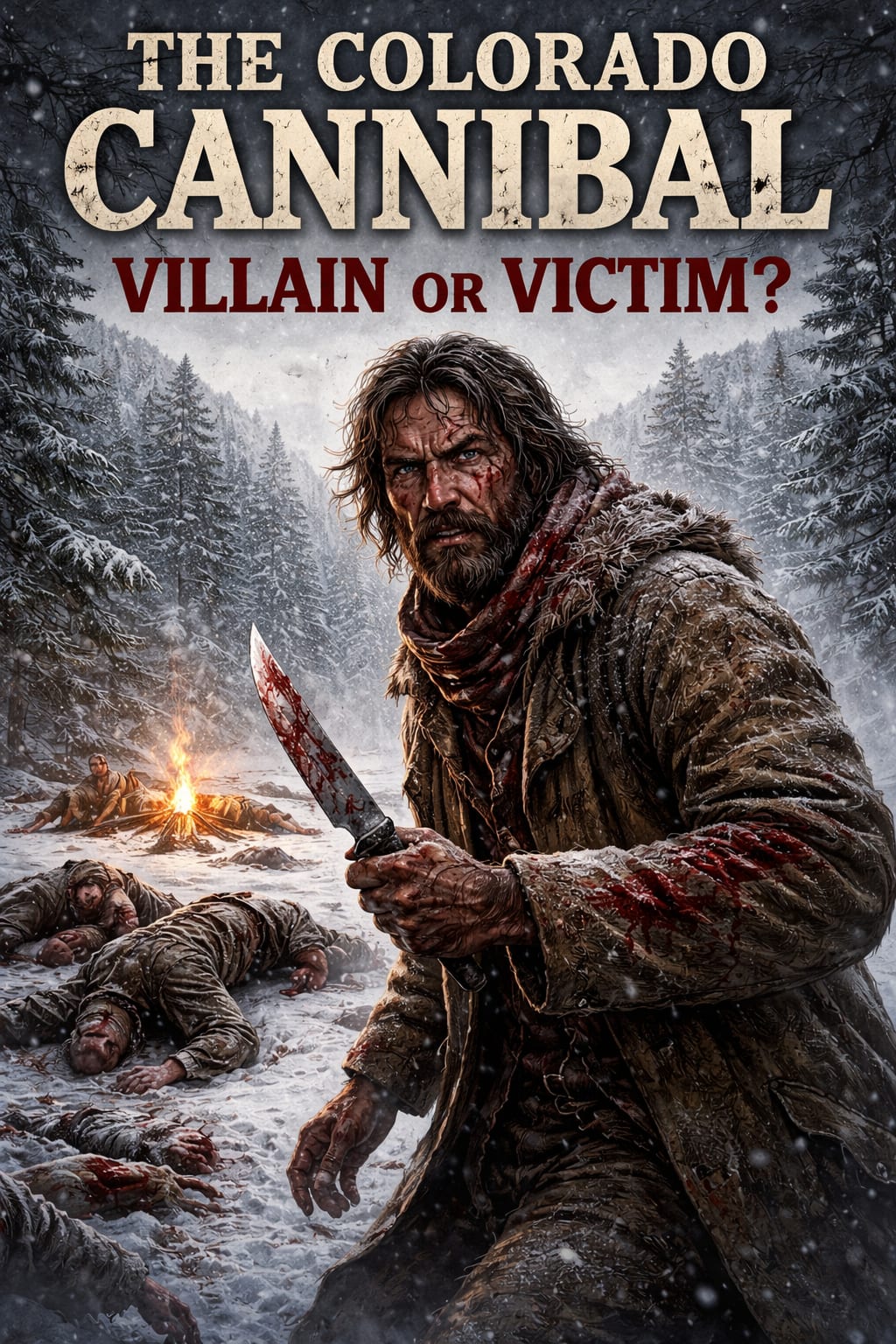
In the harsh winter of 1874, deep within the unforgiving wilderness of the Rocky Mountains, a story unfolded that would haunt American folklore for generations. At its center was a man named Alfred Packer, later infamously dubbed “The Colorado Cannibal.” His tale is one that provokes an uncomfortable question: was he a cold-blooded murderer, or simply a desperate man pushed beyond the limits of human endurance?
Packer joined a group of prospectors hoping to strike gold in Colorado Territory. Against the advice of more experienced guides, the small party ventured into the mountains during one of the most brutal winters on record. Snowstorms, freezing temperatures, and dwindling supplies quickly turned their expedition into a fight for survival. Weeks passed with little food, and the men grew weak, hungry, and increasingly desperate.
Months later, Packer emerged alone.
When he returned to civilization, his appearance raised immediate suspicion. Though he claimed to have endured the same starvation as the others, he seemed relatively well-fed compared to what would be expected of a man lost in the wilderness for so long. Even more troubling were the conflicting stories he told about the fate of his companions. At first, he insisted they had simply become lost and died of exposure. Later, under pressure, his account changed dramatically.
According to Packer’s revised confession, the group had turned on each other as starvation took hold. He claimed that one man had gone mad and killed the others, leaving Packer no choice but to kill the attacker in self-defense. Faced with certain death, he admitted to consuming the flesh of the deceased to stay alive.
This explanation, however, did little to quell suspicions. Investigators eventually discovered the remains of the missing men, and evidence suggested that the deaths may not have unfolded as Packer described. The bodies showed signs of violence inconsistent with his story of self-defense. Many believed that Packer had murdered his companions one by one, using cannibalism not as a last resort, but as part of a calculated plan to survive.
The public quickly branded him a monster.
Yet, the case is far from straightforward. To judge Packer fairly, one must consider the extreme conditions he faced. Starvation has a profound psychological impact, impairing judgment, increasing aggression, and pushing individuals toward actions they would never consider under normal circumstances. History is filled with accounts of otherwise moral people resorting to unthinkable measures when survival is at stake. In such moments, the line between right and wrong becomes blurred, if not erased entirely.
Could Packer have been one of those unfortunate souls? A man driven not by malice, but by primal instinct?
Supporters of this view argue that it is easy, from the comfort of modern life, to condemn someone who faced circumstances most of us will never experience. Alone, starving, and surrounded by death, Packer may have made choices that were less about morality and more about raw survival. If his claim of self-defense holds any truth, then perhaps he was not the instigator of violence, but rather its final participant.
On the other hand, critics point to the inconsistencies in his story as evidence of guilt. Why did his account change? Why did he appear healthier than expected? And why did the physical evidence contradict his version of events? These questions suggest that Packer may have been more than just a victim of circumstance. Instead, he may have exploited the chaos and desperation of the situation to ensure his own survival at the expense of others.
Ultimately, the truth may never be fully known. The passage of time, the lack of definitive evidence, and the contradictions in Packer’s own testimony leave the story shrouded in uncertainty. What remains is a narrative that forces us to confront uncomfortable truths about human nature.
Are we, under enough pressure, capable of the same actions?
The story of the Colorado Cannibal is not just about one man—it is about the fragile boundary between civilization and survival. It challenges us to consider how we define morality when the rules of society no longer apply. In doing so, it leaves us with a haunting realization: the difference between villain and victim may not be as clear as we would like to believe.
About the Creator
Irshad Abbasi
Ali ibn Abi Talib (RA) said 📚
“Knowledge is better than wealth, because knowledge protects you, while you have to protect wealth.
Keep reading
More stories from Irshad Abbasi and writers in History and other communities.
The Final Clue
For generations, the world has been fascinated by unsolved adventure mysteries—stories of daring journeys that ended in silence, leaving behind only fragments of truth. From vanished explorers to lost expeditions, these mysteries have lingered at the edge of human knowledge, inviting speculation and inspiring countless theories. But now, in an age defined by rapid scientific advancement, one such mystery may finally be yielding its secrets.
By Irshad Abbasi about 7 hours ago in History
The World’s BIGGEST Airplane & Its Crazy Transport Network
The Giant's Journey: How Airbus Transports the World's Largest Planes Airbus is a European powerhouse, producing nearly three aircraft every single day. But there is a massive catch: the parts for these planes are manufactured in different countries—wings in the UK, tails in Germany and Spain, and fuselage sections in France. Bringing them all to the final assembly line in Toulouse, France, is one of the most complex transport puzzles in the world.
By Imran Ali Shah4 days ago in History




Comments
There are no comments for this story
Be the first to respond and start the conversation.