
The Fall of Nimrud
Militia Commander Claims Historic Assyrian Site Has Been “100 Percent Destroyed,” Raising Global Alarm Over Cultural Heritage Loss

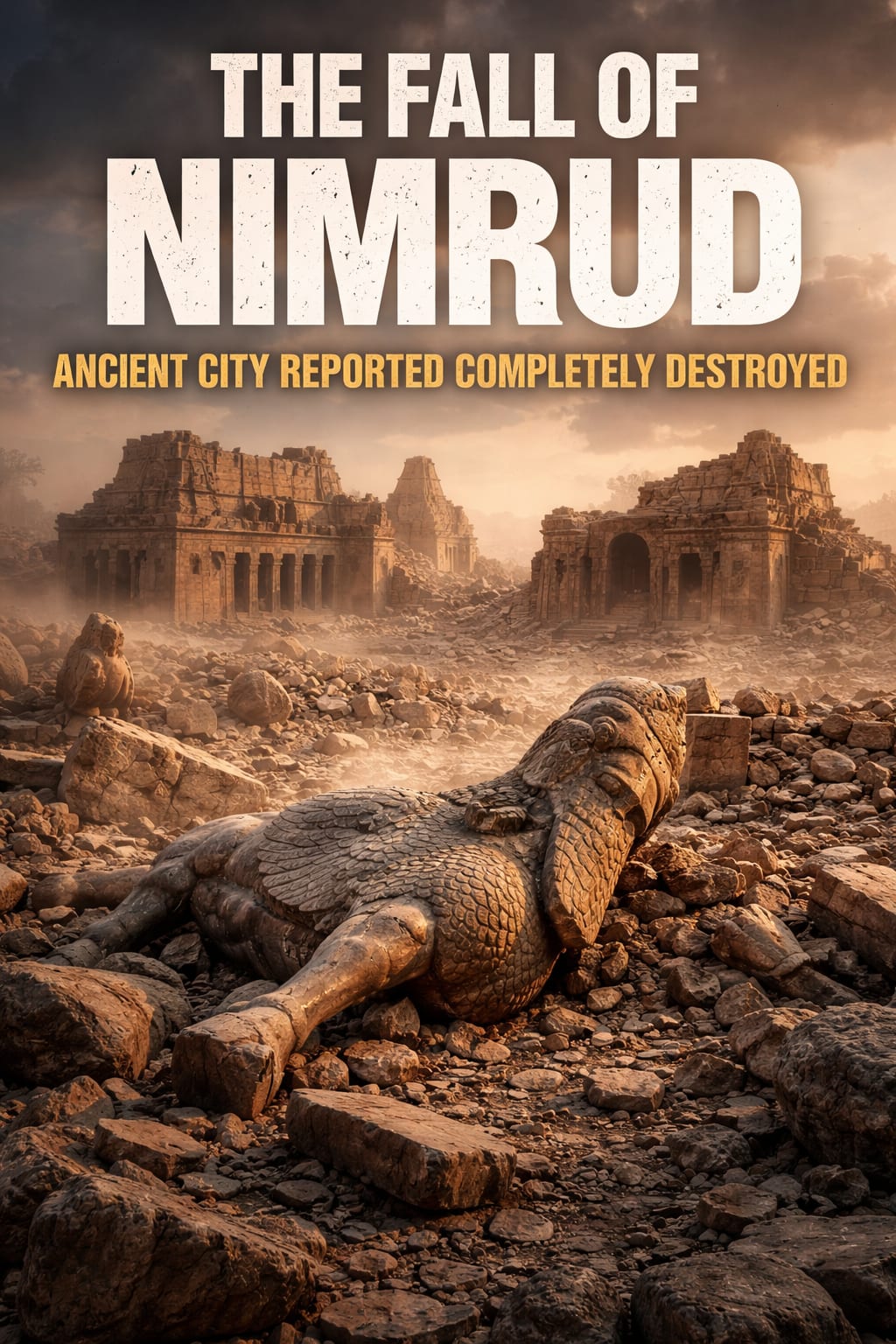
The ancient city of Nimrud—one of the most important archaeological treasures of the ancient world—has reportedly been completely destroyed, according to a statement from a militia commander operating in northern Iraq. The claim that the historic site has been “100 percent destroyed” has sparked renewed concern among historians, archaeologists, and international organizations dedicated to protecting cultural heritage.
Located about 30 kilometers southeast of Mosul, Nimrud was once a thriving imperial capital of the powerful Neo-Assyrian Empire. Founded in the 13th century BCE and later expanded by the Assyrian king Ashurnasirpal II in the 9th century BCE, the city became famous for its grand palaces, massive stone sculptures, and intricate carvings that illustrated the strength and culture of Assyrian civilization.
For centuries, Nimrud remained buried beneath the sands of northern Mesopotamia until European archaeologists rediscovered it in the 19th century. Excavations revealed extraordinary treasures including monumental winged bulls known as lamassu, detailed wall reliefs depicting royal hunts and military campaigns, and priceless artifacts that offered insight into one of the most powerful empires of the ancient Near East.
However, in recent years the site has been caught in the crossfire of regional conflicts. Armed groups have frequently targeted historical monuments, either as a form of ideological destruction or as a way to profit from looted antiquities sold on the black market. According to the militia commander’s latest claim, Nimrud has now been reduced to rubble, leaving little of the once-glorious city standing.
Images and reports circulating among local sources suggest that heavy machinery, explosives, and deliberate demolition were used to destroy large portions of the site. Massive palace walls, statues, and archaeological structures appear to have been flattened. Although some damage had already been reported in earlier years, the latest statement indicates that what remained of the city has now been entirely wiped out.
Experts warn that the destruction of Nimrud represents not only the loss of a historic location but also a devastating blow to humanity’s shared heritage. The site contained irreplaceable artifacts and architectural elements that helped scholars understand the political, religious, and social life of ancient Mesopotamian societies.
Organizations such as UNESCO have repeatedly condemned attacks on cultural sites in conflict zones. UNESCO officials have described such destruction as a “cultural tragedy” and, in some cases, even a war crime under international law. The deliberate targeting of ancient heritage, they argue, erases pieces of human history that belong to all civilizations.
Archaeologists who have studied Nimrud say the city was one of the most significant Assyrian archaeological sites ever discovered. The palaces of Ashurnasirpal II alone contained miles of carved stone panels depicting religious ceremonies, mythological creatures, and scenes of royal authority. Many of these artifacts were eventually displayed in museums around the world, including collections in London and Baghdad.
Despite the grim reports, some experts hope that not everything from Nimrud has been permanently lost. In the past, archaeologists have managed to restore damaged structures and recover buried artifacts even after severe destruction. Modern technologies such as 3D scanning, satellite imaging, and digital reconstruction may also help preserve at least a virtual record of the city.
Still, the scale of the reported devastation raises fears that many of Nimrud’s remaining archaeological layers—untouched by earlier excavations—may now be lost forever. These layers could have held invaluable information about daily life, trade, religion, and governance during the Assyrian period.
Local authorities and cultural preservation groups are calling for urgent international support to document what remains and protect other historical sites in the region. Iraq is home to numerous ancient cities, temples, and monuments that date back thousands of years, many of which remain vulnerable to conflict and neglect.
The story of Nimrud is a stark reminder of how fragile humanity’s past can be when faced with modern warfare and political instability. What once stood as a magnificent symbol of imperial power and artistic achievement now risks becoming little more than a memory preserved in photographs, museum collections, and historical texts.
For historians and archaeologists, the destruction of Nimrud is not just the loss of an ancient city—it is the disappearance of a chapter of human civilization that can never be fully replaced.
About the Creator
Irshad Abbasi
Ali ibn Abi Talib (RA) said 📚
“Knowledge is better than wealth, because knowledge protects you, while you have to protect wealth.
Keep reading
More stories from Irshad Abbasi and writers in History and other communities.
Why Further Excavation at Mohenjo-daro Could Put Its Remaining Ruins at Greater Risk
Mohenjo-daro is one of the most important archaeological sites in the world. As a major city of the Indus Valley Civilization, it offers rare insight into one of the earliest urban cultures in human history. Located in present-day Sindh, Pakistan, the site is admired for its advanced town planning, drainage systems, brick architecture, and organized streets. Yet despite its historical greatness, Mohenjo-daro is also extremely fragile. This is why the question must be asked seriously: why should further excavation be allowed if it may place the remaining ruins in even greater danger?
By Irshad Abbasi about 12 hours ago in History


Comments
There are no comments for this story
Be the first to respond and start the conversation.