
The White Labyrinth: The Lethal Geometry of Himeji Castle
Beyond the elegant facade of the "White Heron" lies a masterpiece of psychological warfare and architectural entrapment.

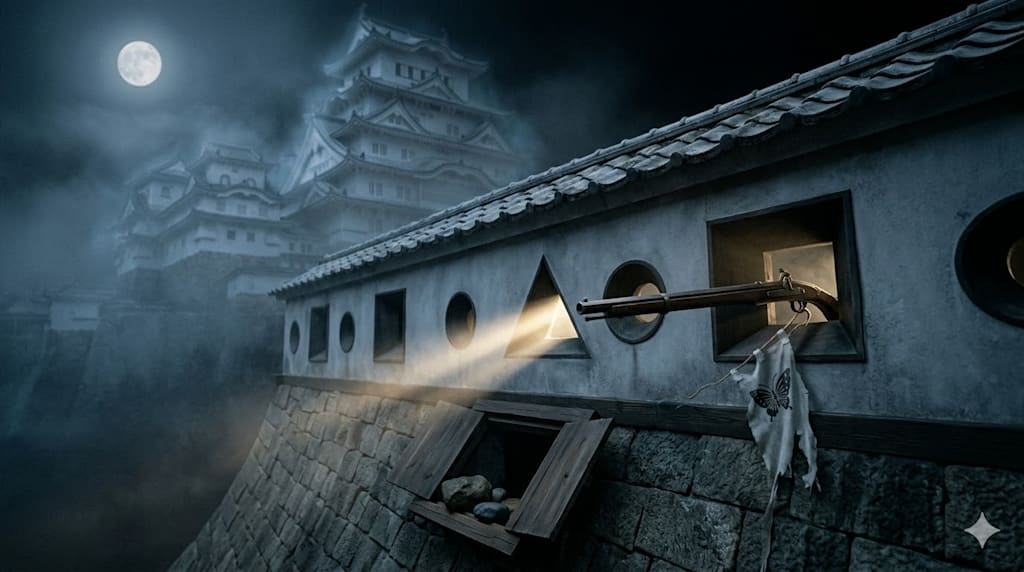
1. The Optical Illusion of Peace
From a distance, Himeji Castle (Himeji-jo) looks like a delicate bird taking flight, earning it the nickname "The White Heron." Its pristine white walls and elegant multi-tiered roofs suggest a palace of peace rather than a fortress of war. But this elegance is the ultimate samurai deception.
Every curve of its plaster and every slope of its gray tiled roofs was engineered for a singular, bloody purpose: to ensure that no intruder would ever leave the grounds alive. If Oda Nobunaga’s castles were symbols of political revolution (image_20.png), Himeji is the pinnacle of defensive obsession—a physical manifestation of a paranoid genius that saw a threat in every shadow.
2. The Spiral Traps: A Labyrinth of Despair
The most terrifying aspect of Himeji isn't its height, but its horizontal layout. The paths leading to the main keep are not straight; they are a confusing, clockwise spiral. As an invader, you are constantly forced to turn corners, losing your sense of direction and orientation.
The gates (Mon) are a study in architectural malice. Some gates are surprisingly small, forcing armored warriors to duck and enter one by one, making them easy targets for a defender’s blade. Others are "blind gates" that lead to dead ends or steep drops. Just as you think you are approaching the main tower, the path leads you away from it, exposing your unshielded right side to the archers hidden behind the walls. It is a psychological meat grinder designed to exhaust the enemy's will and stamina before they even see a defender's face.
3. The "Sama": Geometric Death Holes
Look closely at the walls of Himeji, and you will see thousands of small openings in various shapes: circles, triangles, and squares. These are Sama (loopholes), and they are the castle's primary sensory organs.
Circles and Squares: Designed specifically for the muzzles of matchlock muskets (the legacy of Nobunaga’s tactical shift, image_20.png).
Triangles: Angled for archers, allowing for a vertical range that muskets lacked.
These holes are funneled—wide on the inside to allow a broad field of fire and easy movement for the defenders, but narrow on the outside to make it nearly impossible for an enemy to shoot back accurately. There are over 2,500 of these holes, meaning that as an invader, you are being watched by a thousand invisible eyes through a geometry that favors only the house. You are under fire from a ghost you cannot see.
4. The "Ishi-otoshi": The Vertical Kill Zone
Even if a legendary warrior like Miyamoto Musashi (image_18.png) were to reach the base of the massive stone walls, the architecture continues to fight back. The base of the towers features Ishi-otoshi (stone-dropping windows). These are long, narrow rectangular slits that jut out over the stone foundations.
Through these gaps, defenders could pour boiling water, hot oil, or heavy stones directly onto anyone attempting to scale the walls. But their genius lies in the angle; the "Fan-shaped" stone walls (Musha-gaeshi) curve outward as they rise. This wasn't just for aesthetics; it meant that anyone climbing would eventually be hanging backward, fully exposed to whatever was dropped from above. It is a vertical slaughterhouse where gravity itself becomes a weapon of the state (image_10.png).
5. The Abura-kabe: Fire and Bone
Himeji holds darker secrets in its very chemistry. One specific wall, the Abura-kabe (Oil Wall), is made not of plaster, but of a unique mixture of clay, gravel, and fermented rice water (or oil). It is incredibly hard, fireproof, and practically bulletproof. Legend whispers that the strength of the castle’s foundations required more than just stone—it required sacrifice. While the "Himeji Castle Ghost" (Okiku) is a popular tale, the real horror lies in the cold, calculated efficiency of a structure built to endure an apocalypse that never came.
6. Conclusion: Beauty as a Weapon
Himeji Castle is a reminder that in the era of the samurai, beauty was often a byproduct of lethal efficiency. The white plaster that gives the castle its ethereal glow was a fireproofing measure against fire-arrows. The elegant roofs were designed to shed water and prevent rot in the wooden heart of the fortress.
When you walk through Himeji today, you are walking through a 400-year-old trap that has never been sprung. It remains undefeated because its design made the cost of entry too high to pay. It is a masterpiece of "Defensive Art"—a place where geometry was used to conquer fear, command death, and preserve a legacy in stone and white shadow.
About the Creator
Takashi Nagaya
I want everyone to know about Japanese culture, history, food, anime, manga, etc.
Keep reading
More stories from Takashi Nagaya and writers in History and other communities.
The Last Crimson Blaze: Sanada Yukimura and the Beauty of a Lost Cause
1. The Undisputed Underdog In the pantheon of Japanese history, success often equates to power, like Oda Nobunaga’s brutal unification (image_20.png) or Miyamoto Musashi’s sixty-one undefeated duels (image_18.png). But the most beloved hero in Japan is a man who technically lost. His name was Sanada Yukimura, and his legend is built on the profound, heartbreaking beauty of a doomed cause.
By Takashi Nagaya7 days ago in History
The Rise and Fall of a Dictator
Adolf Hitler was one of the most infamous figures in modern history, a man whose name has become synonymous with tyranny, hatred, and destruction. Born on April 20, 1889, in Austria, Hitler’s early life gave little indication of the catastrophic role he would later play on the world stage. Yet, as history unfolded, his ambitions, combined with the social and political instability of his time, led to one of the darkest chapters humanity has ever witnessed.
By Mariana Farias5 days ago in History
Year 1904 Fun Facts, Trivia, and Historical Events
This quick read presents a collection of fun facts, trivia, and historical events from the year 1904. Discover the year’s top news stories, most influential people, sports facts, historic firsts, entertainment news, and much more.
By Gregory DeVictorabout 13 hours ago in History



Comments
There are no comments for this story
Be the first to respond and start the conversation.