
Why Families Used to Have 10+ Kids
The Real Reason

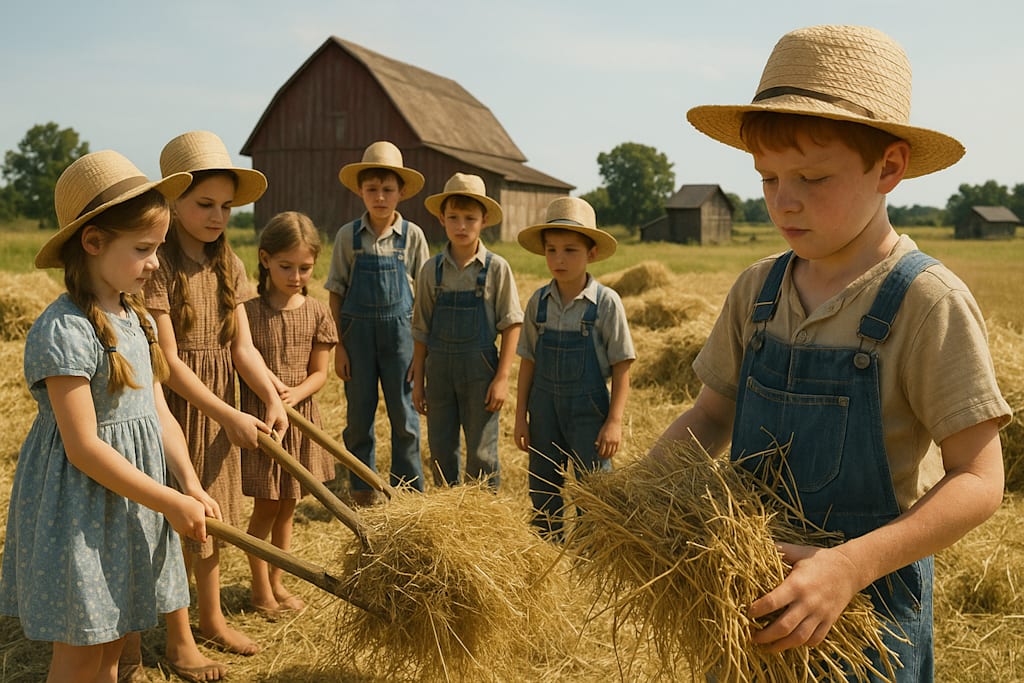
People now talk about very large families as if they were mostly a lifestyle choice, a quaint old custom, or proof that people back then simply loved children more than people do now. That version is easy to repeat because it is warm, simple, and harmless on the surface.
It is also incomplete enough to mislead.
The older reality was harder than that.
When families once had 10, 12, or 13 children, they were usually living inside an economic and physical system where more bodies made survival more possible. That does not mean every family had children for the same reason. It does mean the sentimental version people repeat now leaves out the machinery underneath it.
In rural life especially, children were tied to labor, continuity, survival, and old-age security in ways that are difficult for modern people to feel in their bones.
This is where the confusion starts.
I still remember my Sociology 101 professor in 1996 saying families had 10 or more children so they could work the farm. He was compressing a large historical truth into one sentence, but he was not wrong. He was naming the practical center of it. In an agrarian economy, survival depended on labor.
- Crops did not plant, weed, harvest, preserve, haul, and protect themselves.
- Livestock did not feed or monitor themselves.
- Water did not carry itself.
- Firewood did not split itself.
- Fences did not repair themselves.
Every season came with physical demands, and households that lacked enough working hands stayed exposed to failure.
That is the part modern nostalgia edits out.
People today often think of children as emotional commitments, educational projects, or financial dependents whose needs expand for 18 years or more.
In earlier farm-centered life, children were also dependents, of course, but they were not only that. As they grew, they became part of the household labor force. They gathered eggs, carried water, watched younger siblings, fed animals, hauled supplies, shelled peas, pulled weeds, helped preserve food, and learned the steady repetitive tasks that kept a household functioning. This wasn't considered cruelty, it was considered reality.
A large family, in that setting, could be the difference between holding on and falling behind.
There was another hard fact sitting underneath family size, and people now often glide past it because it is unpleasant.
Children died more often.
Before antibiotics, refrigeration, modern obstetrics, safer surgery, widespread vaccination, and reliable access to medical care, infancy and childhood were far more precarious. Families did not need a history degree to know that. They buried babies. They lost children to fever, infection, accidents, malnutrition, contaminated water, childbirth complications, and diseases that are now preventable or treatable.
That changed how people thought.
If a household needed several children to survive into adolescence and adulthood to help sustain the family economy, then having many births was not irrational. It was a response to a brutal environment.
People sometimes hear that and recoil because they mistake strategic thinking for emotional coldness. It was actually the opposite. It was what families did when life gave them almost no room for error.
There was also the plain biological fact that people had far less control over reproduction than modern readers tend to assume.
Effective contraception was limited, inconsistent, inaccessible, condemned, or absent altogether depending on the era and community.
A lot of family size in earlier centuries was not the result of open-ended personal preference. It was the result of sex, marriage, religion, and biology operating in a world with very few reliable off-ramps.
Women paid the price for that reality with their bodies.
In many agrarian and traditional households, a woman could spend a large portion of her adult life pregnant, recovering from pregnancy, nursing, or caring for infants while also doing demanding domestic labor. That was not an occasional condition. For many, it was the structure of adulthood itself.
Modern readers sometimes try to force that fact into a simple moral slogan, but history is usually more stubborn than slogans.
- Some women wanted large families.
- Some accepted them.
- Some endured them.
- Some had very little practical ability to avoid them.
Religion and community expectations added still more pressure.
In many places, large families were treated as signs of blessing, strength, seriousness, or obedience to God. Birth control could be condemned outright. A woman’s social standing could be tied to fertility. Family identity and family size were often braided together. Those values were not fringe beliefs. They were ordinary beliefs in many households, and ordinary beliefs tend to do the most shaping because nobody inside them thinks they are unusual.
Then there was the old-age issue, which people now regularly forget because modern systems have hidden it from view.
Before pensions, retirement plans, nursing facilities, Social Security, and other state-backed supports, growing old could become dangerous very fast. Parents depended on adult children for help, housing, food, labor, protection, and care. Having more children increased the odds that some would survive, stay nearby, and assist when age reduced a parent’s ability to work.
That was family planning even though it doesn't match modern planning.
A short list makes the structure easier to see:
- children supplied labor in farm and household economies
- high child mortality changed how many births families expected to need
- contraception was weak, limited, or socially blocked
- religion and culture often pushed family size upward
- parents depended on adult children later in life
None of this was sentimental. It was structural.
Once industrialization took hold and more families moved into towns and cities, the arithmetic changed. Children no longer added labor value in the same direct way for most households. They became more expensive to feed, house, clothe, supervise, educate, and medically care for. Compulsory schooling removed them from the fields. Child labor laws reduced their economic role. Urban housing narrowed the physical space for very large households. Paid work moved outside the home and outside the farm. A child who once represented future household labor now represented long-term cost in a cash economy.
That shift changed family size more than nostalgia ever will.
Women’s access to education, wage work, and wider life choices changed it too. Once women had more tools, more information, and more leverage over the direction of their own lives, birth rates dropped across much of the industrialized world. That was not because people suddenly became selfish or anti-family. It was because the old conditions loosened. When survival no longer depended on producing a large labor pool inside the home, family size stopped serving the same practical function.
I grew up in the 1970s and my friend Carol was 1 of 27 children.
In that very large farming family, multiple sets of twins and triplets helped drive the total upward, and they also owned one of the largest farming operations in the region. So yes, that case was unusual. Still, it makes a point worth keeping. Families of extraordinary size did exist, and when they did, there was usually more underneath them than romantic attachment to the idea of a full table. Labor, religion, local culture, remarriage, fertility, and household economics all had a hand in it.
That is usually how human behavior works. More than one force is operating at the same time.
Now the cultural script has flipped.
People talk about overpopulation, housing costs, climate strain, childcare costs, burnout, and the emotional weight of trying to raise even 1 or 2 children well. That is not hypocrisy. It is a response to a different material reality.
Modern life no longer rewards large families in the same way agrarian life once did. In many cases, it punishes them economically. So when people look backward and imagine a more wholesome era of bigger households and simpler values, they are often reacting to the image while missing the conditions.
Families once had 10 or more children because, for a long stretch of history, a large household increased the odds of surviving the world people actually lived in.
- Work was physical.
- Death came earlier.
- Birth control was weak or absent.
- Old age was risky.
- Religion often reinforced fertility.
- Children were bound up with labor and continuity in a way that feels foreign now because modern economies changed the terms.
That is the real reason.
Not fantasy. Not superior virtue. Not some lost golden age of family life.
A hard system produced a hard logic, and people adapted to it.
Sources That Don’t Suck
Alter, G. (1988). Family and the female life course: The women of Verviers, Belgium, 1849-1880. University of Wisconsin Press.
Coale, A. J., & Watkins, S. C. (Eds.). (1986). The decline of fertility in Europe. Princeton University Press.
Haines, M. R. (2000). The population of the United States, 1790-1920. In S. L. Engerman & R. E. Gallman (Eds.), The Cambridge economic history of the United States (Vol. 2, pp. 143-205). Cambridge University Press.
Laslett, P. (1983). Family and household as work group and kin group: Areas of traditional Europe compared. University of California Press.
Mintz, S., & Kellogg, S. (1988). Domestic revolutions: A social history of American family life. Free Press.
About the Creator
Dr. Mozelle Martin
Behavioral analyst and investigative writer examining how people, institutions, and narratives behave under pressure—and what remains when systems fail.
Keep reading
More stories from Dr. Mozelle Martin and writers in Humans and other communities.
When Population Panic Goes Viral
A chart shows up in a feed. The numbers are clean. The colors look official. Somebody adds one loaded word like “extinction,” and within minutes the comment section is full of panic, rage, and certainty. That sequence is common now.
By Dr. Mozelle Martin3 days ago in Humans



Comments
There are no comments for this story
Be the first to respond and start the conversation.