
How Verbs & Adjectives Frame the Israel-Iran Conflict
A war of words


Words are, of course, the most powerful drug used by mankind." - Rudyard Kipling
The choice of language plays a pivotal role in shaping perceptions of conflict, subtly favoring one party over another without the reader ever realizing it.
Below is a list of the most common rhetorical techniques.
Active vs. Passive Voice
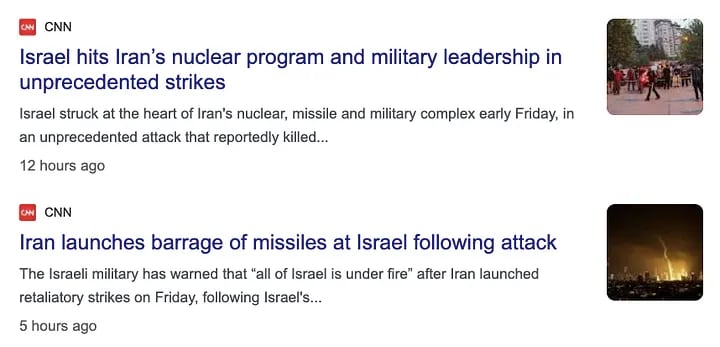
Headlines such as “Israel Strikes Iran” use active voice, portraying Israel as decisive and in control, implying precision and legitimacy.
Conversely, “Israel Hit by Iranian Missiles” employs passive construction, distancing Iran from agency and framing its actions as reactive or chaotic.
The active voice for Israel suggests strength and intent, while the passive voice for Iran can imply aggression without clear responsibility, subtly diminishing its legitimacy.
Adjective Bias
Who controls the vocabulary controls the conversation - Anonymous
Adjectives further skew perception. Israel's actions are described with terms like “precise,” “targeted,” or “defensive,” suggesting restraint and moral clarity. For example, a CNN report might describe an Israeli operation as a “strategic strike on Iranian military targets.”
In contrast, Iran's actions are labeled with adjectives like “provocative,” “hostile,” or “retaliatory.” These descriptors paint Iran as reckless or vengeful, while Israel appears calculated and justified.
Word choices tap into cultural biases, aligning Israel with Western values of order, and Iran framed in the perceived instability of the East.
Context Counts
“Political language… is designed to make lies sound truthful and murder respectable.” - George Orwell
Reports emphasize Israel's strikes as responses to “Iranian aggression” or “proxy threats” from groups like Hezbollah, providing context that justifies Israel's actions. A BBC headline might read, “Israel Targets Iran After Missile Threats,” implying a defensive necessity.
Iran's actions are often decontextualized, with less mention of prior Israeli operations or regional dynamics, as in “Iran Launches Attacks on Israel.” This selective framing obscures Iran's motivations, making its actions seem unprovoked.
Political Subtext
“Give a dog a bad name and hang him.” — Proverb
Western outlets, aligned with U.S. and Israeli interests, often portray Israel as a democratic ally under threat, using language that evokes sympathy.
Iran, labeled a “rogue state,” faces harsher descriptors that align with its adversarial status. Posts on X have noted this disparity, with some users arguing that Israel's actions are framed to “make Iran look like the villain,” even when both sides engage in similar military tactics.
Labeling
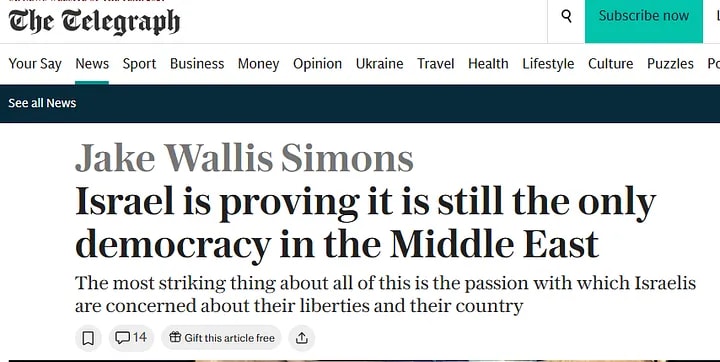
“Only Democracy in the Middle East”
Western media regularly labels Israel as “the only democracy in the Middle East,” a common media trope that emphasizes Israel's democratic governance to contrast it with regional adversaries like Iran.
Yet, the same news outlets print headlines of elections in other Middle Eastern countries.

“Rogue State”
Western politicians frequently call Iran a “rogue state”, framing Iran as a destabilizing force in the Middle East. This reflects a historical Western narrative of Iran, and many other eastern nations, as a threat to global order. Propaganda that the West is “civilized” and the East is chaotic and barbaric, dates back to Roman times.

Different Verbs and Adjectives for the Same Action
Below are the most common verbs and adjectives used in the Western media over the previous decade to describe similar actions taken by Israel, vs those conducted by Iran.
Conduct an Airstrike
- “Strike, Execute, Target” vs “Bombard, Unleash, Launch”
- “Targeted, Defensive, Precise” vs “Hostile, Aggressive, Provocative”
Respond to an Attack
- “Retaliate, Defend, Counter” vs “Retaliate, Escalate, Strike”
- “Measured, Restrained, Justified” vs “Reckless, Retaliatory, Destabilizing”
Develop Military Capabilities
- “Develop, Enhance, Fortify” vs “Pursue, Build, Stockpile”
- “Advanced, Innovative, Necessary” vs “Dangerous, Illicit, Threatening”
Engage in Regional Influence
- “Secure, Influence, Stabilize” vs “Interfere, Meddle, Expand”
- “Democratic, Allied, Resilient” vs “Rogue, Subversive, Menacing”
June 2025 Conflict
CNN's coverage of Israel and Iran's strikes this week demonstrates all of the techniques described above. Can you spot them?
Final Thoughts
The use of active voice, favorable adjectives, and selective context in news creates a narrative. While subtle, linguistic choices shape public opinion in the Israel-Iran conflict.
About the Creator
Scott Christenson🌴
Born and raised in Milwaukee WI, living in Hong Kong. Hoping to share some of my experiences w short story & non-fiction writing. Have a few shortlisted on Reedsy:
https://blog.reedsy.com/creative-writing-prompts/author/scott-christenson/
Keep reading
More stories from Scott Christenson🌴 and writers in The Swamp and other communities.
Trump Declares National Emergency to Tackle 5-Year-Old's Mexican Flag
WAUSAU, WI — President Donald Trump announced a full-scale invasion of Wisconsin Tuesday to apprehend a 5-year-old boy spotted riding a tricycle adorned with a Mexican flag. The operation, code-named “Operation Freedom Pedal,” mobilizes an elite team of US Marines to “secure the border state of Wisconsin from this clear and present danger.”
By Scott Christenson🌴10 months ago in The Swamp
Regarding the Image of God
This post will be a bit of a strange one. I wrote most of the following piece about six months ago, as certain governmental policies and actions were starting to roll out - and while reflecting upon certain ongoing atrocities. While these reflections revolve mostly around those claiming and practicing the Christian faith (and our failures to do so rightly) I do believe that they might be provide valuable insight - or at least something to think about - for folks of all perspectives who are willing to read them. So without further ado, here are a few of my recent reflections regarding the biblical concept of the 'image of God.'
By Gabriel Huizenga17 days ago in The Swamp
President Trump suggests Erika Kirk sue comedian Druski over viral ‘Conservative Women in America’ skit
Let’s crash out on Druski. This talented young man has caught the ire of the president of the United States of America. In a sketch online that has garnered close to 130 million views as of this writing, he has focused his comedic eye on conservative women in America without addressing anyone in particular.
By Skyler Saundersabout 7 hours ago in The Swamp




Comments (2)
All planned by the media to paint one in a more pleasing light of course.
Very nice. Language analysis as well as choice of images used is an excellent way to identify the clear bias and agenda the media usually claims to not have.