
Children’s Wear Market Set for Strong Growth Through 2034 as Fashion, Sustainability, and Digital Retail Reshape Demand
Rising incomes, evolving parenting preferences, and the influence of digital culture are transforming the global children’s apparel industry

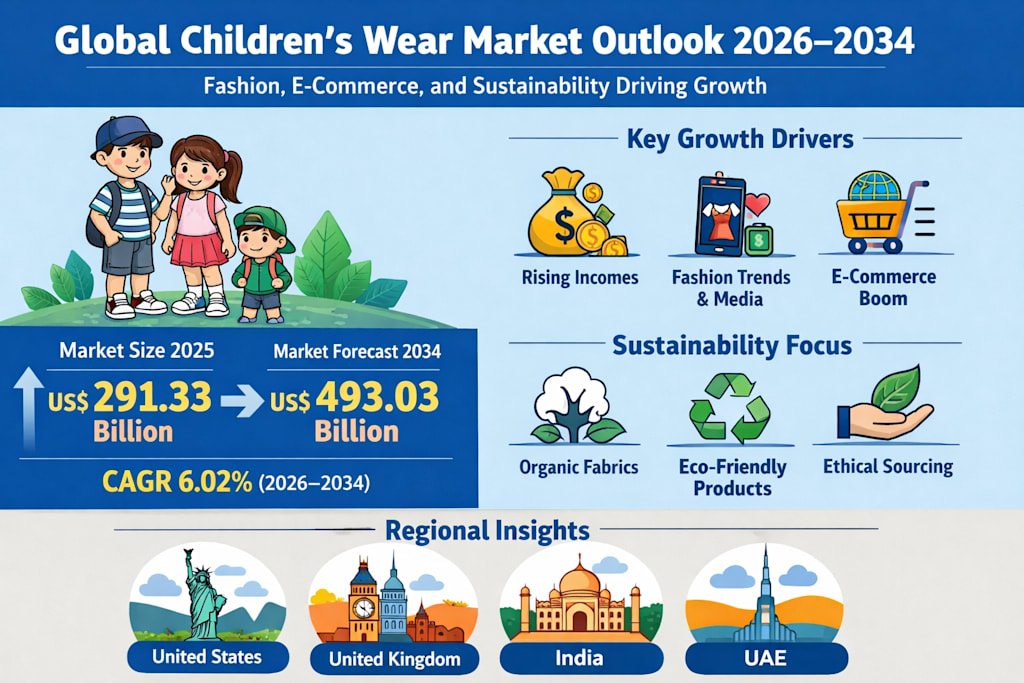
The global children’s wear market is entering a dynamic phase of expansion, driven by shifting consumer behavior, increasing disposable incomes, and the growing influence of fashion-conscious parenting. According to insights from Renub Research, the Children’s Wear Market is projected to grow from US$ 291.33 billion in 2025 to US$ 493.03 billion by 2034, registering a steady CAGR of 6.02% from 2026 to 2034.
This growth trajectory reflects more than just rising demand—it signals a transformation in how children’s clothing is designed, marketed, and consumed globally.
A Market Redefined by Modern Parenting
The children’s wear industry has evolved far beyond basic clothing necessities. Today’s parents are increasingly focused on comfort, safety, style, and sustainability, creating a highly competitive and innovation-driven marketplace.
Children’s apparel now spans a broad spectrum—from everyday essentials and school uniforms to occasion wear, sportswear, and seasonal collections. What makes this segment particularly unique is the dual influence of parents and children on purchasing decisions. While parents prioritize quality and durability, children are becoming more vocal about style, colors, and character-themed designs.
This dual demand dynamic is encouraging brands to strike a careful balance between functionality and fashion, making children’s wear one of the most adaptive segments in the global apparel industry.
Key Growth Drivers Powering the Market
1. Rising Disposable Income and Expanding Middle Class
One of the most significant factors fueling the children’s wear market is the steady rise in disposable income, particularly in emerging economies. As families earn more, spending on children’s apparel increases—not just in volume, but also in value.
Parents are increasingly willing to invest in:
Premium fabrics
Branded clothing
Occasion-specific outfits
Sustainable apparel
Urbanization and the rise of dual-income households have further amplified this trend. In regions like Asia-Pacific, the Middle East, and Latin America, a growing middle class is driving demand for both affordable and premium children’s wear segments.
2. Influence of Fashion Trends and Digital Media
The influence of fashion has extended deeply into the children’s wear segment. Social media platforms, celebrity culture, and digital marketing have transformed how parents shop for their children.
Trends shaping the market include:
“Mini-me” fashion collections inspired by adult styles
Character-themed clothing based on popular media franchises
Limited-edition collaborations and seasonal launches
Children themselves are becoming more style-conscious, often influenced by digital content and peer trends. This has created a continuous demand cycle, where new collections and designs are introduced frequently to keep up with evolving tastes.
3. Rapid Expansion of E-Commerce and Omnichannel Retail
E-commerce has emerged as a game-changer for the children’s wear market. Busy parents increasingly prefer online platforms for their convenience, variety, and competitive pricing.
Key advantages of online retail include:
Access to a wider range of brands and styles
Detailed size guides and customer reviews
Easy return and exchange policies
Home delivery convenience
At the same time, omnichannel retail strategies—combining online and offline experiences—are enhancing customer engagement. Parents can browse online and finalize purchases in-store, improving confidence in fit and quality.
The rise of mobile commerce and social shopping has further accelerated market penetration, particularly in urban and semi-urban regions.
Sustainability: A Growing Priority
Sustainability is no longer a niche trend—it is becoming a central pillar of the children’s wear industry.
Parents are increasingly opting for:
Organic cotton and natural fabrics
Non-toxic dyes and safe materials
Ethically sourced and eco-friendly products
This shift is particularly prominent in developed markets, where awareness of environmental and health concerns is high. However, emerging markets are also catching up, driven by global exposure and changing consumer values.
Brands are responding by:
Adopting sustainable sourcing practices
Introducing recyclable packaging
Promoting transparency in production
Sustainability is not just a moral choice—it is rapidly becoming a competitive differentiator in the children’s wear market.
Challenges Facing the Industry
1. Rapid Fashion Cycles and Inventory Complexity
The fast-paced nature of fashion presents a significant challenge for children’s wear retailers. Trends change quickly, and managing inventory across multiple sizes, styles, and age groups can be complex.
Key issues include:
Overstocking and markdown losses
Stockouts and missed sales opportunities
High SKU management complexity
Additionally, children outgrow clothing quickly, increasing the pressure on retailers to maintain fast inventory turnover.
To address these challenges, companies are investing in:
Advanced analytics
Real-time inventory tracking
Agile supply chain systems
2. Price Sensitivity and Intense Competition
Despite growing demand for premium products, price sensitivity remains a major challenge—especially in emerging markets.
The market is highly competitive, with players ranging from:
Global brands
Fast fashion retailers
Local manufacturers
Private labels
Online platforms have increased price transparency, making it easier for consumers to compare options and seek value for money.
Retailers must balance:
Affordability
Quality
Brand differentiation
Excessive discounting may drive sales in the short term, but it can also erode margins and brand value over time.
Regional Insights: Growth Patterns Across Markets
United States
The U.S. children’s wear market remains mature yet dynamic, driven by high consumer spending and strong demand for branded apparel. Trends such as mini-me fashion, sustainability, and e-commerce adoption continue to shape the market.
United Kingdom
In the UK, the focus is on quality, durability, and eco-friendly clothing. Parents increasingly prefer premium and organic options, while e-commerce plays a central role in retail growth.
India
India represents one of the fastest-growing markets globally, fueled by:
A large young population
Rising disposable incomes
Rapid urbanization
E-commerce platforms have significantly expanded market access, while affordability remains a key factor influencing purchasing decisions.
United Arab Emirates
The UAE market is characterized by:
High demand for premium and branded apparel
A cosmopolitan consumer base
Strong retail infrastructure
Both online and offline channels are thriving, supported by high urbanization and digital adoption.
Innovation and Recent Developments
The children’s wear market is witnessing continuous innovation, with companies introducing new concepts and technologies to stay competitive.
Recent highlights include:
Advanced footwear designs with adjustable sizing technology
Comfortable yet stylish apparel blending loungewear and formal aesthetics
Unisex collections emphasizing durability and versatility
Character-inspired collaborations that appeal to younger audiences
These developments reflect a broader trend toward functional innovation combined with aesthetic appeal, ensuring products meet both parental expectations and children’s preferences.
Competitive Landscape
The market features a mix of global giants and regional players, including companies such as:
Adidas AG
NIKE, Inc.
Gap Inc.
Levi Strauss & Co.
Benetton Group
These companies are investing heavily in:
Product innovation
Digital marketing
Sustainability initiatives
Omnichannel retail strategies
The competitive environment is pushing brands to continuously evolve, ensuring relevance in a fast-changing market.
Market Segmentation Overview
The children’s wear market can be segmented across several dimensions:
By Product Category:
Apparel
Footwear
Others
By Consumer Group:
Infant (0–12 months)
Toddler (1–3 years)
Preschool (3–5 years)
Gradeschooler (5–12 years)
By Distribution Channel:
Offline retail
Online platforms
This segmentation allows brands to target specific consumer needs and develop tailored product offerings.
The Road Ahead
The future of the children’s wear market lies at the intersection of fashion, technology, and sustainability. As consumer expectations continue to evolve, brands must adapt to:
Increasing demand for eco-friendly products
Rapid digital transformation
Personalized shopping experiences
Shorter product life cycles
Emerging technologies such as AI-driven recommendations, virtual fitting tools, and data analytics are expected to play a key role in shaping the next phase of growth.
Final Thoughts
The global children’s wear market is no longer just about clothing—it is about identity, comfort, and conscious consumption. With a projected value of nearly half a trillion dollars by 2034, the industry is poised for sustained growth.
Driven by rising incomes, digital influence, and a growing emphasis on sustainability, the market offers significant opportunities for innovation and expansion. However, success will depend on how effectively brands can navigate challenges such as price sensitivity, inventory management, and rapidly changing trends.
In a world where even the youngest consumers are becoming style-aware, the children’s wear market stands as a powerful reflection of broader societal shifts—where fashion meets function, and tradition blends with modernity.
For publishers: This article is structured for high readability, SEO alignment, and audience engagement—ideal for Vocal and editorial platforms.
About the Creator
RFID Market Set for Strong Growth as Retail, Logistics, and Smart Security Accelerate Worldwide
The way businesses track products, manage inventory, secure facilities, and optimize operations is changing fast—and RFID (Radio Frequency Identification) is at the center of that transformation.
By shibansh kumarabout 6 hours ago in Trader
Biontech Stock Trends: What Investors Should Watch in 2026
Biontech stock is drawing attention as UK investors look for opportunities in the healthcare sector. Understanding how biontech stock moves, its growth potential, and key influences can help you make informed decisions. They will explore the trends and factors that matter most for investors considering biontech stock. For more guidance on smart investment choices, check our article on how to start investing in stocks.
By hamza mirza5 days ago in Trader



Comments
There are no comments for this story
Be the first to respond and start the conversation.