
Digital Camera Market in Focus: Why Creators, Professionals, and Tech Innovation Are Powering a New Growth Cycle
From mirrorless breakthroughs to the booming creator economy, the global digital camera industry is evolving beyond casual photography and into a high-value visual technology market.

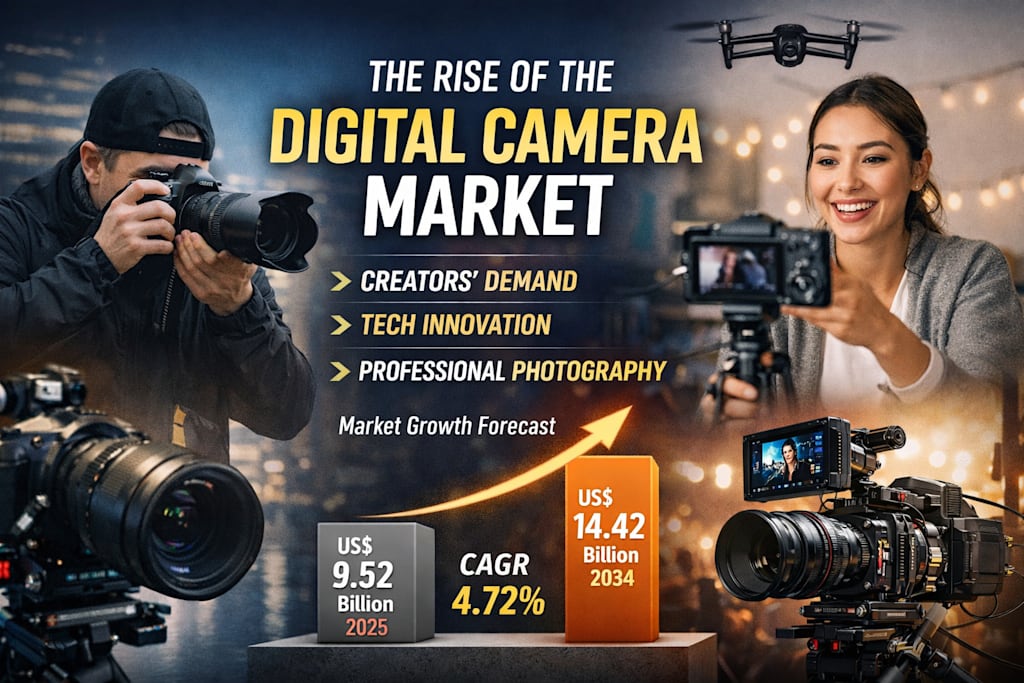
In an age where almost everyone carries a camera in their pocket, it would be easy to assume that dedicated digital cameras are losing relevance. Smartphones have become smarter, faster, and increasingly capable of producing high-quality images. Yet the global digital camera market is not disappearing. In fact, it is entering a new phase—one shaped by creators, professionals, advanced imaging needs, and continuous innovation.
According to Renub Research, the Digital Camera Market is expected to grow from US$ 9.52 billion in 2025 to US$ 14.42 billion by 2034, expanding at a CAGR of 4.72% from 2026 to 2034. That projection reflects a market that is no longer driven primarily by casual users, but by people and industries that need more than what a smartphone can offer.
The modern digital camera is no longer just a photography tool. It is a creative production device, a storytelling instrument, and for many professionals, a business asset.
Why Digital Cameras Still Matter
A digital camera records photos and videos electronically instead of using film. At its core, it combines a lens, sensor, processor, and display system to capture and store visual content instantly. But what makes the category so relevant today is the range of performance it offers.
From simple compact cameras to high-end DSLRs and mirrorless systems, the market serves everyone from beginners to filmmakers, journalists, travel creators, product photographers, and event professionals. Features such as high-resolution sensors, optical zoom, image stabilization, wireless sharing, and advanced video recording have turned digital cameras into highly specialized tools for modern content production.
In a digital-first economy, image quality matters more than ever. Whether someone is building a personal brand, selling products online, producing YouTube content, or shooting commercial campaigns, visual clarity and control can directly affect results. That is where digital cameras continue to outperform phones.
The Creator Economy Is Reshaping Demand
One of the strongest forces behind this market is the explosion of the creator economy. Social media platforms such as Instagram, TikTok, YouTube, and Twitch have transformed visual storytelling into a career path and a marketing necessity.
Content creators, vloggers, influencers, educators, and livestreamers need equipment that can deliver sharp image quality, cinematic video, fast autofocus, and reliable performance in different lighting conditions. Smartphones are useful, but for those who want polished and professional content, digital cameras often remain the better option.
This shift is particularly important because it broadens the customer base beyond traditional photographers. A decade ago, camera brands mostly targeted hobbyists and professionals. Today, they are also targeting creators who may have entered the visual world through social media rather than photography school.
That has changed product design as well. Manufacturers are building cameras with features specifically meant for creators, such as flip screens, better microphones, wireless transfer, vertical video support, and improved stabilization for handheld shooting.
Technology Is Doing the Heavy Lifting
The digital camera market is also benefiting from rapid technological advancement. Cameras are becoming lighter, smarter, and more powerful, making them easier to use without sacrificing performance.
Mirrorless cameras, in particular, have become a major growth engine. Their compact size, fast autofocus, silent shooting, and strong video capabilities have made them highly attractive to both enthusiasts and professionals. Full-frame sensors, advanced processors, low-light optimization, and AI-assisted shooting are pushing the category forward.
Video has become especially important. In today’s market, a camera is expected to do much more than take still photos. Consumers increasingly want 4K and 8K video recording, high frame rates, cinematic depth, and professional color output. This is why modern digital cameras are being positioned as hybrid devices—equally useful for photography and videography.
A strong example of this trend came in July 2024, when Canon unveiled the EOS R1 and EOS R5 Mark II full-frame mirrorless cameras, demonstrating major advances in sensor performance, autofocus, and video capabilities. Product launches like these are not just upgrades—they are signals that competition in premium imaging is intensifying.
Professional Photography Is Still a Powerful Growth Driver
Despite the rise of everyday content creation, the professional segment remains one of the most important pillars of the digital camera market.
Photographers and videographers working in fashion, weddings, media, journalism, advertising, corporate branding, tourism, filmmaking, and e-commerce still depend on dedicated cameras for the precision and consistency they need. These are environments where lens flexibility, image depth, low-light capability, and dynamic range truly matter.
For example, product photography for online retail requires detail and color accuracy. Event coverage needs speed and reliability. Film and video work demand frame control, focus precision, and advanced image settings. These are not always areas where smartphone cameras can fully compete.
Photography education and workshops are also helping sustain demand. As more people enter photography as a skill, hobby, or side business, many eventually move from smartphones to entry-level or mid-range camera systems.
The Smartphone Challenge Is Real
Still, the digital camera industry faces undeniable pressure from smartphones.
Today’s premium phones offer high-resolution sensors, AI-enhanced photography, multiple lenses, optical stabilization, and even 4K/8K video capture. For casual users, that is often more than enough. As a result, the most vulnerable segment in the camera market has been compact and entry-level devices.
This is perhaps the biggest structural challenge facing camera brands. They are no longer competing only against each other. They are competing against a device that consumers already own, carry everywhere, and use for far more than photography.
That means camera manufacturers must justify why a separate device is worth buying. The answer increasingly lies in specialization: better optics, interchangeable lenses, manual control, larger sensors, superior low-light performance, professional-grade video, and long-term creative flexibility.
In short, the future of the market is not about replacing smartphones. It is about serving users who have outgrown them.
Price Remains a Major Barrier
Another challenge is affordability.
Advanced digital cameras—especially DSLRs, full-frame mirrorless models, and professional-grade systems—can be expensive. And the camera body is often only the beginning. Buyers may also need lenses, tripods, lighting, batteries, storage cards, and editing software. That creates a much higher total cost of ownership.
For professionals, this is often a justified investment. But for beginners or budget-conscious users, the cost can be a serious obstacle. Economic uncertainty, regional import duties, and uneven pricing across markets can make the situation worse.
This is why value positioning will remain important. Brands that can balance innovation with accessibility may be better placed to capture emerging demand.
A Global Market with Different Regional Stories
The digital camera market is not growing for the same reason everywhere. Different countries are being shaped by different usage patterns, economic conditions, and consumer behaviors.
United States
The United States remains a mature but active market, supported by high consumer spending, a strong creator economy, and professional media demand. Mirrorless and DSLR adoption is high among photographers, influencers, vloggers, and independent filmmakers. The country also benefits from strong retail and e-commerce networks, which make new camera technologies widely accessible.
Germany
Germany’s market is supported by a strong photography culture and a consumer base that values optical quality, durability, and technical performance. Hobbyists and professionals continue to invest in advanced systems, while workshops and creative communities help sustain interest. However, as in many developed markets, entry-level growth is limited by smartphone competition.
China
China is one of the most dynamic growth markets in the category. Rising disposable incomes, a massive social media ecosystem, and strong demand for live streaming, vlogging, and e-commerce photography are driving adoption. Platforms such as Douyin, Bilibili, and Weibo are helping create a generation of users who need better visual tools. The presence of both domestic and international brands adds further momentum.
Saudi Arabia
Saudi Arabia is emerging as a promising market thanks to rising disposable income, tourism growth, event coverage, and increasing social media participation. Demand is expanding not only among creators but also in real estate marketing and professional photography services. This reflects how digital cameras are increasingly being adopted as practical business tools rather than luxury gadgets.
Recent Industry Developments Show the Market’s Direction
Recent developments suggest that manufacturers are focused on innovation, efficiency, and premium positioning.
In July 2025, Canon celebrated the 20th anniversary of its EOS 5 series, highlighting AI-powered upgrades in the EOS R5 Mark II, reinforcing the growing importance of intelligent imaging features. In April 2025, the company also introduced more automated manufacturing processes for cameras and lenses, aimed at improving efficiency and production quality.
Meanwhile, January 2025 data from CIPA showed that global compact camera shipments rose 11% year-over-year to 124,085 units, with China recording a remarkable 213% increase. That is a notable signal that even categories once thought to be declining may still have room for revival when supported by the right consumer trends.
Other launches also underline the market’s premium evolution. Leica’s D-Lux 8, introduced in July 2024, focused on refined design and usability, while Nikon’s NIKKOR Z 35mm f/1.4 lens, launched in June 2024, catered directly to professionals seeking optical performance.
These developments suggest a market increasingly centered around experience, workflow, and professional output rather than simple image capture.
Where the Market Is Headed Next
The next phase of the digital camera market will likely be defined by three major themes: creator-led demand, professional specialization, and intelligent imaging technology.
Cameras are becoming more connected, more portable, and more adaptive to modern visual needs. At the same time, the market is becoming more segmented. Casual users may remain with smartphones, but serious creators and professionals are expected to continue investing in higher-performance systems.
That makes this an industry of depth rather than mass. The biggest opportunity is not necessarily in selling a camera to everyone. It is in serving the users who need the best possible image, the most flexibility, and the most reliable performance.
And in a world increasingly driven by visuals, that audience is still growing.
Final Thoughts
The digital camera market is proving that relevance is not about ubiquity—it is about value.
Smartphones may dominate casual photography, but they have also helped create a culture that values images and video more than ever before. That cultural shift is now feeding demand for more advanced tools. Whether it is a vlogger building a channel, a brand producing commercial content, or a professional photographer capturing moments that matter, dedicated digital cameras continue to hold an important place.
With Renub Research projecting the market to reach US$ 14.42 billion by 2034, the industry appears well positioned for steady expansion. The future may look different from the camera market of the past, but it is far from fading. If anything, it is becoming more focused, more creative, and more essential to the way modern stories are told.
About the Creator
Keep reading
More stories from shibansh kumar and writers in Trader and other communities.
Why Sour Cream Powder Is Quietly Becoming a Big Business in the Global Food Industry
The global food industry is constantly evolving, but sometimes the biggest opportunities come from the smallest ingredients. Sour cream powder may not be the first product that comes to mind when people think about fast-growing food categories, yet it is quietly becoming one of the most useful dairy-based ingredients in processed foods, snack seasonings, bakery mixes, and ready-to-eat meal solutions.
By shibansh kumarabout 6 hours ago in Trader
Adult Diaper Market Trends 2034: Growth Drivers, Innovation, and Expanding Global Demand
Overview Adult Diaper Market The adult diaper market has transitioned from being a niche healthcare segment to a widely recognized personal care category. Increasing life expectancy and the growing prevalence of age-related health conditions such as urinary incontinence are major factors contributing to market expansion. In addition, the stigma traditionally associated with adult diaper usage is gradually diminishing, encouraging more consumers to adopt these products confidently.
By James Smith7 days ago in Trader




Comments
There are no comments for this story
Be the first to respond and start the conversation.