
Why the Oleochemicals Market Is Quietly Reshaping the Future of Sustainable Industry
From personal care to pharmaceuticals, oleochemicals are emerging as one of the most important bio-based alternatives in a world moving beyond petrochemicals.

The Rise of a Cleaner Chemical Economy
Not all industrial revolutions happen loudly.
Some begin in factories, laboratories, and product formulation rooms—far from public attention, but powerful enough to reshape global supply chains. That is exactly what is happening with oleochemicals, a category of naturally derived chemicals that is becoming increasingly central to the future of sustainable manufacturing.
While the average consumer may not recognize the term immediately, oleochemicals are already embedded in daily life. They appear in soaps, lotions, detergents, food additives, lubricants, pharmaceutical ingredients, and even eco-friendly plastics. What makes them especially important today is not just their versatility, but the fact that they are derived from renewable feedstocks such as vegetable oils, animal fats, and algae.
In an era where industries are under mounting pressure to reduce carbon emissions and move away from fossil-based raw materials, oleochemicals have gone from being a niche alternative to becoming a strategic industrial priority.
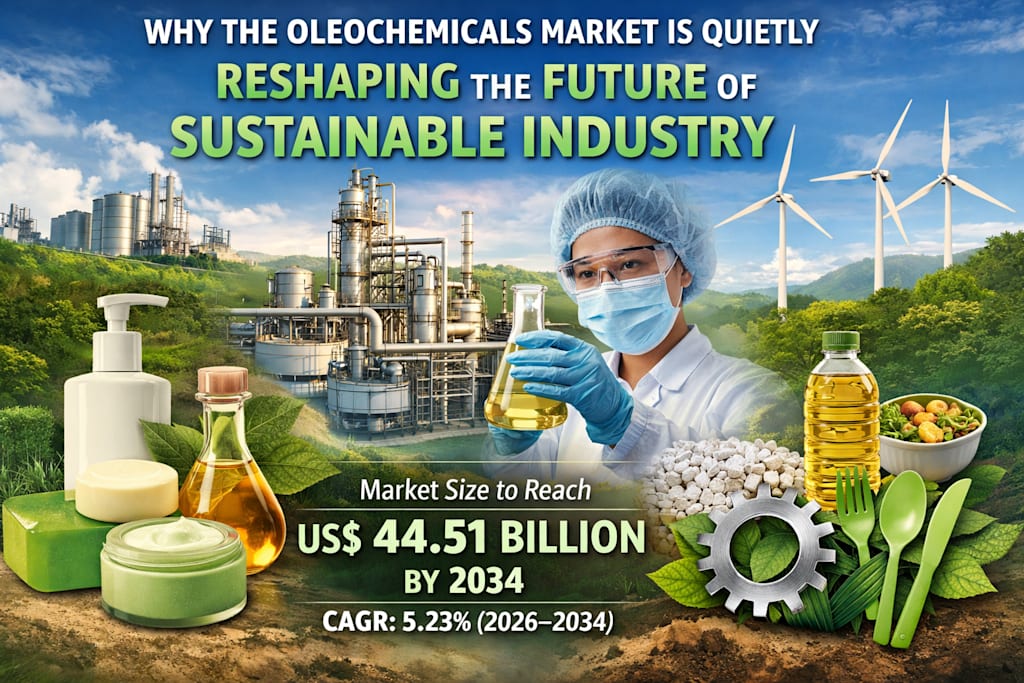
According to Renub Research, the Oleochemicals Market is expected to reach US$ 44.51 billion by 2034, up from US$ 28.13 billion in 2025, expanding at a CAGR of 5.23% from 2026 to 2034. That forecast alone signals a broader shift in how industries are thinking about performance, sustainability, and long-term resource security.
What Exactly Are Oleochemicals?
At their core, oleochemicals are chemical compounds produced from natural fats and oils. They are widely considered a more sustainable alternative to petrochemicals because they are biodegradable, less toxic, and renewable.
The most common categories include:
Fatty acids
Fatty alcohols
Glycerol
Esters
Soap noodles
Fatty amines
Fatty acid methyl esters
These ingredients serve as foundational building blocks across multiple industries. In personal care, they help improve texture and moisturization. In industrial applications, they are used in lubricants and surfactants. In food and pharmaceuticals, they support product stability, functionality, and formulation efficiency.
That wide utility is one reason the market continues to gain momentum. Another is simple: global industry is looking for cleaner chemistry.
Why the Market Is Growing Now
The growth of the oleochemicals market is not happening in isolation. It sits at the intersection of several large, long-term trends.
1. Sustainability Is No Longer Optional
Manufacturers across sectors are being pushed to reduce their environmental impact. Regulatory pressure, investor expectations, and consumer demand are all pointing in the same direction: less dependence on petroleum and more use of renewable materials.
Oleochemicals fit neatly into that transition because they offer both functional performance and environmental credibility.
2. Consumers Want “Natural” Ingredients
This is especially visible in personal care and cosmetics, where product labels matter more than ever. Consumers increasingly seek formulations that feel safer, cleaner, and more plant-based. Oleochemical derivatives like glycerin, esters, and fatty alcohols are therefore gaining preference in skincare, soaps, shampoos, and makeup.
3. Technology Is Making Production Better
New production technologies are helping manufacturers improve yields, lower waste, and produce higher-purity ingredients. That makes oleochemicals more competitive in industries where quality and cost efficiency are both essential.
4. Applications Are Expanding
What was once concentrated in soaps and detergents is now spreading into:
Food processing
Pharmaceuticals
Industrial lubricants
Polymer additives
Paints and inks
Green surfactants
Textiles
That diversification is giving the market resilience and broader commercial appeal.
The Personal Care Industry Is a Major Growth Engine
Among all end-use industries, personal care and cosmetics stand out as one of the strongest growth drivers for oleochemicals.
This makes perfect sense. Beauty and skincare brands today are not just selling performance—they are selling ingredient trust. Consumers want moisturizing, gentle, and skin-friendly components, especially in products designed for daily use.
Oleochemical ingredients are widely used in:
Creams and lotions
Soaps and cleansers
Foundations and lipsticks
Hair care products
Emollients and surfactants
Glycerin, in particular, remains one of the most recognizable and trusted ingredients in skincare. Its moisture-retaining properties make it a staple in soaps and moisturizers, and it aligns well with the broader clean beauty movement.
As more brands position themselves around “natural,” “plant-based,” and “sensitive skin-friendly” messaging, oleochemical demand in personal care is likely to remain strong for years to come.
Innovation Is Pushing the Industry Forward
A market can only scale sustainably if the production side evolves too—and that is exactly what is happening.
Oleochemical manufacturers are increasingly investing in:
Advanced processing technologies
Cleaner production systems
Digital manufacturing tools
R&D for specialty derivatives
Fermentation and biomass conversion
These innovations matter because buyers today are not only looking for sustainable ingredients—they also want consistent quality, reliable supply, and cost competitiveness.
This is where newer production methods are changing the game. More efficient refining and conversion technologies are helping companies improve profitability while also meeting increasingly strict purity requirements for sectors such as healthcare and food.
In short, oleochemicals are becoming not just greener—but smarter and more commercially viable.
Governments Are Also Fueling the Shift
One of the most important but often overlooked drivers of the oleochemicals market is policy support.
Around the world, governments are rolling out initiatives that support bio-based chemicals, renewable feedstocks, and low-carbon industrial development. This includes:
Sustainability incentives
Research and development grants
Carbon reduction programs
Bioeconomy policies
Agricultural support for oilseed production
These policies matter because they reduce the financial and operational barriers involved in transitioning away from petroleum-based inputs.
For example, countries that support edible oil or oilseed production can indirectly strengthen the oleochemicals value chain by improving feedstock availability. Likewise, funding for green chemistry and industrial decarbonization helps accelerate commercialization.
This policy tailwind is especially important in emerging economies, where industrial growth and sustainability goals are increasingly advancing together rather than separately.
But the Industry Still Faces Real Challenges
Despite its strong outlook, the oleochemicals market is not without obstacles.
Raw Material Price Volatility
One of the biggest concerns is the unstable pricing of core feedstocks such as:
Palm oil
Coconut oil
Animal fats
Other vegetable oils
These materials are influenced by climate conditions, crop yields, trade disruptions, geopolitical tensions, and environmental regulations. If prices spike, oleochemical manufacturers can face margin pressure and difficulty maintaining stable pricing for customers.
This is not a small issue. In commodity-sensitive industries, raw material cost swings can significantly affect long-term planning and competitiveness.
Competition from Petrochemicals
Petrochemical alternatives still remain deeply entrenched in many industrial applications. They are often cheaper, easier to source, and backed by long-established supply chains.
That means oleochemicals must do more than just claim environmental benefits—they must also prove themselves in terms of performance, scale, and economics.
In some industries, the switch to bio-based inputs also requires reformulation, testing, and certification. That adds cost and slows adoption, particularly among manufacturers focused heavily on short-term cost efficiency.
So while the long-term direction is clear, the transition is still uneven.
Regional Momentum Is Shaping the Global Market
The oleochemicals opportunity is global, but different countries are contributing in different ways.
United States
The U.S. remains a strong and mature market, supported by demand from personal care, food processing, industrial lubricants, and clean-label product categories. Sustainability initiatives and bio-refinery innovation continue to strengthen domestic adoption.
Germany
Germany stands out as one of Europe’s most advanced oleochemicals markets. Its strong environmental standards, manufacturing sophistication, and consumer preference for natural products create favorable conditions for bio-based chemical growth.
China
China is one of the fastest-growing markets due to industrial expansion, strong consumer demand, and increasing regulatory support for green chemistry. Its large-scale manufacturing ecosystem also strengthens production competitiveness.
Saudi Arabia
Saudi Arabia’s market is growing as part of its broader economic diversification strategy. With industrial expansion under Vision 2030 and rising demand from personal care and specialty chemicals, the country is increasingly investing in sustainable alternatives beyond petroleum.
This regional spread matters because it shows oleochemicals are not tied to one niche geography—they are becoming part of a much wider industrial transformation.
Recent Industry Developments Signal Confidence
Another strong sign of market maturity is the number of strategic moves being made by industry participants.
Recent developments in the oleochemicals ecosystem include:
Distribution partnerships to expand reach in food and beverage applications
Capacity expansions for mild surfactants and specialty ingredients
National initiatives to strengthen oilseed production
Industry lobbying to protect domestic oleochemical manufacturing
New futures-linked pricing mechanisms for oil-related feedstocks
Major manufacturing investment commitments to expand production capacity
These developments indicate that market players are not waiting on the sidelines. They are actively preparing for stronger long-term demand.
That matters because a market forecast becomes more credible when it is supported by real capital movement, supply chain development, and strategic expansion.
Why This Market Matters More Than It Seems
The oleochemicals market is about much more than one industrial segment.
It represents a deeper structural shift in the way modern economies are built. For decades, industrial chemistry has been closely tied to fossil-derived raw materials. But as environmental pressure increases and renewable feedstocks become more commercially viable, the chemical industry is gradually being rewritten.
Oleochemicals sit right in the middle of that rewrite.
They are not a futuristic experiment. They are already in use, already scaling, and already shaping how products are formulated across industries that touch millions of lives every day.
That includes:
The soap in a bathroom
The moisturizer on a shelf
The surfactant in a detergent
The additive in a food product
The lubricant in industrial machinery
When a material can move across so many sectors while aligning with sustainability goals, it becomes more than a trend. It becomes infrastructure.
Final Thoughts
The global oleochemicals market may not dominate headlines the way electric vehicles, AI, or renewable energy do—but it deserves attention for a very simple reason: it is helping make the industrial world cleaner from the inside out.
With rising demand for biodegradable, plant-based, and performance-driven materials, oleochemicals are steadily becoming a preferred solution across personal care, pharmaceuticals, food processing, and industrial manufacturing.
About the Creator
Keep reading
More stories from shibansh kumar and writers in Trader and other communities.
AI in Education Is Reshaping Classrooms, Careers, and the Future of Learning
Education is no longer confined to chalkboards, lecture halls, and one-size-fits-all teaching methods. A major transformation is underway, and artificial intelligence is at the center of it.
By shibansh kumarabout 4 hours ago in Trader
When The Story Pivots and Changes
My writing journey has been a bit of a roller coaster. I don't have any accolades to claim, though if I actually attempted to get serious about writing contests and submitting my work, I could change that. After I finished my rewrite and recording of the audiobook of "Memoirs of the In-Between" I decided that I needed to decide what to do next.
By Hope Martin7 days ago in Writers




Comments
There are no comments for this story
Be the first to respond and start the conversation.