
Why the School Bags Market Is Growing Faster Than You Think
From ergonomic backpacks to laptop-ready designs, the global school bags market is evolving into a much bigger story than just back-to-school shopping.

Every school year begins with a familiar ritual: parents checking supply lists, students choosing notebooks, and one purchase that always seems to matter more than expected—the school bag.
It may look like a simple product, but the global school bags market is turning into a surprisingly dynamic industry. It sits at the intersection of education, parenting, child health, fashion, technology, and retail. What used to be a basic utility item has become a lifestyle and necessity product shaped by design, durability, ergonomics, and even sustainability.
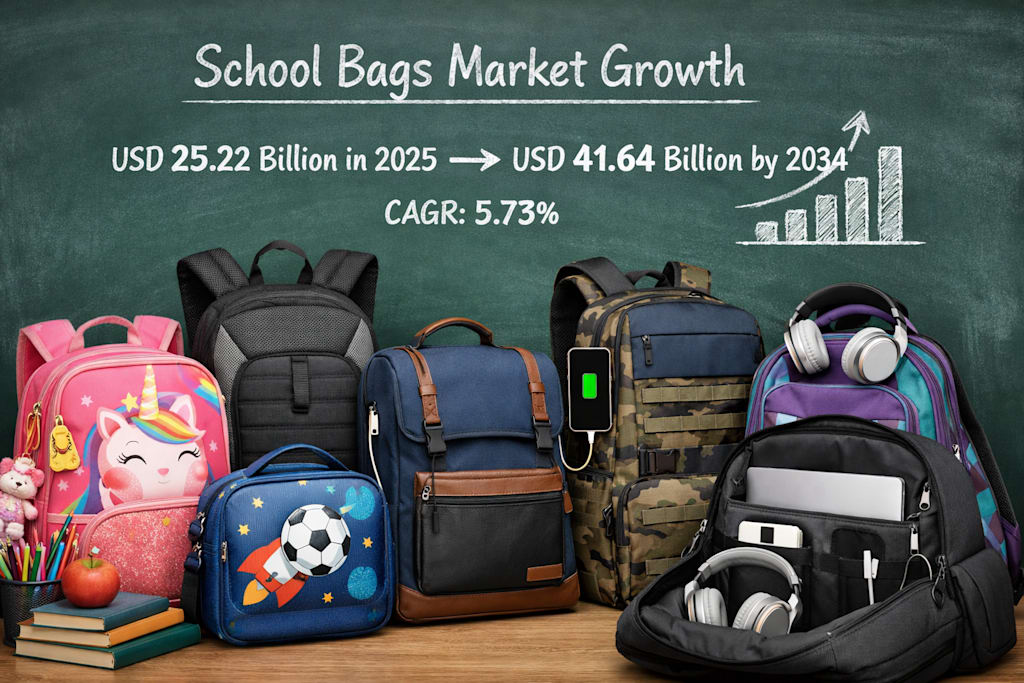
According to market data provided by Renub Research, the School Bags Market is expected to rise from USD 25.22 billion in 2025 to USD 41.64 billion by 2034, expanding at a CAGR of 5.73% from 2026 to 2034 . That is not minor growth for a category many still consider “seasonal.” It signals a market with strong long-term fundamentals and changing consumer expectations.
What is driving that growth? The answer is broader than many realize.
School Bags Are No Longer Just School Bags
For years, the school bag was treated as a standard back-to-school item. Buy one, use it for the year, replace it if necessary. But today’s school bag has to do far more than carry books.
Students now carry notebooks, lunch boxes, stationery, water bottles, tablets, laptops, chargers, sportswear, and in many cases, personal accessories and digital devices. That means the bag itself has become an everyday support system for school life.
Modern school bags are expected to be:
Lightweight
Comfortable to carry
Spacious and organized
Stylish and age-appropriate
Durable enough for daily use
Safe for posture and back health
That shift in expectations is helping move the category from commodity status into a more premium, innovation-driven segment.
The Biggest Growth Driver: More Students, More Spending
One of the clearest reasons the market is growing is simple: there are more students in education systems across the world.
As access to education expands in developing economies and enrollment remains strong in mature markets, the number of school-going children continues to rise. Every one of those students needs a bag. That creates a stable and recurring base of demand year after year .
But the growth story is not only about volume. It is also about value.
Families are increasingly willing to spend more on better-quality school bags. Parents are paying closer attention to material quality, comfort, storage design, and product longevity. In many households, the bag is no longer seen as a low-priority item. It is viewed as an investment in convenience, comfort, and even health.
That is especially true in urban and middle-income households, where school bags are now chosen with the same level of care once reserved for shoes or school uniforms.
Ergonomics Is Reshaping the Market
Perhaps the most important change in the school bags industry is the growing awareness around ergonomics.
Parents, schools, and health professionals have become more vocal about the effects of poorly designed school bags on children’s posture and physical development. Heavy loads, thin straps, poor weight distribution, and low back support can create discomfort and long-term issues, especially for younger students .
This has pushed manufacturers to redesign school bags around comfort and function. Features that were once seen as premium are quickly becoming standard, including:
Padded shoulder straps
Cushioned back panels
Weight-balancing compartments
Lightweight materials
Better airflow and ventilation
Structured support systems
This is a major reason the industry is becoming more sophisticated. A bag is no longer purchased only for appearance or storage capacity. Increasingly, it is being judged by how well it supports a child’s daily routine.
That makes ergonomic design one of the strongest long-term opportunities in the market.
Style Still Sells—Especially Among Students
Of course, functionality is only part of the story.
Children and teenagers do not choose school bags based on orthopedic design alone. Style matters, and it matters a lot.
School bags have become an extension of personality, identity, and social expression. Students want bags that reflect what they like, whether that means bold colors, sleek minimalist designs, licensed characters, sports branding, or trend-driven fashion elements.
That is why the market is seeing strong demand for products that combine fashion and function.
Brands that can deliver both are positioned well. A school bag that looks good but feels uncomfortable will disappoint parents. A bag that is highly ergonomic but visually dull may fail to attract students. The winning products are the ones that manage both.
This is also why innovation is becoming more visible in the category. School bags now come with features such as:
Water-resistant fabrics
Anti-theft compartments
Laptop sleeves
USB charging ports
Hidden pockets
Multi-use storage layouts
As students become more digitally connected and style-conscious, this blend of design and utility will likely remain central to market growth.
Material Choice Matters More Than Ever
Material is another important factor shaping the school bags market.
Nylon Leads for Practical Reasons
Nylon school bags remain highly popular because they are lightweight, durable, resistant to tearing, and relatively water-resistant. For parents looking for everyday reliability without high maintenance, nylon is often the default choice .
It also gives manufacturers flexibility in terms of design, color variety, and ergonomic construction, making it ideal for mass-market and mid-range products.
Leather Serves a More Premium Segment
Leather school bags, including faux leather options, appeal to consumers who value appearance, structure, and a more polished look. These are often more popular among older students or style-conscious buyers who see the bag as part of a fashion statement rather than just a utility item .
While leather remains a smaller segment compared with nylon or polyester, it holds value in premium and design-oriented niches.
Technology in Education Is Creating New Demand
One of the most interesting growth areas in the school bags market is the rise of laptop school bags.
As schools and colleges increasingly integrate digital learning tools, students are carrying more electronic devices than ever before. That has created strong demand for bags with padded laptop compartments, shock protection, cable organizers, and secure storage systems .
This trend is especially strong among:
High school students
College and university learners
Urban school systems
Private institutions
Tech-integrated classrooms
The school bag is adapting to a world where textbooks and tablets now travel together. That makes laptop-compatible designs one of the strongest subcategories to watch in the years ahead.
Different Age Groups, Different Opportunities
The school bags market is not one-size-fits-all. Different age groups create different product needs, and that gives brands room to specialize.
Preschool Bags
Preschool bags focus on size, safety, bright visuals, and easy handling. Parents want something lightweight, durable, washable, and fun for young children. Cartoon themes and colorful designs remain especially strong here .
High School Bags
At the other end of the spectrum, high school bags require larger carrying capacity, stronger construction, better organization, and more mature styling. Students in this category often carry books, electronics, and sports items, making functionality critical .
The contrast between these age groups shows why segmentation matters so much. The market is broad, but demand is highly specific.
Where Consumers Buy Is Also Changing
The way school bags are sold is evolving quickly.
Supermarkets Still Matter
Supermarkets remain important because they offer convenience, affordability, and strong visibility during the back-to-school season. Many families prefer buying school bags while also purchasing stationery, lunch supplies, and uniforms in one trip .
This channel is especially powerful in price-sensitive markets and among mass consumers.
Online Retail Is Growing Fast
At the same time, online retail is becoming one of the strongest growth channels in the market.
Why? Because online shopping makes it easy to compare:
Prices
Features
Designs
Reviews
Brand options
It also gives consumers access to a wider range of products than local stores can usually offer. For students and parents looking for specific styles, licensed themes, premium brands, or laptop-friendly designs, e-commerce has become a natural choice .
As digital shopping continues to expand globally, online channels are likely to play an even bigger role in shaping brand competition.
India Is Emerging as a High-Growth Market
Among the country-level opportunities, India stands out strongly.
The Indian school bags market is being driven by:
A very large student population
Rising school enrollment
Urbanization
Greater awareness of quality and ergonomics
Growing organized retail and online shopping access
There is also a clear split in demand. In many households, affordability remains essential, which keeps nylon and polyester bags highly relevant. At the same time, urban consumers are becoming more brand-aware and style-conscious, creating room for premium and specialized products.
Colorful children’s bags remain popular, while high-capacity and laptop-compatible bags are gaining traction among older students.
This makes India not just a volume market, but also a market where consumer preferences are becoming more layered and commercially attractive.
What Could Slow the Market Down?
No industry grows without friction, and the school bags market has some real challenges.
Price Sensitivity
In many countries, buyers still prioritize price over brand or features. Local and unorganized manufacturers often sell lower-cost alternatives, which can put pressure on margins for established players .
Intense Competition
Back-to-school demand is strong, but it is also highly competitive. Brands often rely on discounting and promotions during peak seasons, which can reduce profitability.
Durability Expectations
Consumers increasingly expect school bags to last. If straps tear, zippers fail, or stitching weakens too early, customer loyalty can disappear quickly.
Sustainability Pressure
Eco-friendly materials are gaining interest, but sustainable manufacturing often comes with higher costs. Brands must balance environmental responsibility with affordability—a challenge that will likely define the next phase of competition.
Why This Market Deserves More Attention
The school bags industry may not always dominate headlines, but it reflects several major global trends all at once:
Rising investment in education
Growing parental awareness
Expanding e-commerce
Youth fashion culture
Digital learning adoption
Health-conscious product design
That combination gives the market more resilience than many people assume.
It is not just about what students carry. It is about how education, retail, health, and lifestyle are changing together.
And when a category serves millions of families every single academic year, even small changes in consumer behavior can create very large business opportunities.
Final Thoughts
The global school bags market is proving that even everyday products can become high-potential industries when consumer expectations evolve.
With Renub Research forecasting growth from USD 25.22 billion in 2025 to USD 41.64 billion by 2034, the category is clearly moving beyond seasonal demand into a more durable long-term growth story .
About the Creator
MSCI World Index: Global Benchmark, Performance Insights, and Investment Value
Introduction to MSCI World Index The MSCI World Index is a major global stock market index that tracks the performance of large and mid-cap companies across developed countries. It is widely used by investors to understand the overall health of global equity markets.
By Hammad Nawaz7 days ago in Trader


Comments
There are no comments for this story
Be the first to respond and start the conversation.