
The Haunted Mountain: The Unsolvable Riddle of the Dyatlov Pass Incident
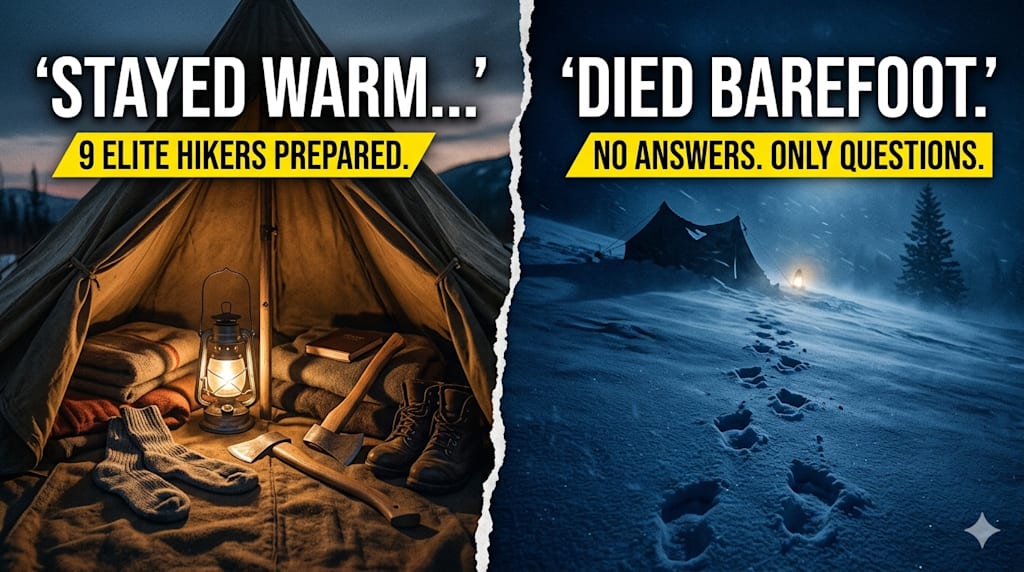
In the winter of 1959, nine of the Soviet Union's most experienced hikers set out on a challenging trek. They never returned. Their tent was found ripped open from the inside, their bodies scattered and barefoot in the snow, bearing catastrophic, inexplicable injuries. This is the ultimate, dark, unsolved mystery.

The greatest fear is not the fear of what we know. It is the fear of what we cannot understand.
Most stories about the wilderness are about survival, or about the simple, brutal power of nature. They are about avalanches, hypothermia, or predatory animals. They have clear beginnings, terrifying middles, and logical ends. We look at the data, we reconstruct the timeline, and we can say with certainty: *This is why they died.*
But once in a long while, history presents us with a scenario so illogical, so violent, and so profoundly strange that it defies every attempt at rational explanation.
This is the case of the Dyatlov Pass incident. It is not just an unsolved mystery; it is the ultimate psychological puzzle, a dark, atmospheric horror story that took place in the real world. For over sixty years, it has consumed the minds of investigators, journalists, and amateur sleuths, and yet, we are not a single step closer to understanding what truly happened on that haunted mountain.
It performance is so gripping precisely because it refuses to yield answers. It performance is so gripping because it forces us to face the terrifying possibility that sometimes, the "compelling force" that destroys us is something we have not yet imagined.
### The Elite Nine and the Dead Mountain
To grasp the depth of the mystery, you must first understand the individuals involved. This was not a group of naive amateurs.
In January 1959, a team of ten skilled, experienced, and physically fit hikers—most of them students or graduates of the Ural Polytechnic Institute—set off on a demanding winter expedition into the Northern Ural Mountains in the Soviet Union. Their goal was to reach Mount Otorten, a remote peak whose name, ominously, translates from the local Mansi language as *"Don't Go There."*
The group was led by Igor Dyatlov, a brilliant 23-year-old engineering student and a veteran of multiple high-difficulty treks. His team was equally elite. They were well-equipped, prepared for extreme sub-zero temperatures, and utterly confident in their collective ability to handle any challenge the mountains could throw at them.
One member, Yuri Yudin, fell ill early in the trip and was forced to turn back. His departure saved his life. But for the remaining nine—seven men and two women—the journey continued into the deep, frozen isolation of the wilderness.
### The Final Campsite: February 1, 1959
Based on diaries and film developed from their cameras, we can reconstruct their final, relatively mundane hours.
On February 1, as they began to ascend toward a pass near Mount Otorten, a fierce snowstorm hit. Visibility plummeted, and the group drifted off course. They found themselves on the upper slope of a smaller, exposed mountain known in the Mansi language as *Kholat Syakhl*—"Dead Mountain."
Instead of descending to the nearby forest for shelter, Dyatlov made a surprising, but tactical decision. He ordered the group to set up camp right there on the windswept, exposed slope. Some investigators believe he wanted to practice camping on an incline; others think he simply didn't want to lose the altitude they had just gained.
They pitched their large canvas tent, ate a late-night meal of bacon and bread, and settled in for the night. They were safe. They were warm. They were together.
Then, at some unknown point in the dark hours of the early morning, something happened.
Something so sudden, so horrifying, and so utterly unprecedented that it compelled nine of the Soviet Union's most disciplined, experienced hikers to collectively abandon their safety and make decisions that guaranteed their death.
### The Discovery: A Crime Scene Without a Criminal
When the group failed to send a mandatory telegram by February 12, their university organized a rescue mission.
On February 26, after searching the wilderness for two weeks, they spotted the tent on Dead Mountain.
The searchers were prepared for a tragic, simple explanation—an avalanche, a collapsed tent, or signs of carbon monoxide poisoning from a faulty stove. But the reality they stepped into was far darker and more disturbing.
The tent was abandoned. It was mostly buried in snow, but the investigators immediately noticed something wrong: **The tent had been violently, frantically sliced and ripped open from the *inside***. It was not unzipped. It was torn. It was an act of desperation.
Inside, the searchers found everything that meant survival. They found boots, heavy jackets, hats, gloves, knives, and the group's food supply. All the essential gear required to survive a Siberian winter night had been left behind.
Footprints led away from the tent toward the nearby forest. There were eight or nine sets of tracks. And this is where the mystery becomes a psychological nightmare.
The footprints revealed that the hikers had walked—not run—away from the tent. And they had done so without their shoes. Some wore only socks. **Two of them were completely barefoot.** They were stepping into a freezing, night-time environment that would cause terminal hypothermia in minutes.
Why would the most experienced hikers in the country do this? What could possibly be more terrifying than freezing to death?
### The Bodies: A Tapestry of Trauma
The rescue team followed the tracks to the edge of the forest, about 1.5 kilometers away. There, under a massive Siberian pine tree, they found the first two bodies: Yuri Doroshenko and Yuri Krivonischenko. They were dressed only in their underwear, barefoot, with their hands raw and blistered from trying to climb the tree. Next to them were the remains of a small, pathetic fire.
In the days that followed, searchers found three more bodies: Igor Dyatlov, Zinaida Kolmogorova, and Rustem Slobodin. They were found between the pine tree and the tent, scattered in the snow. Their positions suggested they were crawling *back* toward the tent, attempting a desperate, futile return to the supplies that could save them.
An initial medical examination of these five hikers concluded that all had died of hypothermia. Some had minor internal scratches, but no fatal external trauma.
But the final four hikers were still missing. They wouldn't be found for another two months, after the spring thaw melted the snow.
And their discoveries shattered any attempt at a rational explanation.
They were found buried under four meters of snow in a ravine, deeper into the woods. Some were wearing pieces of clothing taken from the other dead hikers, indicating they had survived the longest.
But unlike the first five, these four had not died of hypothermia. They had been victims of a force that was physical, massive, and horrifying.
Nicolai Thibeaux-Brignolle was found with a fatal fractured skull, compressed by a crushing force. Semyon Zolotaryov had internal damage that fractured several ribs. Lyudmila Dubinina suffered the same catastrophic chest trauma. Their internal injuries were so severe that the medical examiner compared them to the kind of impact from a car crash at high speed.
But there was absolutely no external trauma. There were no bruises. There were no marks on the skin that corresponded with the broken bones. Their bodies had been crushed from the inside out.
To make the scenario even more chilling, Lyudmila Dubinina was found **missing her tongue, her eyes, and a portion of her upper lip**. Semyon Zolotaryov was also missing his eyes.
There were no signs of a struggle with a foreign party. There were no Mansi footprints, and no modern aircraft were known to be in the area.
Nine elite hikers had met something invisible and all-powerful, something that could crush their bones without bruising their skin and cut their bodies without a weapon.
Official investigations at the time were summarized by a terrifyingly ambiguous verdict: **"The cause of death was an unknown compelling force."**
### The Theories: When Science Meets the Unexplainable
For sixty years, a thousand different theories have been presented to explain the Dyatlov Pass incident. None of them, not a single one, can account for all the facts.
**Theory #1: Mansi Attack.** The indigenous Mansi people had a historical presence in the area. Did they attack the hikers for trespassing on sacred ground? *Problem:* There were no signs of a fight, no Mansi footprints, and the Mansi were known to be peaceful. Furthermore, the missing tongues and eyes were post-mortem, likely caused by scavenging animals after the hikers were dead.
**Theory #2: Secret Military Testing.** This was the Soviet Union at the peak of the Cold War. Did the hikers accidentally wander into a classified weapons testing range? Some locals reported seeing strange "orange spheres" in the sky around that time. Perhaps a parachute bomb exploded above the tent, creating a shockwave that crushed the victims' chests and skulls. *Problem:* No debris was found. There was no military cleanup operation. And a bomb blast would have severely damaged the tent itself, which was found mostly intact.
**Theory #3: Paradoxical Undressing.** Some have argued that hypothermia causes a phenomenon called paradoxical undressing, where a dying victim perceives their body temperature as boiling hot and removes their clothes. *Problem:* This would explain why they were undressed *when they died*, but it does not explain why they cut their way out of the tent *before* they had hypothermia. They were still functional when they made the logical decision to leave.
**Theory #4: A Katabatic Wind.** A katabatic wind is a sudden, powerful, cold wind that rushes down a slope. Did a massive gust of wind hit the tent, making the hikers believe a severe storm or even an avalanche was imminent? *Problem:* These winds are powerful, but not typically a lethal threat. It is unlikely this would frighten *nine* veterans to abandon their only source of heat.
### The Best Modern Explanation: The "Mini-Avalanche" and Infrasound
In recent years, modern investigations have attempted to apply advanced physics and avalanche modeling to solve the case.
**Theory #5: The Infrasound Terror.** This is one of the most compelling and chilling psychological theories. The specific, convex shape of Dead Mountain, combined with the extreme winter wind, might have created a phenomenon called Von Kármán vortex streets. This effect can produce **infrasound**—a very low-frequency sound that is below the threshold of human hearing, but which can trigger severe, primal panic, nausea, and existential dread in the brain.
Did an invisible acoustic weapon of nature simply drive the entire group into a collective, mad panic, forcing them to slash their way out of the tent and run to escape a fear that had no source?
**Theory #6: The Rare Slab Avalanche.** This is the current "official" modern explanation favored by some investigators. They argue that Dyatlov's decision to cut a ledge on the slope to pitch the tent weakened the snowpack above them. During the night, a small, but incredibly dense "slab" of compacted snow slid down, hitting the tent and pinning the group.
This would explain the "crushing" injuries to the final four hikers (the weight of the snow) and would explain why they had to cut their way out of the tent (it was partially collapsed). They ran to the woods because they feared a secondary, larger avalanche. They took off their clothes because the slab avalanche was a short-term impact, and they were functional when they fled. t is a beautiful, mathematically sound argument.
Except it doesn't fit all the facts.
Skeptics point out that Dyatlov and Slobodin were crawling *back* to the tent. Why return if they were terrified of an avalanche? Furthermore, search parties who arrived two weeks later reported the slope was entirely intact, with no sign of an avalanche debris field, and the tent was not buried deeply enough to support the slab avalanche theory.
Every time science finds a logical solution, the haunted mountain presents a contradictory piece of data.
### The Haunted Legacy: Facing the Final Question
The Dyatlov Pass incident performance is so enduring not because of the gore, but because of the uncertainty.
As humans, we are fundamentally uncomfortable with the unknown. We want closure. We want explanation. We want to categorize tragedy into a logical spreadsheet of "cause" and "effect." But this case refuses to be categorized.
The biggest mystery is not how they died, but *why* they acted the way they did. What single event could simultaneously compel nine veteran hikers to:
1. Slash their own tent open from the inside?
2. Abandon all their shoes and heavy gear in freezing temperatures?
3. Walk—not run—into a forest where they knew they would die of hypothermia?
4. And leave some with injuries so severe they resemble a high-speed collision, yet leave no bruise on the skin?
We will likely never know.
The Dyatlov Pass incident remains the ultimate, final reflection on the fragility of human knowledge against the raw, indifferent, and sometimes utterly unexplainable power of the natural world.
Nine experienced hikers entered the mountains. Confident. Prepared. Together. But something was waiting for them on Dead Mountain. Something that made them abandon safety, ignore their years of experience, and run barefoot into the frozen darkness.
And to this day, no one knows exactly what it was. And that is what makes them unforgettable.
About the Creator
Frank Massey
Tech, AI, and social media writer with a passion for storytelling. I turn complex trends into engaging, relatable content. Exploring the future, one story at a time
Keep reading
More stories from Frank Massey and writers in Wander and other communities.
Kusliga Vista
“I told you we were going too far off trail,” said Clark. “I thought Ammon said he could read a compass,” said Kit. “Guys, it’s easy, we just need to find a river or stream and follow it. Those things always lead to civilization,” Ammon said and pushed through thick patch of bushes.
By Amos Glade3 days ago in Horror



Comments
There are no comments for this story
Be the first to respond and start the conversation.