
What Survives After Editing
Before the thought fully knows what it means

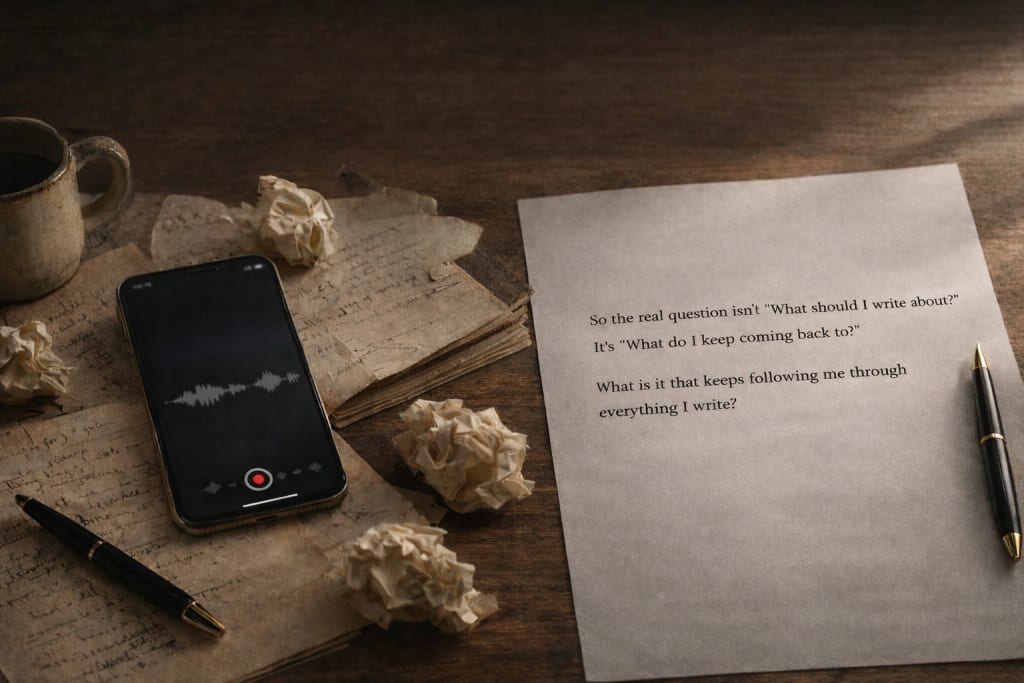
Writing usually starts out in a worse form than people ever get to see.
It comes out messy, repetitive, overexplained, and half-formed. Editing is where you go back, cut what’s dead, fix what’s weak, and keep only what still holds. That’s the point where writing either gets better or gets abandoned.
The first version is the longer draft.
The second, further down, is what survived when it got cut down.
People love to say “follow your passion” or “just write what you love,” like that actually clears anything up. But the real problem is when you can write well across a lot of things and still don’t know what is actually yours.
You know that feeling where “I can write about almost anything, so how do I know what I’m actually supposed to write?”
Then the question becomes: “What kind of writer am I, really?”
That’s a much bigger question.
Being able to write about a lot is both a gift and a curse at the same time. Talent doesn’t give you direction. Sometimes it just gives you too many possible selves.
The hard truth is this:
Your path is usually not the subject. It’s the way your mind keeps returning to the world.
You can write about politics, medicine, literature, family, religion, identity, and social issues… and still be circling the same thing underneath it all.
Really, you’re always writing about power, injustice, human behavior, control, grief, truth, silence, performance, what people refuse to see.
That’s the real thing.
Your road is probably not “Shakespeare” or “doctoring” or “politics.”
Those are just vehicles.
What keeps showing up underneath them is usually the real thing.
Ask yourself this instead:
What do I always end up caring about, no matter what I’m writing?
If the same nerve keeps appearing in different forms, that’s the thread.
That's where your intelligence and your fixation meet.
It usually shows up where you can’t stop noticing something, where you get angry or obsessed in a very specific way, and where you keep circling the same human tension again and again.
That’s usually where your voice is.
There's no requirement to choose one “respectable topic” and marry it forever.
You figure it out by what you keep coming back to.
Because once you know that, you can write about anything and still sound like yourself.
A “power” writer can write about governments, hospitals, families, marriages, religion, even Shakespeare.
The subject might change. The obsession usually doesn’t.
And one more thing:
You do not have to “pick one lane” too early.
Some writers are not built to be the one-topic person. They’re built to become a voice first, and a niche second.
That’s not confusion. That’s just a wider range.
But even wide-range writers still have a center.
You need your center, not a prison.
This is the version after final editing.
Sometimes I wonder what my writing path actually is.
I can write about almost anything. Politics, medicine, literature, human behavior, social issues, personal truth.
And that’s the problem.
When you can write about everything, it becomes difficult to know which direction is really yours. Which subject you’re meant to keep returning to.
Then one day it clicked.
It probably isn’t in the subject itself.
It’s in the single thread you keep noticing, no matter what you’re writing about.
Power.
Silence.
Injustice.
Grief.
Control.
Truth.
Human contradiction.
What people refuse to see.
Those obsessions stay with me through every piece.
Shakespeare, politics, medicine, family, religion, identity, they no longer feel like separate worlds. They feel like different doors leading into the same deeper territory.
So the real question isn’t “What should I write about?”
It’s “What do I keep coming back to?”
What is it that keeps following me through everything I write?
About the Creator
Annam M Gordon
My books and writing focus on real people. These stories come from lived experience. I collaborate with individuals and mental health professionals. I am not a psychologist or therapist, just a writer committed to authenticity and care.
Keep reading
More stories from Annam M Gordon and writers in Writers and other communities.
Insurances
When I was asked to move from the big city of Philly halfway across the country to the small town of Centerville, OK, I was excited for the new start and the new job. My insurance company offered me a promotion to move because I'm young and unattached. I was to be one of two agents in the branch.
By Julie Lacksonen7 days ago in Fiction



Comments
There are no comments for this story
Be the first to respond and start the conversation.