movie review
Felony-focused film reviews; fictional movies and true crime documentaries depicting real-life stories or inspired by them.
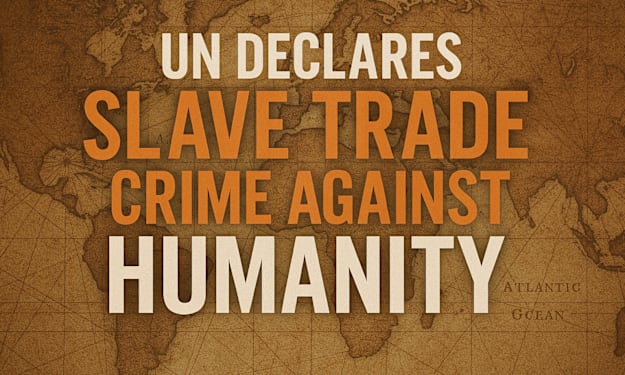
UN Declares Transatlantic Slave Trade the Gravest Crime Against Humanity. Content Warning.
April 2, 2026 In a watershed moment for international justice and historical accountability, the United Nations General Assembly has formally recognized the transatlantic slave trade as the gravest crime against humanity. The resolution, adopted by a vote of 123 in favor, 3 against, with multiple abstentions, marks one of the most consequential acknowledgments in the UN’s history—one that confronts centuries of denial, erasure, and unresolved harm.
By TREYTON SCOTTa day ago in Criminal
Oil at War: The Strait of Hormuz Crisis and the Rising Iran–Israel–US Conflict
Oil at War: The Strait of Hormuz Crisis and the Rising Iran–Israel–US Conflict The Middle East has once again become the center of global attention as tensions between Iran, Israel, and the United States intensify. At the heart of this crisis lies one of the world’s most strategic waterways: the Strait of Hormuz. This narrow maritime corridor carries a huge portion of the world’s oil supply, and any disruption here has the power to shake the global economy.
By Wings of Time 19 days ago in Criminal
Nuclear Firestorm
When a modern nuclear weapon explodes, the world inside its blast zone changes in a matter of seconds. The moment the weapon detonates, a blinding flash of light brighter than the sun fills the sky. Temperatures at the center of the explosion can reach millions of degrees, hotter than the surface of the sun. Everything close to the explosion—buildings, trees, vehicles, and living creatures—is instantly vaporized.
By imtiazalam20 days ago in Criminal
The Man Who Never Existed
M Mehran In the quiet city of Brookvale, crime was rare. The streets were peaceful, the people friendly, and the police department mostly dealt with minor thefts and traffic violations. That changed on a cold November morning. At exactly 6:15 AM, a jogger running through Riverside Park discovered something disturbing near the old iron bridge. A man was lying motionless on the ground. Within minutes, police sirens echoed through the fog-covered park. Officers quickly sealed the area as detectives examined the scene. The victim was well-dressed, wearing an expensive coat and polished shoes. At first glance, it looked like a robbery. But nothing was missing. His wallet was still in his pocket. His watch remained on his wrist. Detective Laura Bennett arrived at the scene shortly after sunrise. Known for her sharp instincts and calm demeanor, she immediately sensed something unusual. The victim had no visible injuries. Yet he was clearly dead. A Death Without a Cause The autopsy revealed something shocking. The man had been poisoned. A rare and fast-acting toxin had entered his bloodstream only minutes before death. But investigators couldn't find any injection marks or signs of forced consumption. Even stranger, the victim had no identification. The wallet contained cash but no ID cards, no driver’s license, no credit cards—nothing that could reveal who he was. For the first time in her career, Detective Bennett was dealing with a victim who seemed to have no identity. The Invisible Life Police released the man’s photo to the public, hoping someone would recognize him. Days passed. No one came forward. Fingerprints were run through national databases. No match. Facial recognition searches produced nothing. It was as if the man had never existed. But Bennett refused to believe that. She began examining the smallest details. The label inside his coat came from a high-end tailor in the city. When she visited the shop, the owner recognized the design immediately. “Yes,” the tailor said slowly. “I made this coat… about three months ago.” “Do you remember the customer?” Bennett asked. The tailor nodded. “He paid in cash. Said his name was Adrian Cross.” The Name That Led Nowhere Detectives searched every public record for the name Adrian Cross. No birth records. No tax filings. No employment history. No bank accounts. Nothing. The name was fake. But one detail from the tailor stood out. Cross had been accompanied by another man when ordering the coat. A nervous man who kept watching the door. Security cameras from nearby stores eventually captured the pair walking down the street together. Facial recognition finally produced a match for the second man. His real name was Marcus Doyle. And he was already wanted by federal authorities for cyber fraud and identity theft. The Criminal Puzzle Police tracked Doyle to an abandoned warehouse on the edge of the city. When officers stormed the building, they discovered something that shocked even seasoned investigators. Inside were dozens of computers and stacks of fake identification documents. Passports. Driver’s licenses. Bank records. Doyle had been running one of the largest identity forgery operations in the region. But that raised a bigger question. Who was the dead man in the park? When Doyle was arrested, he initially refused to speak. But after hours of interrogation, he finally broke. The truth was darker than anyone expected. The Ultimate Betrayal Doyle admitted that “Adrian Cross” was not a real person. He had created the identity himself. The dead man’s real name was Ethan Ward, a former partner in Doyle’s criminal network. Together, they had built dozens of fake identities and sold them to criminals trying to disappear. But recently, Ward had grown paranoid. He believed Doyle planned to eliminate him to take control of the operation. So Ward threatened to expose everything. Doyle decided to act first. He invited Ward to meet in Riverside Park early that morning, pretending they needed to discuss a new client. Before the meeting, Doyle had poisoned a small bottle of water with the rare toxin. Ward drank it during their conversation. Minutes later, he collapsed. Doyle walked away, confident the man would remain forever unidentified. Without a real identity, Ward’s death would become an unsolved mystery. Or so Doyle believed. The Truth Always Surfaces Thanks to Detective Bennett’s determination, the plan failed. Doyle was charged with murder, fraud, and multiple federal crimes. His network of fake identities was dismantled, preventing countless future crimes. But the case left a lasting impression on everyone involved. In a world filled with digital records and surveillance, it seemed impossible for someone to vanish without a trace. Yet Ethan Ward had almost succeeded in becoming a man who never existed. And if one determined detective hadn’t followed the smallest clues—a coat label, a security camera, a forgotten face—the truth might have remained buried forever. Because in the world of crime, the most dangerous criminals are often the ones hiding behind identities that aren’t real.
By Muhammad Mehran27 days ago in Criminal
The Silence Behind Room 307
M Mehran The rain fell heavily over the quiet town of Ravenshade, turning the narrow streets into rivers of shimmering reflections. Most people had already gone home, locking their doors against the stormy night. But inside the old Hawthorne Hotel, the lights of Room 307 still glowed faintly. That room would soon become the center of one of the most chilling criminal mysteries the town had ever known. A Crime That Shocked the Town At 11:42 PM, the hotel receptionist heard a loud crash echo from the third floor. At first, she assumed a guest had dropped something. But minutes later, a terrified scream shattered the silence. When the police arrived, they found the door to Room 307 half open. Inside, the scene was disturbing. A wealthy businessman named Daniel Mercer lay lifeless on the floor beside a broken glass table. The room looked untouched—no signs of forced entry, no robbery, no struggle. Yet Mercer was clearly murdered. Detective Aaron Cole, a veteran investigator known for solving impossible cases, stepped into the room carefully. Years of experience had taught him that the smallest detail could expose the biggest lie. But this case felt different from the beginning. The Impossible Mystery The first strange detail was the door. It had been locked from the inside. The second strange detail was the window. Closed. Sealed. Impossible for anyone to escape through. This meant one thing: whoever killed Mercer had either vanished into thin air… or was still in the hotel. Cole began questioning the staff and guests. Mercer had checked in earlier that evening, arriving alone and carrying only a black leather briefcase. According to hotel records, he had ordered dinner to his room and made two phone calls. After that, nothing. But one witness changed everything. A young waitress named Clara said she saw someone leaving the hallway near Room 307 shortly before the scream. “A man in a gray coat,” she told police. “Tall. Wearing a hat. I didn’t see his face.” The problem? No guest registered at the hotel matched that description. A Secret Hidden in Plain Sight Detective Cole examined Mercer’s belongings carefully. Inside the briefcase were documents related to a major financial investigation. Mercer had been working with authorities to expose a massive corporate fraud operation involving millions of dollars. Someone powerful clearly had a reason to silence him. But how did the killer enter and leave the locked room? That question haunted Cole. Until he noticed something unusual. The bathroom mirror. It wasn’t aligned with the wall like normal hotel mirrors. When Cole touched its edge, it shifted slightly. Behind it was a hidden service panel used by hotel maintenance workers decades ago. A narrow passage ran between the walls of the building. Suddenly, the “impossible crime” wasn’t impossible anymore. The Killer Revealed The passage led to a storage room on the same floor. Inside, detectives discovered a gray coat hanging on a hook. And inside the pocket was a hotel keycard. The card belonged to Victor Hale—the hotel’s night manager. When police confronted him, Hale tried to stay calm. But the evidence was overwhelming. Hale had once worked for the same corporation Mercer was investigating. If Mercer exposed the fraud scheme, several powerful executives—and their accomplices—would face prison. Hale was paid to ensure that never happened. Using the old maintenance passage, he entered Mercer’s room through the hidden panel, confronted him, and killed him before escaping back through the wall. He then locked the door from the inside using a simple wire trick through the gap under the door. A perfect crime. Or so he thought. Justice in the Darkness When Hale finally confessed, he revealed something chilling. Mercer had refused to stay silent even when threatened. “He said the truth was worth dying for,” Hale admitted quietly. The investigation that followed exposed the entire fraud network Mercer had been trying to reveal. Several high-ranking executives were arrested, and millions of dollars in stolen funds were recovered. But for Detective Cole, the victory felt incomplete. Mercer had paid the ultimate price. The Lesson Behind the Crime Criminal cases like the Room 307 murder remind us that crime is rarely random. Behind every shocking act lies a chain of decisions, secrets, and motives. Sometimes the truth hides in shadows. Sometimes it hides behind a mirror. But as Detective Cole often said: “Every crime leaves a whisper of the truth. You just have to listen carefully.” And in the silent hallway of the Hawthorne Hotel, the whisper of justice had finally been heard.
By Muhammad Mehran27 days ago in Criminal
The Middle East at a Crossroads
The Middle East at a Crossroads The Middle East has once again become the center of global attention as tensions rise between several powerful countries and regional actors. Conflicts, political rivalries, and military movements have created an atmosphere of uncertainty that many analysts believe could reshape global politics in the coming years. Although wars and crises have occurred in this region for decades, the current situation feels more fragile and dangerous because multiple global powers are indirectly involved.
By Wings of Time about a month ago in Criminal
Ten Days of Marriage, A Lifetime Lost: A Wake-Up Call Against Greed, Dowry, and Domestic Violence
Ten Days of Marriage, A Lifetime Lost: A Wake-Up Call Against Greed, Dowry, and Domestic Violence a relationship that only lasted ten days. A young woman who had visions of the future as she entered her new residence. After that, a shocking end: her husband killed her with a broken piece of glass following an argument about money, property, and a car.
By Farida Kabirabout a month ago in Criminal
The Last Train from Lahore
M Mehran On a fog-drenched winter night in Lahore, the last train pulled away from the platform with a tired metallic scream. Vendors packed up their tea stalls. Porters stretched their aching backs. The city exhaled. But in coach C-7, a crime was already in motion. His name was Hamza Iqbal. To his neighbors, he was polite. To his mother, devoted. To the law, invisible. And to the passengers on that train, he was about to become a nightmare. A Criminal Who Studied People, Not Locks Hamza wasn’t the kind of criminal who relied on force. He relied on observation. For months, he had studied human behavior at railway stations—who traveled alone, who carried expensive gadgets, who looked distracted, who trusted too easily. He learned patterns. Businessmen guarded briefcases but ignored backpacks. Students protected phones but forgot wallets in jacket pockets. Families assumed safety in numbers. Hamza didn’t steal randomly. He selected with precision. But what made him different from petty thieves was his long game. He wasn’t after wallets. He was after identities. The Perfect Setup Inside coach C-7, Hamza smiled warmly at an elderly couple struggling with luggage. “Let me help,” he offered. They thanked him. Trust was built in seconds. Across the aisle, a young tech entrepreneur tapped away on his laptop. Hamza noticed the company logo on his bag. Startup founder. Likely successful. Likely careless. As the train rolled into darkness, Hamza moved like a shadow. He didn’t snatch. He didn’t threaten. He cloned. With a small wireless device hidden inside his power bank, he skimmed unsecured data from nearby phones and laptops connected to the train’s public Wi-Fi. Passwords. Banking apps. Email logins. Most passengers never realized their digital doors had been left open. By the time the train reached Karachi, Hamza had stolen more than cash could ever buy. He had stolen access. When Theft Becomes Destruction Within days, bank accounts were drained. Cryptocurrency wallets vanished. Confidential business proposals leaked online. Victims filed complaints, confused and ashamed. No one remembered being robbed. No physical evidence. No witnesses. Cybercrime units suspected phishing scams. Malware. International hacking rings. But Hamza worked alone. He operated from a modest apartment, using public networks and temporary devices. After each operation, he destroyed hardware. Burned SIM cards. Wiped drives. He believed himself untouchable. And for a while, he was. The Investigator Who Refused to Guess Enter Detective Ayesha Khan of the Federal Investigation Agency. Unlike others, Ayesha didn’t begin with technology. She began with geography. She mapped every victim’s travel history. One connection stood out: each had taken the Lahore–Karachi night train within the same three-month window. Coincidence? Criminal investigations rarely reward coincidence. Ayesha rode the train herself. She watched. Listened. Waited. And she noticed something subtle—one passenger who never seemed to sleep, never seemed to panic, never seemed to disconnect from the public Wi-Fi. Hamza. The Psychology of a Criminal Criminal profiling suggests that repeat offenders develop rituals. Habits. Comfort zones. Hamza always chose coach C-7. Always boarded last. Always offered help to elderly passengers to avoid suspicion. It wasn’t greed that motivated him. It was superiority. He believed he was smarter than the system. Smarter than his victims. That belief would become his weakness. The Trap On her third undercover ride, Ayesha deliberately connected a decoy laptop to the train’s Wi-Fi. It contained traceable bait—fake financial credentials monitored by cyber forensic teams. Within minutes, the system detected an intrusion attempt. The signal originated only meters away. Ayesha felt her pulse steady, not race. Criminal apprehension isn’t about adrenaline. It’s about timing. When the train slowed near Hyderabad, officers in plain clothes quietly surrounded Hamza. He tried to remain calm. But calm cracks under certainty. Inside his backpack, they found modified signal boosters, portable data skimmers, and encrypted storage drives containing hundreds of stolen identities. The silent thief of the rails was finally visible. In the Interrogation Room “Why?” Ayesha asked him. Hamza shrugged. “Because they made it easy.” It wasn’t poverty. It wasn’t desperation. It was opportunity. He saw society’s dependence on technology and recognized its vulnerability. Public Wi-Fi networks. Weak passwords. Blind trust. He didn’t see faces. He saw access points. Psychologists later described him as a high-functioning cybercriminal driven by intellectual thrill rather than necessity. But thrill fades. Consequences don’t. The Impact of Modern Crime Hamza’s arrest exposed more than one man’s wrongdoing. It revealed a larger truth about modern criminal activity: Digital theft can be more damaging than physical robbery. Cybercrime leaves victims confused and self-blaming. Public networks are fertile ground for exploitation. News outlets across Pakistan covered the case extensively. Security experts warned travelers to avoid unsecured Wi-Fi. Banks strengthened authentication systems. The Lahore–Karachi train added cybersecurity advisories to ticket confirmations. Crime had evolved. And so had fear. The Sentence In court, Hamza showed little emotion as charges were read: identity theft, cyber fraud, illegal data interception, financial crimes. He was sentenced to fifteen years. Some called it harsh. Others called it justice. For the entrepreneur who lost his startup funding overnight, it was closure. For the elderly couple whose savings disappeared, it was relief. For Detective Ayesha Khan, it was a reminder: Criminals adapt. So must those who chase them. The Moral Behind the Crime Story This criminal story isn’t just about one man on a train. It’s about vulnerability in a connected world. It’s about how trust, convenience, and technology can become weapons in the wrong hands. Hamza didn’t wear a mask. He wore normalcy. And that is what makes modern criminals so dangerous—they blend in. The next time you connect to public Wi-Fi, glance around. The quiet passenger helping with luggage. The man who never seems to sleep. The stranger who smiles too easily. Crime no longer needs a gun. Sometimes, it only needs a signal. And somewhere, on another train slicing through the night, someone may already be watching the bars of your connection rise—waiting for them to fall.
By Muhammad Mehranabout a month ago in Criminal