
How A Pilot Hijact a plane (Real Story)
The chilling true story of how a reinforced security system and a hidden medical crisis led to one of aviation's most haunting tragedies.

At 9:27 AM on March 24, 2015, the sky over Marseille was clear. An Airbus A320, operated by Germanwings, was cruising toward Düsseldorf with 150 souls on board. To the air traffic controllers below, everything seemed routine. The captain’s voice was steady as he read back his clearances. But within three minutes, the "routine" began to dissolve into a terrifying anomaly.
The aircraft started to bleed altitude. It wasn't a sudden plunge, but a controlled, deliberate descent, dropping from 38,000 feet to 30,000 feet without a word of explanation. Controllers in Marseille grew frantic, calling the flight crew over multiple frequencies. Silence. A French air defense controller tried to break through. Silence. Other aircraft in the vicinity reached out to the cockpit of Flight 9525. Still, there was only silence. At 9:41 AM, the radar went dark. The plane had struck the side of a mountain in the French Alps at over 400 miles per hour.
In the days that followed, investigators picked through a debris field so vast and fragmented that it was accessible only by helicopter. When they finally stitched together the data from the cockpit voice recorder, they discovered a story that was more chilling than any mechanical failure. The plane had been hijacked, but not by an outside force. The threat was already inside the cockpit.
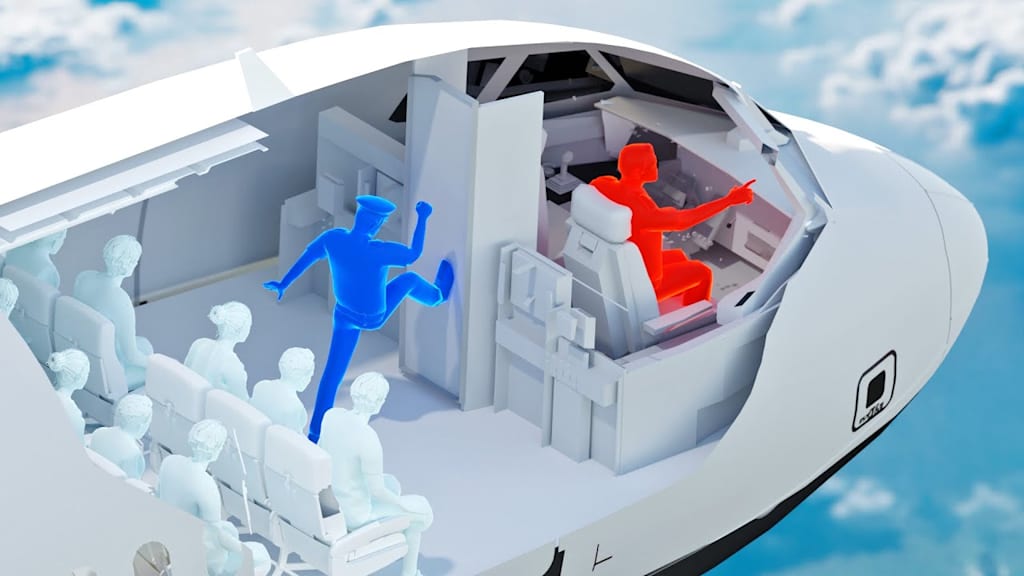
The recordings revealed that after the plane reached its cruise altitude, the captain—Patrick Sondenheimer, a 34-year-old father of two—left the cockpit to use the bathroom. Almost the second the door clicked shut, the co-pilot changed the flight settings. When the captain returned and requested entry, he found himself locked out. He buzzed the intercom. No answer. He tried the emergency override code.
In the wake of 9/11, cockpit doors were reinforced to be impenetrable. They are designed to keep the world out, but on that morning, they were used to keep the captain out. A toggle switch inside the cockpit allows a pilot to "Lock" the door, overriding even the emergency codes for five minutes at a time. The co-pilot held that switch. As the plane descended toward the peaks, the voice recorder captured the sound of violent blows against the reinforced door. The captain was trying to break back into his own cockpit with a crowbar, his screams echoing in the narrow galley as the passengers realized their fate.
The man behind the controls was 27-year-old Andreas Lubitz. To his neighbors, he was a passionate flyer who had gliders on his childhood bedroom walls. But his medical records told a darker story. Years earlier, he had dropped out of flight school due to a severe depressive episode. Though he was eventually cleared to fly, his "fit to fly" certificate carried a caveat: any relapse would ground him permanently.
By early 2015, the shadows had returned. Lubitz began suffering from a psychosomatic condition; he believed he was going blind, seeing flashes of light and "flying insects" that doctors could not find on any scan. He was seeing ophthalmologists and neurologists multiple times a week, and he had been issued multiple sick notes declaring him unfit for work. But in the aviation industry’s honor system, the responsibility to report those sick notes fell on the pilot. Lubitz chose to stay silent, hiding the torn-up medical notes in his apartment.
Four days before the crash, his search history revealed his final intentions. He didn't search for a way to fix his eyes; he searched for the locking mechanisms of an Airbus A320 cockpit door. On the outbound flight from Düsseldorf to Barcelona that very morning, he even performed a "test run," briefly setting the plane to a lower altitude while the captain was out of the room.
The tragedy of Germanwings 9525 sparked a global debate on the limits of doctor-patient confidentiality. Multiple doctors knew Lubitz was unfit to be in a cockpit, yet none broke the silence to warn the airline. In Germany, where privacy laws are among the strictest in the world, the dilemma was agonizing: at what point does a patient’s right to privacy end and the public’s right to safety begin?
Today, the aviation world is different. Psychological screenings have been tightened, and many airlines implemented a "two-person rule," ensuring a pilot is never left alone in the cockpit. But for the families of the 150 victims—including an entire high school class returning from a trip to Spain—no regulation can bridge the void. Flight 9525 remains a somber reminder that the most sophisticated security systems in the world are only as reliable as the people we trust to operate them.
About the Creator
Edge Words
All genres. All emotions. One writer. Welcome to my universe of stories — where every page is a new world. 🌍
Keep reading
More stories from Edge Words and writers in History and other communities.
The Most Dangerous Job in Crime
The Port of Antwerp is not just a shipping hub; it is a metallic continent that never sleeps. Spanning over 11,000 hectares—larger than the city of Paris—it is a landscape of towering steel cliffs and endless canyons formed by millions of shipping containers. Throughout the night, the ground trembles with the weight of rolling trucks and massive cranes shifting cargo. But amidst this industrial symphony, a different kind of work is happening.
By Edge Wordsabout 19 hours ago in Criminal
The Rise of Genghis Khan: From Outcast to Conqueror
Genghis Khan, born as Temujin around 1162 in the harsh steppes of Mongolia, is one of history’s most formidable and transformative leaders. His life story is not just about conquest and empire-building, but also about resilience, strategic brilliance, and the unification of a fragmented people. From a childhood marked by betrayal and poverty to becoming the founder of the largest contiguous empire in history, his journey is both extraordinary and complex.
By Mariana Farias4 days ago in History
The Spice Wars: When Europe Fought Over Flavor and Fortune
When Flavor Was Worth Fighting For Back in the late 1400s and early 1500s, Europe had a serious obsession with spices. Pepper, nutmeg, cloves, and cinnamon weren’t just kitchen ingredients—they were status symbols. A pinch of pepper could cost as much as a day’s wages. Most of these spices came from a tiny cluster of islands in Southeast Asia known as the Maluku Islands. Getting them to Europe was complicated and expensive, mostly controlled by middlemen through the Ottoman Empire and trading hubs like Venice. European powers didn’t like that arrangement. They wanted direct access—and bigger profits. The Race to Find a Shortcut This is where things start to feel like a real-world adventure story. Explorers began searching for sea routes to Asia, kicking off what we now call the Age of Discovery. One of the most important breakthroughs came when Vasco da Gama successfully sailed around Africa to reach India in 1498. That single journey changed everything. Portugal suddenly had a direct line to the spice trade. And they didn’t waste time—they built forts, controlled ports, and used military force to dominate the routes. From Trade to War Here’s where things got messy. Other European powers—especially the Dutch and the British—weren’t going to sit back and watch Portugal cash in. They formed powerful trading corporations like the Dutch East India Company and the British East India Company. These weren’t regular businesses. They had armies, navies, and the authority to wage war. Think about that for a second: private companies fighting battles over spices. The Dutch, in particular, became ruthless in securing control over nutmeg and cloves. They even went as far as destroying spice trees in areas they didn’t control—just to keep supply low and prices high. A Practical Example (That Still Applies Today) When I first learned about this, it reminded me of something very modern: supply chains. If you’ve ever tried to buy a popular gadget during a shortage—or even struggled to find a specific ingredient—you’ve experienced a tiny version of what was happening back then. The spice trade worked on three simple principles: Control the source Limit supply Maximize profit It’s not that different from how certain tech products or luxury brands operate today. Mistakes That Cost Lives and Empires One thing that stands out when you look deeper into the spice wars is how often greed led to poor decisions. Portugal, for example, expanded too quickly. They controlled key routes but couldn’t maintain dominance everywhere. The Dutch learned from that and focused more strategically, locking down the most valuable islands instead of spreading thin. The British took a different route. Instead of fighting only for spices, they gradually shifted toward broader control in India, which turned out to be a much more sustainable long-term strategy. It’s a lesson I’ve seen play out even in small-scale projects: trying to control everything at once usually backfires. What This Means for Everyday Life You might be thinking, “Okay, interesting history—but how does this matter now?” Here’s the thing: the spice wars shaped the modern world in ways we still live with. Global trade routes? Built on those early spice journeys Colonial borders? Influenced by these power struggles Cultural food exchange? A direct result of spice movement Even your local grocery store—with spices from all over the world—is part of that legacy. If You Want to Experience It Yourself This might sound unusual, but one of the best ways to understand the spice wars is through cooking. Here’s a simple way to do it: Step 1: Buy whole spices instead of pre-ground Try cloves, cardamom, black pepper, and cinnamon sticks Step 2: Toast them lightly in a pan This releases oils and gives a deeper flavor Step 3: Grind them fresh A simple mortar and pestle works great Step 4: Use them in a basic dish Even plain rice or chicken becomes something special The difference is dramatic—and it helps you understand why people once risked everything for these ingredients. A Story That Still Feels Alive The spice wars weren’t just about food. They were about ambition, risk, and control. Empires rose and fell chasing something as simple as flavor. And honestly, once you’ve cooked with real, fresh spices, it stops feeling strange. You start to get it. There’s something powerful about taste. It connects people, drives demand, and—at least once in history—reshaped the entire world. That’s not something you notice from a textbook. But once you experience it firsthand, even in a small way, the story sticks with you.
By JAMES NECK 6 days ago in History


Comments
There are no comments for this story
Be the first to respond and start the conversation.