
Who Could Buy a Book in the Middle Ages, and How Much Did It Cost?
Why medieval books cost months or even years of labour, and why only monasteries, universities, nobles, and the wealthy could afford them.

A book in the Middle Ages was never cheap, but there was no single price for everyone. Everything depended on the time, the place, the length, the materials, and the decoration. If we take Western Europe, especially England and France in the thirteenth to fifteenth centuries, a simple academic manuscript could cost several pounds. That meant months of work for a skilled craftsman. A large liturgical book or an elaborately decorated Bible could cost as much as a year’s income, or even more.
To understand why, you first have to look at how a medieval book was made.
Why books were so expensive
Because they were made by hand. First, the writing material had to be prepared. In the early and high Middle Ages, this was most often parchment — specially treated animal skin. For example, one large Bible could require a whole herd of sheep or calves. Then the text was copied by a scribe. If the book was ceremonial or luxurious, an illuminator, an artist who painted initials, a rubricator who wrote headings, and a binder would also be involved. Sometimes there was also a bookseller acting as an intermediary, assembling the order piece by piece. By the late Middle Ages, this had already become an entire urban market, especially in Paris, Bologna, which was famous for legal books, Oxford, and London.
The most important point is that the price was determined not only by materials. English calculations from the fourteenth and fifteenth centuries have survived. For two luxurious antiphonaries, books of chants, made for the chapel of St. Thomas Becket on London Bridge in the late 1380s, about 74% of the price came from labour and only 26% from materials. In five manuscripts from Peterhouse College in Cambridge in the fifteenth century, labour accounted for as much as 83%, with materials making up 17%. In other words, books were expensive not because parchment was rare, but because they required weeks and months of human labour.
Sometimes the sheer volume of raw material was astonishing in itself. The enormous Bible known as the Codex Amiatinus, created around 716 under Abbot Ceolfrith in Northumbria, in the northeast of England, required more than a thousand skins. This was an extreme, almost monumental case, but it shows clearly why a large manuscript was seen as a costly object even before any decoration was added. Such a book weighed dozens of kilograms. One person could barely lift it.

Concrete figures

When it comes to medieval prices, there is always a problem: what survives are not shop price tags, but library valuations, commission records, and account books. Even so, they make the scale clear.
In the library of Hereford Cathedral, the average valuation of 33 manuscripts rose from about 97 pence around 1300 to 196 pence around 1400. That was an increase of 174%. Books were not only expensive — their value also changed noticeably over time.
Here are some vivid examples: In Peterhouse, Cambridge, in the fifteenth century, five university manuscripts cost between £2 5s 3d and £4 0s 8d. Here, £ means pound, s means shilling, and d means penny. One pound contained 20 shillings, or 240 pence. A commission for an evangelary, a book containing Gospel readings, for Canon John Prust in Windsor between 1379 and 1385 cost £3 15s 8d. Two London antiphonaries from the late fourteenth century together cost £24 5s 2d. That was a completely different level of expense, affordable not to a private customer but to a major church institution.
To make these sums easier to grasp, it helps to compare them with wages.
In England around 1300, a master mason or master carpenter earned about 4 pence a day. After the Black Death, the plague epidemic of 1348–1349 that killed a third of Europe’s population, the rate in many places rose to 5 or 6 pence. The Statute of Labourers, passed by the English Parliament in 1351, allowed a wage of about 1.5 pence a day for servants and day labourers.
Now let us convert the price of a book into working days: A manuscript costing £2 5s 5d came to 545 pence. That meant about 100 to 130 days of labour for a skilled craftsman, at 4 to 5 pence a day, or more than 360 days of low-paid work. John Prust’s evangelary at £3 15s 8d came to 908 pence. That was about 150 to 225 days of skilled labour. A pair of antiphonaries costing £24 5s 2d represented nearly 1,000 working days for a craftsman paid 6 pence a day. That meant three years of continuous work.
For comparison, a cow in fourteenth-century England cost about 10 to 12 shillings, or 120 to 144 pence. That means even the cheapest university textbook was four or five times more expensive than a cow. A luxury book could equal the value of a hundred cows or a small estate.
Who could afford books
In the early Middle Ages, from the fifth to the eleventh centuries, the main centres of book production were monasteries and cathedral schools. Books were copied by monks and remained in monastic libraries.
In the thirteenth to fifteenth centuries, the circle of buyers widened, but it still did not become mass-market. Books were bought by: Monasteries and cathedrals, such as Notre-Dame of Paris or Westminster Abbey. Bishops and senior church officials. Universities, including Oxford, Cambridge, Paris, and Bologna. Princes and dukes. For example, Duke Jean de Berry, 1340–1416, the brother of the king of France, was a passionate collector of manuscripts. He commissioned books from the finest masters, including the Limbourg brothers. Major merchants from the Italian city republics, such as Florence, Venice, and Genoa. Lawyers and physicians. In fourteenth-century Bologna, a lawyer could pay for a collection of laws with a sum equal to a craftsman’s annual income. Wealthy townspeople, though more as an exception than as a rule.
Students often could not afford their own copies. That is why they used books from university libraries. The most valuable volumes were chained to the shelves. Less expensive ones could be borrowed against a deposit. In England, there were rules under which the library valuations of manuscripts were deliberately inflated so that readers would handle books more carefully. One such statute is known from Oxford in 1439.
From the fourteenth to the sixteenth centuries, Books of Hours, Livres d'Heures, personal prayer books for laypeople, became enormously popular. Thousands survive. But the difference between them was enormous. One Book of Hours might be modest, without pictures, on cheap parchment. Another could become an object of luxury.

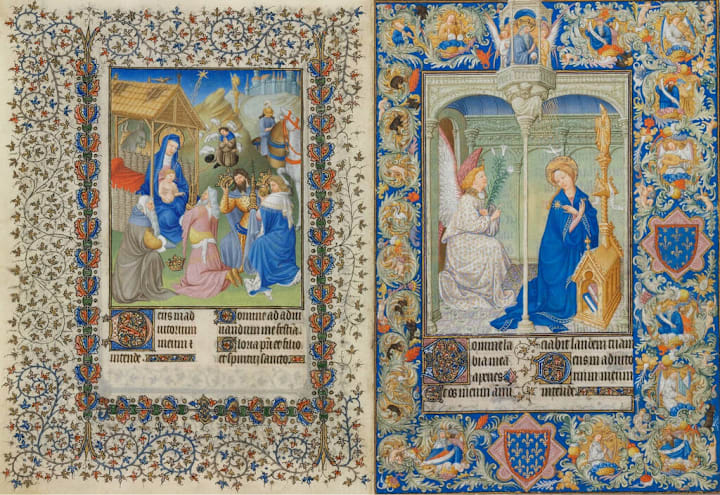
The best example is the Belles Heures of Duke Jean de Berry. It was created in Paris between 1405 and 1409 by the Limbourg brothers — Herman, Paul, and Jean — the three most famous illuminators of their age. The book contains 172 leaves, 94 miniatures, and countless decorated initials. This was no longer simply a text for prayer, but a sign of power, taste, and wealth. Its exact price is unknown, but similar commissions by the duke ran into the hundreds of livres. For comparison, a craftsman in Paris earned about 100 livres a year. That means such a book could cost several years of wages.
What changed by the end of the Middle Ages

By the end of the fifteenth century, books began to grow somewhat cheaper. There were several reasons.
Paper. Paper production was established in Europe in the thirteenth century, with the first mill in Italy, at Fabriano, in 1264. Paper was about six times cheaper than parchment. By the fourteenth century, most academic books in universities were already being written on paper, while parchment was reserved for expensive liturgical books.
The pecia system. In major universities, especially in Paris and Bologna, a master text was divided into sections, peciae, and handed out to copyists in turn. This made copying faster and lowered the price somewhat.
The printing press. Around 1450, Johannes Gutenberg in Mainz invented printing with movable type. His famous 42-line Bible was printed in an edition of about 180 copies in 1455. According to early reports, one copy cost 30 florins. For comparison, a clerk, an educated office worker, in Germany earned about 10 florins a year. So the Bible cost three years of wages. That was still very expensive, but already cheaper than a handwritten Bible, which could cost as much as an entire estate.
Researchers directly link the growth of book production after the 1450s with falling prices and the expansion of the literate audience. By 1500, about 20 million copies of books had been printed in Europe. For comparison, throughout the entire fourteenth century, probably only a few hundred thousand manuscript books were produced.
But even in the sixteenth century, books remained expensive. A simple school grammar could cost several days of a craftsman’s work. A thick volume on law or medicine could cost several weeks. An illustrated edition could cost months.
Final point
A book in the Middle Ages was almost always expensive. A simple academic manuscript meant months of work for a skilled craftsman. More expensive than a cow, cheaper than a house. A large liturgical book with miniatures meant years of work and a price equal to the annual income of a craftsman or even a minor noble. A luxury manuscript for a duke or a bishop could cost as much as a small estate or several years of income for a wealthy person.
A medieval book was not simply a carrier of text. It was a costly object of labour, faith, learning, and prestige. It was locked with chains, passed on in wills like a treasure, and given as a gift to kings and popes. And even when Gutenberg made books cheaper, they remained symbols of status and wealth for a long time. Only in the nineteenth century, after the Industrial Revolution and the mass production of paper, did the book become accessible to ordinary people. In the Middle Ages, the right to read was paid for in working days, months, and years of life.
About the Creator
Archaeologists are fascinated by a gruesome tale told by a 5,000-year-old rock carving in the Sinai.
In the Sinai Peninsula of Egypt, researchers have discovered a 5,000-year-old rock carving depicting an Egyptian victor standing over a guy who is chained and has already been pierced by an arrow. The discovery recasts one of Egypt's initial incursions onto the peninsula as a copper-related conquest war.
By Francis Damiabout 8 hours ago in History
I Live By the Bottle
For about a week I had the Norovirus. The Norovirus is a gastrointestinal virus that causes vomiting and diarrhea. Most people get over it within three days. It is troublesome for the elderly and young children, as well as people with medical conditions. I, myself, have a rare medical condition called Nephrogenic Diabetes Insipidus.
By Sid Aaron Hirji3 days ago in Education




Comments
There are no comments for this story
Be the first to respond and start the conversation.