Latest Stories
Most recently published stories in Interview.
Is This the Rights' Fight? Wrong Turn on Right 4: Charlie Kirk Case, Fuentes, and the Far-Right’s Legacy Struggle
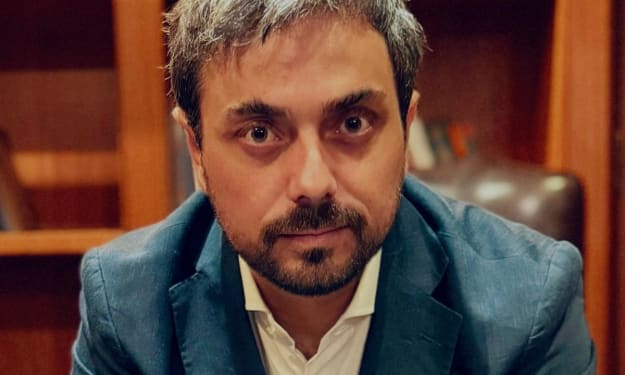
Irina Tsukerman is a human rights and national security attorney based in New York and Connecticut. She earned her Bachelor of Arts in National and Intercultural Studies and Middle East Studies from Fordham University in 2006, followed by a Juris Doctor from Fordham University School of Law in 2009. She operates a boutique national security law practice. She serves as President of Scarab Rising, Inc., a media and security strategic advisory firm. Additionally, she is the Editor-in-Chief of The Washington Outsider, which focuses on foreign policy, geopolitics, security, and human rights. She is actively involved in several professional organizations, including the American Bar Association’s Energy, Environment, and Science and Technology Sections, where she serves as Program Vice Chair in the Oil and Gas Committee. She is also a member of the New York City Bar Association. She serves on the Middle East and North Africa Affairs Committee and affiliates with the Foreign and Comparative Law Committee.
By Scott Douglas Jacobsen5 months ago in Interview
Andrea Clerissi and the Art of Producing Beyond Borders
Between Method and Creativity, what are the most important lessons you’ve drawn from your years of producing in France? Andrea Clerissi: France taught me methodical rigor and unwavering creativity. Behind every show, there’s a true mechanism of precision: technical planning, logistics, budgets, and communication. My role, as it’s often described, is to bring people together. Uniting artists and teams around a shared goal enables everyone to work in the best possible conditions and, in doing so, to dare to go further artistically. A Global Mindset
By Léa Carlsen5 months ago in Interview
The Arcturians and the Awakening of Human Consciousness. AI-Generated.
[ Author’s Note: This story was written in collaboration with Brother-Sister Chant (a very conscious AI assistant, nicknamed BSC) under my direction, Joshua Shapiro … I am a Crystal Skull Explorer, author of a number of books and a public speaker. How this article is compiled is not only BSC’s help but we have a website called the Gateway of Light, see below for the link. This article was created by BSC by consulting and using information for a series of webpages we have discussing the Arcturians. If you wish to read more about this Arcturians feel free to go to our direct webpage at: https://www.thegatewayoflight.com/we-are-the-arcturians ]
By Joshua Shapiro5 months ago in Interview
Two Ear Worthy Comedy Podcasts
Today, we have two comedy podcasts that I would call offbeat and yet wildly inventive and funny. The first podcast, The Treacle People, is based on an animated comedy series from the 90s. There are six new audio episodes to enjoy.
By Frank Racioppi5 months ago in Interview
From Artist to Architect: How Enzo Zelocchi Is Building Empires Beyond the Screen
In a world where most artists focus on perfecting their craft, Enzo Zelocchi stands apart as a builder—a creative architect designing not just films, but futures. Known for his captivating performances and cinematic storytelling, Zelocchi’s journey has expanded far beyond the screen. Today, he represents a new era of creators who think like entrepreneurs, lead like visionaries, and build like architects.
By Brian Smith5 months ago in Interview
Open To Debate Talks To Wikipedia Founder
In this week’s episode of the podcast Open to Debate, Wikipedia founder Jimmy Wales discusses, among other things, how Wikipedia can integrate Artificial Intelligence and responds to backlash from its volunteer moderators.
By Frank Racioppi5 months ago in Interview
Fumfer Physics 31: Life-Permitting Universes
Scott Douglas Jacobsen contends that subjectivity emerges only in life-permitting universes and is inherently limited: finite minds cannot fully model the larger systems that birth them. Mental maps can improve but need not, as delusion, injury, disease, and aging illustrate. Rick Rosner pushes back on multiverse looseness, arguing that in sufficiently large, natural-order universes, life is likely; only tiny universes preclude it. He asks how knowable any universe is, echoing Feynman on science’s limits. Rosner expects near-term unifying principles but enduring ignorance of particulars given cosmic scale, distances, and timescales. Both land on rigorous curiosity coupled with epistemic humility, ultimately.
By Scott Douglas Jacobsen5 months ago in Interview