coping
Life presents variables; learning how to cope in order to master, minimize, or tolerate what has come to pass.
It's NOT a Sign of Weakness. Top Story - May 2025. Content Warning.
In my last story, I discussed the topic of mental health and Boston Red Sox player Jarren Duran. Duran exchanged words with a Cleveland Guardians fan during a recent game, which the fan responded with an insensitive remark, referring to the outfielder's suicide attempts in 2021 and 2022. I condemned that fan for his actions and should face some sort of punishment from MLB and/or the Guardians organization. Duran has previously been open about his struggles with depression. He has full support from his fellow Red Sox players and the organization. He's not the only player who has been open about their mental health. Dansby Swanson of the Chicago Cubs recently revealed on a podcast that he also had difficulties with alcohol on top of his mental health issues during the early stages of his career. Last year, I watched an ad from MLB about in times of difficulties, there's always people that will support you unconditionally. People tend to forget that athletes are regular individuals, too. I never put anyone famous on pedestals, because you never know what they're going through. May is Mental Health Awareness Month, which has been observed in the United States since 1949. Athletes, celebrities, and everyday people like me are sharing our stories in order to let others know that they're not alone. One of the misconceptions that I dislike the most about mental health is that seeking help for it or discussing your struggles with it means that you're a weak person. This will only make people reluctant or hesitant to seek help. That's the reason why there's so much stigma behind it. Just because someone is depressed, it doesn't mean that they're less of a person. Someone asking for help when they're feeling down should be commended, not chastised. If you know someone who is suffering from mental health problems, support them unconditionally, because they need all of it.
By Mark Wesley Pritchard 11 months ago in Psyche
Slip and the Foundations of Cognitive Drive Architecture
In cognitive science and psychology, fluctuations in mental performance are often attributed to motivation, distraction, or emotional state. While these factors undoubtedly play a role, a newly proposed structural field—Cognitive Drive Architecture (CDA)—suggests that the story of effort variability is more mechanically complex. CDA introduces a system-level theory for understanding how cognitive effort emerges, stabilizes, or fails, based on internal configuration rather than external conditions or surface-level traits.
By Nikesh Lagun11 months ago in Psyche
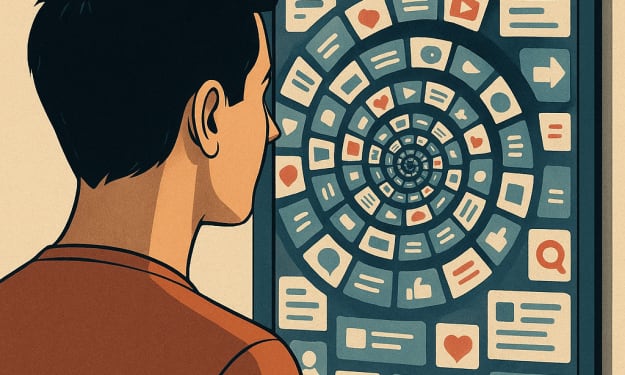
The Echo Chamber of the Self: How Personal Algorithms Are Rewriting Our Reality. AI-Generated.
In the early days of the internet, we marveled at its ability to open up the world. With a single search, we could find voices from distant lands, cultures we’d never known, and ideas that challenged our own. It was chaotic, but liberating. And then, bit by bit, the web stopped feeling so wide.
By Ahmet Kıvanç Demirkıran11 months ago in Psyche
My Thoughts About Jarren Duran . Content Warning.
Mental health---let's talk about it. As of 2025, nearly 800 million people globally have been diagnosed with mental disorders. During the global pandemic in 2020, individuals like me were isolated and increasingly desperate to be with our friends and loved ones. Through it all, celebrities and everyday people like us shared their personal stories about mental health. It has a stigma behind it, because there are those who are too afraid to open up about their mental struggles, fearing judgment from others, which is completely understandable. I've been open about my struggles with depression and anxiety for years, especially during the pandemic. Not only that, but I've had several suicide attempts.
By Mark Wesley Pritchard 12 months ago in Psyche
WARNING: This Is Not A Drill
As someone who is Autistic, I often feel like one of the few sane people in a world gone mad. Earbuds and headphones exist, yet Neurotypicals insist on broadcasting both sides of a very loud phone conversation, or their personal taste in music, throughout a crowded public transport compartment.
By Natasja Rose12 months ago in Psyche