
India Elevator and Escalator Market Is Rising Fast as Urban India Builds Upward
From high-rise apartments to smart metro stations, vertical mobility is becoming one of India’s most essential infrastructure stories

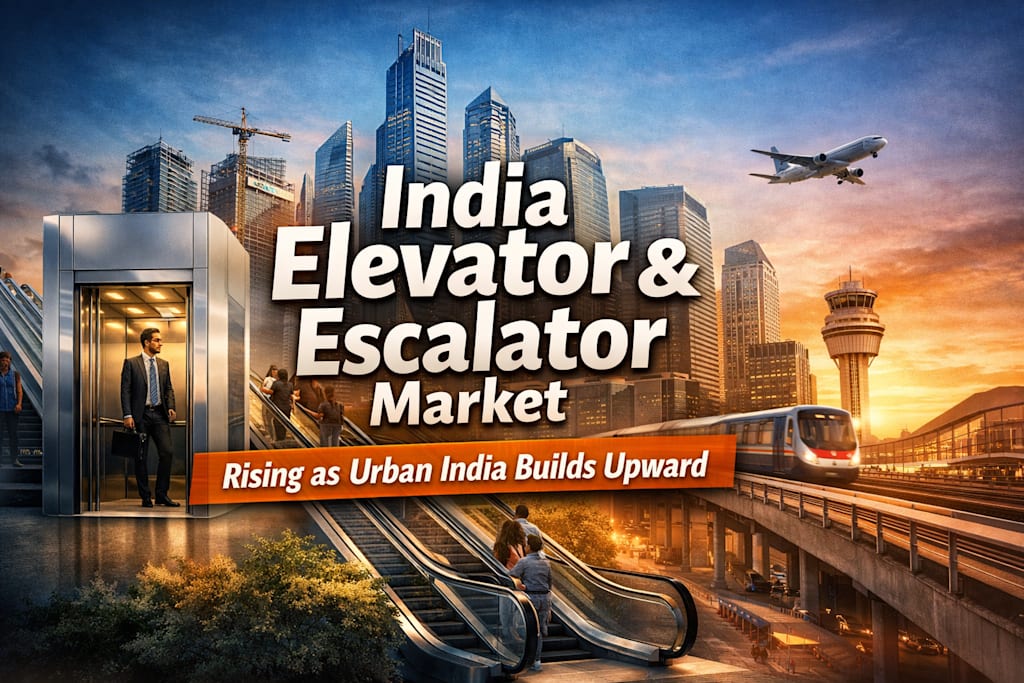
Across the country, skylines are stretching taller, metro stations are expanding, airports are modernizing, and commercial spaces are becoming increasingly vertical. In this environment, elevators and escalators are no longer seen as luxury additions or premium building features. They have become a core part of how modern India moves.
According to Renub Research, the India Elevator and Escalator Market is projected to grow from US$ 15.82 billion in 2025 to US$ 23.77 billion by 2034, expanding at a CAGR of 4.63% from 2026 to 2034. That steady rise reflects something deeper than just construction activity — it points to a major transformation in how Indian cities are being designed, built, and experienced.
This market is being fueled by a powerful mix of forces: rapid urbanization, high-rise residential development, commercial real estate growth, public transportation expansion, and rising expectations for safe, energy-efficient mobility systems. In many ways, elevators and escalators are becoming the hidden engines of India’s infrastructure future.
Why Vertical Mobility Matters More Than Ever
Elevators and escalators are often overlooked because they are so deeply integrated into daily life. Yet they are among the most important systems in any multi-level structure.
Elevators help transport people and goods efficiently across floors in residential towers, office buildings, hospitals, hotels, and industrial facilities. Escalators, meanwhile, are crucial for high-footfall public spaces such as metro stations, malls, airports, and transit terminals. Together, they reduce congestion, improve accessibility, and help buildings function smoothly in increasingly dense urban environments.
As Indian cities continue to grow, the importance of these systems is only increasing. Modern buildings are not just getting taller — they are also becoming more complex. Mixed-use developments, integrated transport hubs, and premium residential towers all require reliable vertical transportation that supports both convenience and safety.
This is why the elevator and escalator market is no longer a niche industrial segment. It now sits at the intersection of real estate, urban planning, technology, and public infrastructure.
India’s Urban Growth Is Creating the Perfect Market
One of the biggest reasons for this market’s expansion is simple: India is urbanizing at an extraordinary pace.
Major cities such as Mumbai, Bengaluru, Delhi NCR, Hyderabad, Pune, and Chennai continue to absorb population growth, business expansion, and real estate investment. With land availability shrinking in dense urban centers, developers are increasingly building upward rather than outward. High-rise construction is no longer limited to premium luxury projects. It is now a standard part of residential and commercial development in many urban areas.
That shift automatically increases the need for elevators. In fact, in most urban developments today, elevators are not optional amenities — they are a basic infrastructure requirement.
The same logic applies to escalators in public-facing spaces. As shopping malls, transport stations, and airport terminals become larger and busier, escalators are critical for managing continuous movement. They are especially important in India’s growing transit economy, where millions of commuters rely on public mobility systems every day.
What makes this trend even more important is that it is no longer confined to metro cities. Tier-2 and tier-3 cities are now seeing stronger real estate and infrastructure investment, which is widening the market for elevator and escalator installations across the country.
Government Infrastructure Projects Are Accelerating Demand
India’s elevator and escalator market is not being driven by private real estate alone. Government-backed infrastructure programs are also playing a major role.
Metro rail expansion across more than 20 Indian cities is creating large-scale demand for escalators and elevators designed for heavy public usage. Cities such as Pune, Ahmedabad, Chennai, Kanpur, and others are building or expanding urban transit networks that require safe and efficient vertical transport systems.
At the same time, airport modernization under regional connectivity and aviation development programs is adding another strong layer of demand. New terminals, upgraded transit zones, and passenger service areas all rely heavily on escalator and elevator systems.
Then there is the Smart Cities Mission, which is pushing for better public infrastructure, digital building management, accessibility features, and safer urban mobility systems. Hospitals, educational institutions, government complexes, and civic buildings are also contributing to the overall installation base.
The result is a market with long-term structural demand — not just cyclical growth.
Technology Is Redefining What Modern Elevators Can Do
One of the most interesting shifts in this industry is the growing move from basic mechanical systems to smart, connected, and energy-efficient solutions.
Today’s building owners and developers are no longer only asking whether a lift works. They are asking whether it is intelligent, efficient, safe, and future-ready.
That is where technologies such as IoT-enabled monitoring, AI-based predictive maintenance, destination control systems, and energy-saving traction mechanisms are changing the game. These innovations help reduce downtime, improve passenger safety, optimize energy usage, and extend system life cycles.
This trend is especially important in India, where maintenance quality and system reliability have often varied significantly across building types and cities. Predictive maintenance and remote monitoring can help solve these challenges by identifying issues before they become serious failures.
There is also rising demand for modernization. Many residential societies, office buildings, and public institutions still operate older lift systems that are outdated in both performance and safety terms. As compliance expectations increase and building owners seek better occupant experience, modernization and replacement are becoming important revenue drivers for the industry.
In other words, the market is no longer only about new installations — it is also increasingly about upgrades, retrofits, and long-term service contracts.
But the Market Still Faces Real Challenges
Despite the strong growth outlook, the industry is not without obstacles.
One of the biggest barriers is cost.
Elevator and escalator systems require significant upfront investment, especially when buildings need structural modifications, advanced safety features, or imported components. For smaller developers, older residential properties, or cost-sensitive buyers, these expenses can be difficult to justify. Maintenance also adds to the long-term financial burden, since safe operation depends on regular servicing, inspections, and part replacements.
This creates a common market tension: while demand for advanced systems is rising, a portion of buyers may still choose cheaper or lower-spec solutions to save on cost.
Another major challenge is regulation and safety compliance.
India’s elevator and escalator sector still deals with fragmented rules, varying state-level norms, and uneven enforcement. While safety standards are improving, not every region has the same level of technician training, inspection discipline, or compliance infrastructure. Older buildings may also continue using outdated systems that fall short of current expectations.
This means the industry’s future growth will depend not only on demand, but also on how effectively India strengthens installation quality, maintenance standards, and regulatory consistency.
Regional Growth Is Creating a Broader National Opportunity
The elevator and escalator market in India is becoming increasingly state-driven, with different regions contributing growth in distinct ways.
Maharashtra remains one of the strongest markets due to the vertical nature of Mumbai’s real estate, Pune’s expanding urban development, and the broader redevelopment of aging buildings. Metro projects, airport upgrades, and premium commercial construction all reinforce demand.
Tamil Nadu is another key market, especially with Chennai and Coimbatore supporting residential, industrial, IT, and institutional development. The state’s role as a manufacturing and service hub for several elevator companies also strengthens its position.
Karnataka, led by Bengaluru, is benefiting from tech-campus growth, residential towers, and ongoing metro development. The state’s appetite for smart and energy-efficient solutions also makes it an attractive market for higher-value installations.
Uttar Pradesh is seeing strong momentum through cities like Noida, Ghaziabad, Lucknow, and Kanpur. Urban housing, shopping centers, office spaces, and public modernization projects are all contributing to a rising installation base.
Together, these regional growth centers show that the industry’s future is not limited to one or two megacities. It is becoming a truly national infrastructure story.
Recent Industry Moves Show Where the Market Is Heading
The latest developments in the market offer a clear glimpse into its future direction.
In March 2025, BRIO Elevators India introduced the Brio BE360, described as India’s first hybrid hydraulic elevator with a full 360-degree panoramic experience. Designed especially for premium homes such as villas, duplexes, and penthouses, the model combines visual appeal with compact space usage.
In December 2024, KONE India launched a new generation of SMART elevators at ISEE 2024 in Mumbai. These systems were built to align with updated IS 17900 safety norms and included advanced safety architecture, fail-safe controls, reinforced door systems, and light curtain technology.
In February 2024, Hybon Elevators and Escalators announced a ₹25 crore R&D expansion at its Noida plant, aimed at doubling production capacity and accelerating innovation in IoT-enabled and user-focused mobility solutions.
And in January 2024, TK Elevator unveiled a new home elevator concept tailored for luxury villas and multi-storey residences, highlighting the rising demand for residential mobility systems beyond traditional apartment towers.
These developments reveal an important shift: the market is not just growing larger — it is also becoming more specialized, more premium, and more technology-driven.
The Road Ahead: More Than Just Lifts and Moving Stairs
The future of India’s elevator and escalator market is about far more than moving people between floors.
It is about how India is preparing for a denser, faster, and more connected urban future.
As buildings become smarter and cities become more vertical, vertical mobility will be central to how people live, work, shop, commute, and access essential services. That makes this market not just a construction segment, but a strategic pillar of modern urban infrastructure.
The companies that succeed in this space will likely be the ones that combine safety, energy efficiency, smart technology, service reliability, and localized execution. Price will still matter, especially in a value-sensitive market like India, but performance and trust will matter just as much.
With demand expanding across residential, commercial, industrial, and public sectors, India’s elevator and escalator industry is entering a decade where its role will become far more visible — even if the systems themselves remain quietly in the background.
Final Thoughts
India’s future is rising floor by floor.
The country’s elevator and escalator market may not always grab headlines the way electric vehicles, AI, or smartphones do — but it plays a vital role in enabling the modern Indian city. From metro commuters and hospital patients to office workers and apartment residents, millions of people rely on these systems every single day.
About the Creator
Gallagher share price Alert: Key Insights for UK Investors Today
The Gallagher share price has recently seen notable movement, drawing the attention of investors across the UK. Sudden shifts in share price can affect both short-term and long-term investment strategies, making it important to understand what is driving these changes. They will examine the reasons behind the current Gallagher share price movement, how it impacts portfolios, and practical steps investors can take to stay ahead.
By John.doe7987 days ago in Trader
Australia Health Insurance Market 2026: Digital Healthcare, Personalized Plans & Rising Coverage Demand
Australia Health Insurance Market Overview The Australia health insurance market is a vital component of the country’s healthcare ecosystem, providing financial protection for medical expenses, hospital treatments and preventive care services. The market operates within a dual public-private system, where private insurance complements the national Medicare system by offering faster access and broader coverage options.
By Amyra Singh5 days ago in Trader
Ghostly Happenings in Colorado
Disturbed Spirits In Denver, an expanse of greenery, Cheesman Park comes with a macabre history since it was once a burial ground known as Mount Prospect Cemetery established by General William Larimer in 1858. The job of exhuming bodies began, and some were left behind resting beneath the park. However, the ghostly spirits don’t wish to rest in peace beneath the park, and visitors here have felt cold touches, seen ghostly children playing at night, and heard a singing lady who disappears when approached.
By Rasma Raisters5 days ago in Horror




Comments
There are no comments for this story
Be the first to respond and start the conversation.