
Smart Parking Market Set for Steady Growth as Cities Embrace Intelligent Mobility Solutions
Rising Urban Pressures and Digital Transformation Drive the Next Phase of Parking Innovation

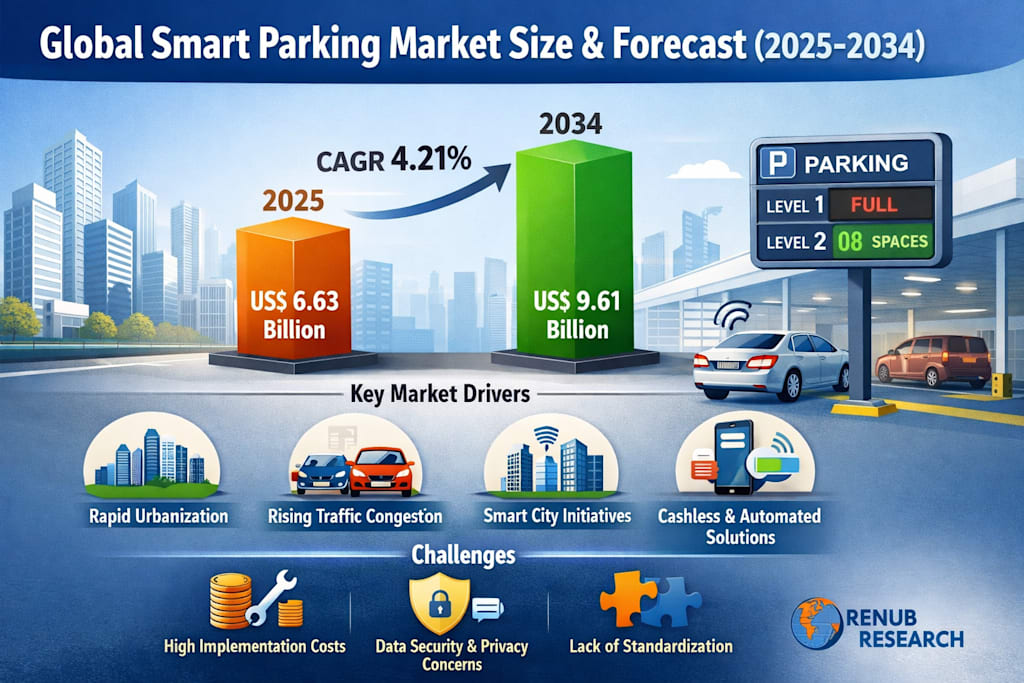
The global smart parking market is entering a transformative phase, fueled by rapid urbanization, increasing vehicle ownership, and the accelerating push toward smart city ecosystems. As cities struggle with congestion, inefficient parking systems, and rising emissions, smart parking solutions are emerging as a critical component of modern urban infrastructure.
According to recent insights, the global smart parking market is projected to grow from US$ 6.63 billion in 2025 to US$ 9.61 billion by 2034, expanding at a CAGR of 4.21% between 2026 and 2034 . This steady growth reflects the increasing adoption of digital technologies such as IoT, artificial intelligence, and mobile applications in everyday urban mobility.
What Is Smart Parking and Why It Matters
Smart parking refers to a technology-driven system that uses sensors, cameras, mobile apps, and data analytics to optimize parking space usage. Unlike traditional parking systems, smart parking enables real-time visibility into available spaces, automated payments, and seamless navigation for drivers.
This transformation is not just about convenience—it addresses deeper urban challenges. A significant portion of city traffic is caused by drivers searching for parking. By guiding users directly to available spots, smart parking systems reduce congestion, lower fuel consumption, and minimize environmental impact.
Moreover, these systems enable municipalities to manage parking resources more effectively, introducing dynamic pricing, better enforcement, and improved revenue transparency.
Market Growth Driven by Urbanization and Traffic Challenges
Urbanization remains one of the most powerful forces shaping the smart parking market. With more than half of the global population already living in cities—and projections indicating this will rise to nearly 68% by 2050—the pressure on urban infrastructure is intensifying.
As cities expand, so does the number of vehicles on the road. This creates a dual challenge: limited parking space and increased congestion. Traditional parking systems are no longer sufficient to manage this complexity.
Smart parking solutions directly address these issues by:
Providing real-time data on parking availability
Reducing time spent searching for spaces
Improving traffic flow across urban areas
Lowering carbon emissions
In essence, smart parking is becoming a foundational element of sustainable urban mobility.
Smart Cities and Digital Infrastructure Accelerating Adoption
The global push toward smart city development is significantly boosting the adoption of smart parking technologies. Governments and municipalities are investing heavily in intelligent transportation systems to improve efficiency, safety, and sustainability.
Smart parking systems integrate seamlessly into broader digital ecosystems, combining:
IoT sensors for real-time monitoring
Cloud platforms for centralized management
AI-driven analytics for predictive insights
Mobile applications for user convenience
The rapid expansion of digital infrastructure, along with widespread smartphone penetration, has made these systems more accessible and user-friendly. Citizens now expect seamless, app-based services—including parking.
Large-scale investments in AI and infrastructure partnerships are further accelerating this trend, unlocking new opportunities for innovation and scalability across regions .
Consumer Demand for Convenience and Automation
Modern consumers increasingly prioritize convenience, speed, and automation in their daily lives—and parking is no exception.
Traditional parking systems often involve:
Manual ticketing
Cash payments
Long queues at entry and exit points
Smart parking eliminates these inefficiencies through:
Cashless payment systems
License plate recognition (LPR)
Automated entry and exit
Mobile app integration
These features not only enhance user experience but also improve operational efficiency for parking operators. As digital lifestyles evolve, the demand for frictionless parking solutions is expected to rise significantly.
Key Market Segments Shaping the Industry
The smart parking market is highly diverse, encompassing multiple technologies and applications that cater to different urban needs.
1. Smart Parking Cameras and LPR Systems
Cameras and license plate recognition systems are central to automated parking management. Powered by AI and machine learning, these systems enable real-time vehicle identification, automated billing, and enhanced security.
They are widely used in airports, shopping malls, and corporate campuses, where efficiency and security are critical.
2. Smart Parking Gates
Smart gates automate entry and exit processes using technologies such as RFID, QR codes, and mobile apps. These systems reduce human intervention and minimize congestion at parking facilities.
Their adoption is growing rapidly in both commercial and residential spaces, driven by the need for secure and efficient access control.
3. Parking Guidance Systems
Parking guidance systems use sensors and digital signage to direct drivers to available spaces. These systems are particularly valuable in large facilities such as airports, hospitals, and shopping centers.
By improving space utilization and reducing search time, they enhance both user satisfaction and operational efficiency.
4. Mobile App-Based Parking Services
Mobile applications are revolutionizing how people interact with parking systems. Users can:
Locate available parking spots
Reserve spaces in advance
Navigate to parking locations
Make cashless payments
The integration of mobile apps with IoT and LPR technologies creates a seamless end-to-end parking experience.
5. On-Street and Commercial Parking Solutions
On-street smart parking focuses on managing curbside spaces in densely populated areas, while commercial parking solutions cater to malls, offices, airports, and entertainment venues.
Both segments benefit from real-time monitoring, dynamic pricing, and improved enforcement, making them essential components of urban mobility strategies.
Regional Insights: Global Adoption Trends
United States
The United States represents one of the most advanced markets for smart parking. Cities like New York, Los Angeles, and San Francisco have widely adopted sensor-based and app-driven solutions.
Public-private partnerships have played a key role in scaling these technologies, particularly in airports and commercial hubs.
United Kingdom
The UK market is driven by high population density and strong environmental policies. Cities are increasingly adopting cashless, app-based parking systems integrated into broader traffic management platforms.
Government initiatives are also simplifying parking payments, making systems more user-friendly.
China
China’s smart parking market is expanding rapidly due to large-scale urbanization and severe parking shortages in major cities. The country is leveraging advanced technologies such as AI, big data, and cloud computing to optimize parking operations.
Mobile payment integration is particularly strong, reflecting the country’s digital-first approach.
Saudi Arabia
Saudi Arabia is emerging as a promising market, supported by its Vision 2030 initiative. Investments in smart mobility and infrastructure are driving the adoption of intelligent parking systems in cities like Riyadh and Jeddah.
Challenges Hindering Market Growth
Despite its strong growth potential, the smart parking market faces several challenges.
High Implementation Costs
Deploying smart parking systems requires significant investment in hardware, software, and infrastructure. Sensors, cameras, and networking systems can be costly, especially for smaller cities with limited budgets.
Additionally, ongoing maintenance and upgrades add to the overall cost burden.
Data Security and Privacy Concerns
Smart parking systems rely heavily on data collection, including vehicle information, payment details, and location data. This raises concerns about data privacy and cybersecurity.
In regions with strict data protection regulations, these concerns can slow adoption. Addressing security risks and ensuring compliance will be critical for long-term growth.
Lack of Standardization
The absence of standardized platforms and technologies can create compatibility issues across systems. This fragmentation may hinder large-scale implementation and reduce user trust.
The Road Ahead: Future Opportunities
The future of the smart parking market lies in continued innovation and integration with broader smart city ecosystems.
Key trends expected to shape the market include:
AI-driven predictive analytics for demand forecasting
Integration with autonomous vehicles
Expansion of contactless and touchless solutions
Enhanced interoperability across platforms
Sustainability-focused solutions to reduce emissions
As cities become more connected and data-driven, smart parking will play an increasingly important role in shaping urban mobility.
Final Thoughts
The global smart parking market is not just about finding a place to park—it represents a fundamental shift in how cities manage mobility, infrastructure, and sustainability.
With steady growth projected through 2034, the industry is poised to become a cornerstone of smart city development. While challenges such as cost and data security remain, ongoing technological advancements and government support are likely to drive widespread adoption.
About the Creator
Mexico Retail Market 2026: Industry Size to Reach USD 698.8 Billion by 2034, at a CAGR of 4.38%
Mexico Retail Market Size, Growth, and Forecast (2026–2034) The Mexico retail market is undergoing steady transformation as technology and consumer expectations continue to evolve. In 2026, the sector reflects a dynamic blend of traditional retail formats and rapidly expanding digital channels.
By Jackson Watson3 days ago in Trader
Why the United States Data Center Cooling Market Is Heating Up Faster Than Ever
The United States is building the future of the digital economy at an extraordinary pace. From artificial intelligence and cloud computing to streaming, e-commerce, and remote work, nearly every modern activity depends on one invisible but essential force: data centers. Yet while most people think about servers, chips, and fiber networks, one of the most important pieces of this ecosystem often stays out of the spotlight—cooling.
By shibansh kumarabout 7 hours ago in Trader
Earrings
April truly is the cruelest month, especially in Augusta during the first full week, breeding dogwoods and azaleas into dreams of a green jacket on Sunday. I won’t go into it about badges; suffice to say my family received. I was dating some loser the year I was twenty-two or -three, and I was taking him to the Par 3. At least I was until the night before.
By Harper Lewis2 days ago in Writers




Comments
There are no comments for this story
Be the first to respond and start the conversation.