
Payment Gateway Market Set for Strong Expansion as Digital Commerce Reshapes Global Transactions
From online shopping to mobile wallets and cross-border payments, payment gateways are becoming the invisible engine behind the world’s cashless economy

The way people pay has changed dramatically over the last decade. What once depended heavily on cash, checks, or in-person card swipes has rapidly evolved into a digital-first financial ecosystem powered by online transactions, mobile wallets, embedded finance, and instant payment platforms. At the center of this transformation is one essential technology: the payment gateway.
Whether someone is ordering groceries online, subscribing to a streaming platform, booking a flight, or paying through a smartphone app, a payment gateway quietly handles the transaction behind the scenes. It encrypts data, authorizes payments, verifies security, and ensures money moves safely from the customer to the merchant.
That invisible role is now becoming one of the most important in the global digital economy.
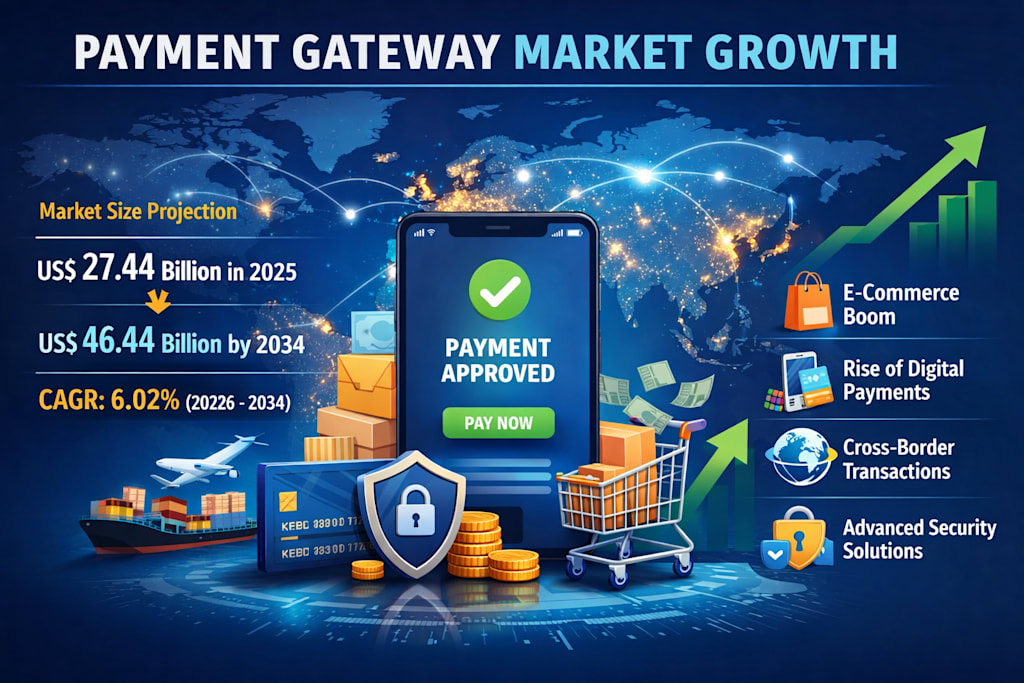
According to Renub Research, the Payment Gateway Market is expected to grow from US$ 27.44 billion in 2025 to US$ 46.44 billion by 2034, expanding at a CAGR of 6.02% from 2026 to 2034. This growth reflects more than rising online shopping — it signals a deeper structural shift in how businesses and consumers interact financially across the world.
Why Payment Gateways Matter More Than Ever
A payment gateway acts as the digital bridge between a customer’s chosen payment method and the merchant’s financial institution. In practical terms, it ensures that a payment made using a debit card, credit card, bank transfer, QR code, or digital wallet is processed securely and efficiently.
But modern gateways do far more than simply “approve” a transaction.
Today’s leading platforms help merchants reduce fraud, support international currencies, integrate into websites and mobile apps, manage recurring billing, and even optimize checkout flows to reduce cart abandonment. In a world where a few seconds of payment friction can cost a business a sale, payment gateways are no longer just back-end infrastructure — they are a direct driver of customer experience and revenue performance.
That is one of the main reasons the market is seeing sustained investment and innovation.
E-Commerce Growth Continues to Fuel Market Expansion
The most obvious growth engine for the payment gateway industry is the ongoing rise of e-commerce and digital transactions.
Consumers across age groups and income segments increasingly prefer online shopping for convenience, better pricing, broader product selection, and faster access to services. Businesses, in turn, are expanding their digital storefronts and mobile commerce capabilities to capture this demand.
Every one of those transactions requires a secure and reliable payment processing layer.
Retailers, travel brands, food delivery apps, digital subscription services, gaming companies, education platforms, and online healthcare providers all rely on payment gateways to accept and process customer payments without interruption. As more sectors move toward online-first or omnichannel business models, demand for flexible and scalable payment gateway solutions continues to rise.
This is especially relevant for merchants operating across multiple channels. A business today may sell through its own website, social commerce platforms, mobile app, marketplace listing, and even physical store. Payment gateways that can unify these payment streams into one operational framework are increasingly valuable.
The Push Toward a Cashless Economy Is Accelerating Adoption
The second major force reshaping the market is the global move toward cashless and digital-first payments.
Governments, fintech firms, and banks are actively promoting digital payment adoption as a way to improve transparency, financial inclusion, transaction speed, and convenience. In many countries, QR-based payments, instant transfers, and mobile wallet usage have become part of everyday life.
Consumers are also changing their behavior quickly. They now expect payment experiences to be fast, secure, and effortless — whether shopping online or in-store. This expectation has elevated the importance of payment gateways that support multiple payment methods and localized checkout options.
Cross-border commerce adds another layer of urgency. Businesses selling internationally need gateways that can handle multi-currency payments, local payment preferences, regional regulations, and international authorization processes. For merchants hoping to scale globally, choosing the right payment gateway has become a strategic business decision rather than a technical one.
Technology Is Redefining What Payment Gateways Can Do
The payment gateway market is not just growing — it is also becoming significantly smarter.
Artificial intelligence and machine learning are increasingly being integrated into payment systems to detect fraud in real time, flag suspicious transaction patterns, and improve approval rates. Instead of relying solely on static rules, modern gateways can analyze behavioral patterns, device information, geolocation signals, and purchase history to make better risk decisions.
Security innovations are equally important. Features such as tokenization, 3D Secure, and end-to-end encryption help protect sensitive customer information while reducing the risk of fraud and chargebacks. These capabilities are especially critical in a world where cybercrime and payment fraud remain persistent threats.
At the same time, API-driven and cloud-hosted payment gateway solutions are making it easier for businesses of all sizes to adopt advanced payment infrastructure without heavy technical investment. Startups, mid-sized merchants, and global enterprises alike can now integrate payment capabilities into websites, apps, and point-of-sale systems with much greater speed and flexibility.
Some providers are also exploring support for cryptocurrency transactions, Buy Now, Pay Later (BNPL) models, and alternative local payment methods, expanding the definition of what a payment gateway can offer.
But the Market Still Faces Serious Challenges
Despite its strong outlook, the payment gateway market is not without friction.
One of the biggest concerns remains security and fraud risk.
As transaction volumes rise, so do opportunities for cybercriminals. Payment gateways process highly sensitive data, including card credentials, personal identity information, and banking details. This makes them prime targets for hacking, phishing, account takeover, and transaction fraud.
Even with strong encryption and compliance frameworks such as PCI DSS, gateway providers must continuously invest in cybersecurity and fraud prevention to stay ahead of evolving threats. For smaller merchants, implementing and managing these protections can be difficult and expensive. A single breach can lead to financial loss, reputational damage, and customer distrust.
Another major hurdle is regulatory complexity.
Payment gateways often operate across borders, which means they must comply with different national and regional rules related to data privacy, anti-money laundering, tax reporting, and digital payment authorization. These requirements can vary significantly from one country to another, making expansion more complicated — especially for emerging players.
Cross-border payments also introduce challenges such as currency conversion, local banking regulations, and settlement delays. As the industry becomes more global, compliance and operational agility will remain central to long-term success.
Regional Markets Are Expanding at Different Speeds
While the payment gateway market is global, growth patterns vary by region.
United States
The United States payment gateway market is seeing strong momentum thanks to rising e-commerce activity, digital wallet adoption, contactless payment usage, and increasing demand for seamless online checkout experiences. The market is also benefiting from innovation in fraud detection, tokenization, and cloud-based payment infrastructure. Businesses in the U.S. increasingly need gateways that support mobile, omnichannel, and international transactions while maintaining strict compliance and security standards.
Germany
In Germany, the market is growing steadily due to strong digital infrastructure, high internet penetration, and increasing adoption of secure online payment systems. Regulatory support, including alignment with the EU’s PSD2 directive, has also encouraged safer and more transparent payment environments. German merchants are increasingly seeking payment gateways that offer strong authentication, API integration, and support for cross-border digital commerce.
China
China remains one of the most dynamic markets in the global payment ecosystem. With widespread use of mobile wallets, QR-based payments, and digital banking, the country has become a major growth center for payment gateway solutions. The market is also being shaped by AI-based fraud tools, blockchain experimentation, and strong domestic digital payment adoption. As cross-border e-commerce expands, China’s gateway ecosystem is likely to become even more influential.
Saudi Arabia
In Saudi Arabia, the market is advancing rapidly as the country pushes forward with digital transformation and cashless payment initiatives. Growing e-commerce activity, fintech adoption, and regulatory support are helping accelerate payment gateway deployment across industries. Businesses are increasingly turning to scalable digital payment solutions to serve a younger, mobile-first consumer base.
Recent Industry Moves Signal a More Competitive Future
Recent developments suggest the payment gateway space is entering a new phase of consolidation and strategic repositioning.
In April 2025, Worldpay was set to be acquired by Global Payments in a USD 22.7 billion deal aimed at expanding acquiring scale, improving omnichannel capabilities, and unlocking cost synergies. Around the same period, FIS sold its Worldpay interest for USD 6.6 billion and acquired Global Payments’ Issuer Solutions division for USD 12 billion, signaling a sharper focus on issuer processing and loyalty data services.
Also in April 2025, IFX Payments announced plans to acquire Argentex Group to strengthen its FX and e-money capabilities, especially for corporate clients requiring multi-currency support. In March 2025, Visa highlighted 200% growth in Tap to Phone, showing how payment acceptance is expanding even among micro-merchants with minimal hardware requirements.
These moves are important because they show where the industry is heading: toward broader service ecosystems, smarter payment orchestration, stronger global capabilities, and more embedded financial tools.
A Market That’s Becoming Core to Digital Business Strategy
The payment gateway industry is no longer a background utility. It is becoming a strategic layer of digital commerce, customer trust, and business scalability.
For merchants, the right gateway can improve checkout conversion, reduce fraud, enable global expansion, and support customer retention. For consumers, it can mean faster, safer, and more flexible ways to pay. For financial institutions and fintech companies, it represents one of the most important battlegrounds in the future of digital transactions.
As digital commerce becomes more embedded in daily life, payment gateways will only become more central to how the global economy functions.
Final Thoughts
The global Payment Gateway Market is entering a period of sustained relevance and long-term opportunity. With Renub Research projecting the market to rise from US$ 27.44 billion in 2025 to US$ 46.44 billion by 2034, the outlook reflects a world that is moving steadily toward seamless, secure, and always-on financial transactions.
About the Creator
Keep reading
More stories from shibansh kumar and writers in Trader and other communities.
Why the United States Data Center Cooling Market Is Heating Up Faster Than Ever
The United States is building the future of the digital economy at an extraordinary pace. From artificial intelligence and cloud computing to streaming, e-commerce, and remote work, nearly every modern activity depends on one invisible but essential force: data centers. Yet while most people think about servers, chips, and fiber networks, one of the most important pieces of this ecosystem often stays out of the spotlight—cooling.
By shibansh kumarabout 8 hours ago in Trader
Stanislav Kondrashov on Billions in Motion: Reading the Hidden Signals Across Global Markets
The movement of large volumes of capital across markets is often described in numerical terms, yet its deeper significance lies in the patterns it creates. Stanislav Kondrashov examines these movements not as isolated transactions, but as signals embedded within complex systems. In this perspective, billions in motion are not merely quantities—they are indicators of shifting dynamics, evolving priorities, and structural transformations within the global landscape.
By Stanislav Kondrashov 3 days ago in Trader
Complete Guide to Forging Parts Manufacturer for Industrial Applications
Companies that produce forged parts provide essential support to many industries by providing high quality, durable, and accurately designed components. Forged parts are created by applying compressive forces to shape metal; these forces can be generated using hammers, presses, or dies. Forging produces stronger and more durable components than components produced using machining or casting techniques. Forged products are used extensively in a wide variety of industries, such as the automotive, oil and gas, power generation, construction, aviation, and heavy industrial sectors, as they have superior structural qualities and longer service lives than either cast or machined products.
By Rosalind Desai7 days ago in Trader


Comments
There are no comments for this story
Be the first to respond and start the conversation.